Share this now - someone’s life could change.


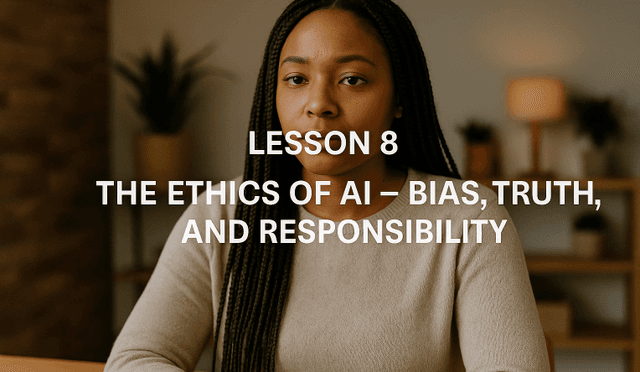
Lesson 8: The Ethics of AI - Bias, Truth, and Responsibility
Understanding Why AI Ethics Matter
As AI becomes more powerful and more woven into daily life, ethical concerns are more important than ever. AI systems make decisions that affect hiring, healthcare, education, justice, social media, and even national security. Because AI learns from human data, it also inherits human flaws. This means AI can amplify bias, spread misinformation, and influence behavior at massive scale. Understanding AI ethics is not just a topic for scientists - it is essential for anyone living in a world shaped by algorithms.
AI Bias - Why It Happens and Why It Is Dangerous
AI systems learn from data created by humans, and human data often contains bias. For example, if a hiring AI is trained on past hiring decisions that favored certain demographics, it may repeat and amplify those biases. If a medical AI is trained mostly on one population, it may misdiagnose others. Bias is not always intentional, but it can cause unfair outcomes. Recognizing this helps us understand why AI must be designed carefully and constantly evaluated for fairness.
The Problem of Misinformation and AI Generated Content
AI can create massive amounts of content quickly: articles, images, voices, videos, and even realistic deepfakes. While this unlocks creative power, it also threatens the public's ability to trust what they see and hear. Bad actors can use AI to spread false information, manipulate opinions, or impersonate real people. This creates a world where truth can be distorted easily. Being aware of this risk helps individuals stay more alert and cautious when consuming online content.
Privacy and Data Responsibility
AI relies on huge amounts of personal data to function. Every app, device, and service you use collects information that may be used to train AI models. If companies are careless, this data can be mishandled, leaked, or used in ways you never agreed to. Ethical AI development requires respecting user privacy, being transparent about data use, and giving people control over their personal information. Your data is valuable, and ethical AI protects it instead of exploiting it.
Transparency - Understanding How AI Makes Decisions
One of the biggest challenges in AI is the lack of transparency. Many AI systems operate like black boxes - they give results, but people cannot see how they arrived at them. This makes it difficult to understand or challenge decisions that affect your life. Ethical AI development encourages explainability so users, researchers, and even regulators can understand how the system works. Transparency builds trust and prevents abusive or harmful uses of technology.
Accountability - Who Is Responsible When AI Makes a Mistake
When an AI system makes an error, who should be held responsible? The developers? The company? The user? The government? These questions are at the center of AI ethics. As AI takes on more decision-making roles, clear rules must be established to ensure that harm is not ignored or blamed on machines. Ethical AI requires accountability so that systems are designed with safety, fairness, and responsibility built in from the start.
AI for Good - Using Technology to Solve Human Problems
Ethical AI is not just about preventing harm - it is also about maximizing positive impact. AI can help detect diseases early, expand access to education, reduce traffic accidents, fight climate challenges, assist people with disabilities, and improve global communication. When used responsibly, AI becomes a tool for human advancement. Ethics ensures we harness the power of AI to build a better world rather than create new problems.
What You Can Do to Promote Ethical AI
Even if you are not a developer, you play a role in shaping the future of AI. Learn how AI uses your data. Support companies that prioritize transparency and privacy. Be cautious about what information you share online. Question content that seems manipulated or misleading. And always think critically about how technology influences your decisions. Awareness is the first step toward a safer, more responsible AI future.
Why Ethics Will Shape the Future of AI
As AI continues to grow, ethical questions will determine how far it can be trusted. The choices developers, companies, governments, and everyday users make will shape the direction of the entire technology. Understanding AI ethics prepares you to navigate the future wisely, protect yourself and your community, and support technology that improves the world instead of harming it.
Lessons 1 to 10 - Building Your Foundation
The first ten lessons introduce the core ideas that help you understand what AI really is and how it affects the world around you. You learn:
Lesson 2: The Basics of AI - Understanding What Artificial Intelligence Really Is
Lesson 4: What Is Deep Learning - The Power Behind Modern AI
Lesson 7: AI and Customer Service - Chatbots, Support, and Personalization
Lesson 8: The Ethics of AI - Bias, Truth, and Responsibility
Lesson 9: AI and Privacy – What You Should Know About Your Data
Lesson 10: The Global Race for AI Leadership - Who Is Winning and Why
These lessons give you clarity. They explain AI in simple terms so you can finally understand the technology that is redefining modern society.
Lessons 11 to 20 - Understanding the Tools and Applications
The next ten lessons reveal the tools you use every day and the industries AI is transforming. You learn:
Lesson 11: How AI Already Shapes Your Life Without You Knowing It
Lesson 12: Using AI Tools to Boost Productivity, Learning, and Creativity
Lesson 13: AI Assistants - How to Use ChatGPT and Other Bots Effectively
Lesson 14: AI in Communication - Clearer Writing, Smarter Messaging, and Better Connections
Lesson 15: AI and Personal Finance - Smarter Money Decisions With Intelligent Tools
Lesson 16: AI in Personal Health - What the Future of Medicine Means for You
Lesson 17: AI in Transportation – Self-Driving Cars, Smart Traffic, and the Future of Mobility
Lesson 19: AI for Students - Smarter Studying, Faster Learning, Better Results
Lesson 20: How to Stay Relevant in an AI World - Skills You Must Build Now
These lessons show you how AI benefits your personal life, your career, and your long-term success. You also begin learning how to apply AI tools to real tasks immediately.
Lessons 21 to 30 - Preparing for the Future of Work
The middle section of the AI School focuses on the changing economy. AI is reshaping the job market, and these lessons prepare you for that shift. You learn:
Lesson 21: AI and Cybersecurity - Protecting Data in a Digital World
Lesson 22: AI in Education - Personalized Learning for Every Student
Lesson 23: AI in Healthcare - Diagnosis, Treatment, and the Future of Medicine
Lesson 24: AI in Finance - Smarter Investing, Fraud Detection, and Risk Management
Lesson 25: AI in Marketing - Smarter Campaigns, Better Targeting, Bigger Results
Lesson 26: AI in Sales - Close More Deals, Understand Customers Better
Lesson 27: AI and Customer Service - Chatbots, Support, and Personalization
Lesson 28: AI-Powered Decision Making - Smarter, Faster, More Accurate
Lesson 29: The Rise of No-Code AI - Building Powerful Tools Without Programming
Lesson 30: Future-Proofing Your Career - How to Become AI-Proficient
By the end of this section, you understand how to remain valuable, adaptable, and competitive no matter how fast the world changes.
Lessons 31 to 40 - Advanced Concepts, Risks, and Opportunities
The final lessons focus on the deeper, more advanced topics of AI - the ones that will shape the next century. You explore:
Lesson 31: Deep Learning Mastery - Why It Changes Everything
Lesson 33: Natural Language Processing - How AI Understands Human Speech
Lesson 34: Robotics and Automation - The Machines That Will Transform Industry
Lesson 35: AI in Science and Discovery - New Medicines, New Materials, New Worlds
Lesson 36: The Future of Transportation - Self-Driving Cars, Drones, and Beyond
Lesson 37: AI and the Future of Work - What Society Will Look Like in 10 Years
Lesson 38: AI Risks - Job Displacement, Deepfakes, and the Battle for Truth
Lesson 39: The Coming Age of AGI - What Happens When Machines Become Smarter Than Us?
Lesson 40: Where the Biggest AI Opportunities Will Be - And How You Can Start Today
These lessons prepare you intellectually, ethically, and strategically for a future where AI is more powerful, more present, and more influential than any technology in human history.
SmartGuy AI School gives you the knowledge to be not just a user of AI but a responsible participant in its evolution.
Sign in to share your thoughts