Share this now - someone’s life could change.


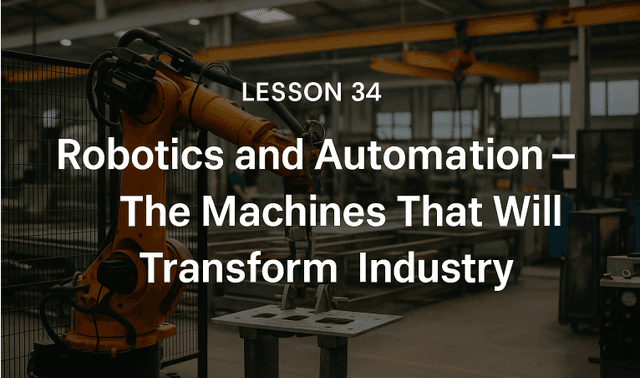
Lesson 34: Robotics and Automation - The Machines That Will Transform Industry
A World Where Machines Handle the Heavy Lifting
Robotics and automation are rapidly reshaping how industries operate. Tasks that once required physical labor, precise movements, or repetitive actions are now being performed by intelligent machines. These machines can work faster, operate continuously, and execute tasks with incredible accuracy. As robots become more flexible and AI powered, they are moving from large factories into small businesses, warehouses, hospitals, restaurants, and even homes. Understanding this shift is essential because automation will influence every part of the modern economy.
How Robots and AI Work Together
Robots used to be simple machines programmed for a single task. Today, the real power comes from combining robotics with Artificial Intelligence. AI enables robots to see, detect objects, understand patterns, and make decisions in real time. This allows robots to pick up irregular objects, navigate busy environments, collaborate with humans, and even learn from experience. AI transforms robots from mechanical tools into adaptable assistants capable of performing complex tasks previously impossible to automate.
Automation in Factories and Manufacturing
Manufacturing is the epicenter of robotic innovation. Automated assembly lines are becoming smarter, safer, and more efficient. Robots can weld, paint, assemble, inspect, and package items with precision. This reduces production costs, increases output, and improves quality control. In the next decade, factories will rely heavily on AI powered robots that can adjust to new products with minimal reprogramming. This makes manufacturing more flexible and competitive, especially for companies adopting automation early.
Warehouses and Shipping Reimagined
Warehouses are transforming into highly automated environments. Robots move shelves, retrieve items, scan inventory, and prepare shipments. AI optimizes layout, predicts demand, and coordinates robotic fleets to reduce delays. Companies like Amazon and major logistics providers are using automation to speed up deliveries and reduce human strain. This shift will continue until most warehouse tasks are performed by machines, with humans focusing on oversight, maintenance, and operational strategy.
Robots in Healthcare and Everyday Life
Robots are extending far beyond industrial settings. In hospitals, they deliver medicine, disinfect rooms, assist in surgery, and support patient care. In homes, robots vacuum floors, mow lawns, prepare food, and provide companionship for seniors. As robots become more affordable and intelligent, they will integrate into daily life as common appliances, improving convenience and quality of living.
Automation in Restaurants, Retail, and Service Industries
Service industries are experiencing a quiet transformation. Robots can cook, serve food, scan shelves, manage inventory, handle checkouts, and greet customers. AI powered kiosks and robotic assistants reduce labor shortages and improve consistency. Businesses using automation gain a competitive edge through faster service, lower costs, and better customer experience. These shifts will expand dramatically as more companies adopt automation to remain profitable in a changing economy.
Jobs Will Change, Not Disappear
Automation often raises fear about job loss, but the reality is more nuanced. While some repetitive tasks will be replaced, new roles will emerge, such as robot maintenance, system monitoring, AI coordination, programming, and workflow design. Humans will continue to guide, oversee, and manage robotic systems. The greatest opportunities will be for people who learn to work with automation rather than compete against it.
Preparing for a Robot Powered Future
To thrive in an automated world, learn how robots and AI function, stay comfortable with new technologies, and develop skills in problem solving, creativity, and system management. Explore how automation affects your industry and identify areas where robots can enhance efficiency.
The future belongs to people who understand how to collaborate with machines and use them to amplify their abilities.
Lessons 1 to 10 - Building Your Foundation
The first ten lessons introduce the core ideas that help you understand what AI really is and how it affects the world around you. You learn:
Lesson 2: The Basics of AI - Understanding What Artificial Intelligence Really Is
Lesson 4: What Is Deep Learning - The Power Behind Modern AI
Lesson 7: AI and Customer Service - Chatbots, Support, and Personalization
Lesson 8: The Ethics of AI - Bias, Truth, and Responsibility
Lesson 9: AI and Privacy – What You Should Know About Your Data
Lesson 10: The Global Race for AI Leadership - Who Is Winning and Why
These lessons give you clarity. They explain AI in simple terms so you can finally understand the technology that is redefining modern society.
Lessons 11 to 20 - Understanding the Tools and Applications
The next ten lessons reveal the tools you use every day and the industries AI is transforming. You learn:
Lesson 11: How AI Already Shapes Your Life Without You Knowing It
Lesson 12: Using AI Tools to Boost Productivity, Learning, and Creativity
Lesson 13: AI Assistants - How to Use ChatGPT and Other Bots Effectively
Lesson 14: AI in Communication - Clearer Writing, Smarter Messaging, and Better Connections
Lesson 15: AI and Personal Finance - Smarter Money Decisions With Intelligent Tools
Lesson 16: AI in Personal Health - What the Future of Medicine Means for You
Lesson 17: AI in Transportation – Self-Driving Cars, Smart Traffic, and the Future of Mobility
Lesson 19: AI for Students - Smarter Studying, Faster Learning, Better Results
Lesson 20: How to Stay Relevant in an AI World - Skills You Must Build Now
These lessons show you how AI benefits your personal life, your career, and your long-term success. You also begin learning how to apply AI tools to real tasks immediately.
Lessons 21 to 30 - Preparing for the Future of Work
The middle section of the AI School focuses on the changing economy. AI is reshaping the job market, and these lessons prepare you for that shift. You learn:
Lesson 21: AI and Cybersecurity - Protecting Data in a Digital World
Lesson 22: AI in Education - Personalized Learning for Every Student
Lesson 23: AI in Healthcare - Diagnosis, Treatment, and the Future of Medicine
Lesson 24: AI in Finance - Smarter Investing, Fraud Detection, and Risk Management
Lesson 25: AI in Marketing - Smarter Campaigns, Better Targeting, Bigger Results
Lesson 26: AI in Sales - Close More Deals, Understand Customers Better
Lesson 27: AI and Customer Service - Chatbots, Support, and Personalization
Lesson 28: AI-Powered Decision Making - Smarter, Faster, More Accurate
Lesson 29: The Rise of No-Code AI - Building Powerful Tools Without Programming
Lesson 30: Future-Proofing Your Career - How to Become AI-Proficient
By the end of this section, you understand how to remain valuable, adaptable, and competitive no matter how fast the world changes.
Lessons 31 to 40 - Advanced Concepts, Risks, and Opportunities
The final lessons focus on the deeper, more advanced topics of AI - the ones that will shape the next century. You explore:
Lesson 31: Deep Learning Mastery - Why It Changes Everything
Lesson 33: Natural Language Processing - How AI Understands Human Speech
Lesson 34: Robotics and Automation - The Machines That Will Transform Industry
Lesson 35: AI in Science and Discovery - New Medicines, New Materials, New Worlds
Lesson 36: The Future of Transportation - Self-Driving Cars, Drones, and Beyond
Lesson 37: AI and the Future of Work - What Society Will Look Like in 10 Years
Lesson 38: AI Risks - Job Displacement, Deepfakes, and the Battle for Truth
Lesson 39: The Coming Age of AGI - What Happens When Machines Become Smarter Than Us?
Lesson 40: Where the Biggest AI Opportunities Will Be - And How You Can Start Today
These lessons prepare you intellectually, ethically, and strategically for a future where AI is more powerful, more present, and more influential than any technology in human history.
Sign in to share your thoughts