Share this now - someone’s life could change.


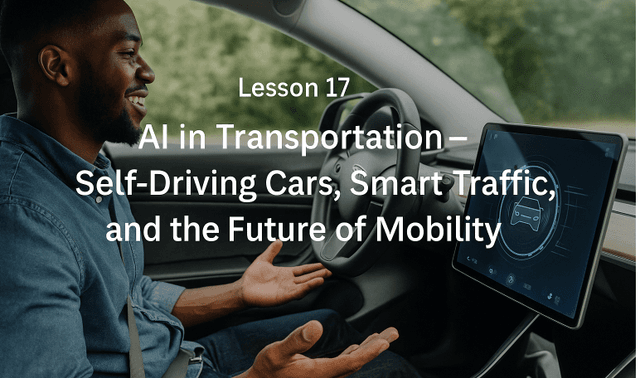
Lesson 17: AI in Transportation – Self-Driving Cars, Smart Traffic, and the Future of Mobility
AI Is Reshaping How the World Moves
Transportation is entering a new era where vehicles, roads, and cities are becoming intelligent. Artificial Intelligence now plays a major role in how people travel, how goods are shipped, and how traffic flows. From self-driving cars to automated logistics systems, AI is making transportation safer, faster, and more efficient. Understanding these changes helps us prepare for a future where mobility is largely automated.
Self-Driving Cars Are Closer Than People Think
AI powered autonomous vehicles use cameras, sensors, radar, and advanced algorithms to see the world, recognize objects, and make driving decisions. They can detect pedestrians, read traffic signs, stay in lanes, and react to sudden obstacles faster than human drivers. While fully autonomous cars are still being perfected, the technology is rapidly advancing. Within the next decade, self-driving vehicles will become a common sight on roads around the world.
Reducing Accidents and Saving Lives
Human error causes the majority of traffic accidents. AI has the potential to dramatically reduce collisions by driving with consistent awareness and eliminating distractions, fatigue, and emotional reactions. AI systems can predict dangerous situations, avoid sudden hazards, and maintain perfect attention at all times. This could transform road safety and save thousands of lives each year.
Smarter Traffic Flow in Cities
AI is improving traffic flow by analyzing data from cameras, sensors, and connected vehicles. It can adjust traffic lights, predict congestion, and reroute cars automatically. Cities using AI driven traffic systems experience shorter travel times, fewer bottlenecks, and less pollution. Smart transportation networks will become essential as urban populations continue to grow.
AI in Public Transportation
Buses, trains, and ride-sharing systems are becoming smarter thanks to AI. These systems can optimize schedules, predict demand, reduce delays, and improve route efficiency. Some cities are testing autonomous buses and trains that operate with precision and lower operational costs. AI will help public transportation become more reliable and accessible to millions of people.
Revolutionizing Shipping and Delivery
AI is transforming how goods move around the world. Automated warehouses, route-optimizing algorithms, delivery robots, and drone deliveries are already being tested and deployed. AI powered logistics systems reduce fuel costs, speed up delivery times, and improve inventory accuracy. This will reshape global trade and make same-day delivery the new standard.
Aviation and AI-Assisted Flight
Airplanes already rely heavily on automation, but AI is taking aviation to a new level. AI assists pilots with navigation, safety checks, fuel optimization, and monitoring aircraft systems. Some future aircraft may include autonomous components that reduce pilot workload and increase safety. AI can also analyze weather patterns to prevent delays and turbulence.
Environmental Benefits of AI Transportation
AI helps reduce emissions by optimizing routes, improving fuel efficiency, and supporting the growth of electric and autonomous vehicles. Smarter traffic means less idling and fewer traffic jams, which significantly reduces pollution. Long-term, AI powered transportation will help cities become cleaner and more sustainable.
Preparing for an AI-Driven Transportation Future
The transportation workforce will evolve as AI grows. Drivers, logistics workers, pilots, and mechanics will need new skills to work alongside intelligent systems. The people who understand how AI shapes transportation will have strong opportunities in engineering, planning, fleet management, and technology development.
A More Connected, Efficient, and Safer World
AI will continue transforming how we move, making transportation faster, safer, and more accessible for everyone. As AI systems mature, cities and societies will experience a dramatic shift in mobility, logistics, and travel.
The future of transportation is intelligent, connected, and powered by artificial intelligence.
Lessons 1 to 10 - Building Your Foundation
The first ten lessons introduce the core ideas that help you understand what AI really is and how it affects the world around you. You learn:
Lesson 2: The Basics of AI - Understanding What Artificial Intelligence Really Is
Lesson 4: What Is Deep Learning - The Power Behind Modern AI
Lesson 7: AI and Customer Service - Chatbots, Support, and Personalization
Lesson 8: The Ethics of AI - Bias, Truth, and Responsibility
Lesson 9: AI and Privacy – What You Should Know About Your Data
Lesson 10: The Global Race for AI Leadership - Who Is Winning and Why
These lessons give you clarity. They explain AI in simple terms so you can finally understand the technology that is redefining modern society.
Lessons 11 to 20 - Understanding the Tools and Applications
The next ten lessons reveal the tools you use every day and the industries AI is transforming. You learn:
Lesson 11: How AI Already Shapes Your Life Without You Knowing It
Lesson 12: Using AI Tools to Boost Productivity, Learning, and Creativity
Lesson 13: AI Assistants - How to Use ChatGPT and Other Bots Effectively
Lesson 14: AI in Communication - Clearer Writing, Smarter Messaging, and Better Connections
Lesson 15: AI and Personal Finance - Smarter Money Decisions With Intelligent Tools
Lesson 16: AI in Personal Health - What the Future of Medicine Means for You
Lesson 17: AI in Transportation – Self-Driving Cars, Smart Traffic, and the Future of Mobility
Lesson 19: AI for Students - Smarter Studying, Faster Learning, Better Results
Lesson 20: How to Stay Relevant in an AI World - Skills You Must Build Now
These lessons show you how AI benefits your personal life, your career, and your long-term success. You also begin learning how to apply AI tools to real tasks immediately.
Lessons 21 to 30 - Preparing for the Future of Work
The middle section of the AI School focuses on the changing economy. AI is reshaping the job market, and these lessons prepare you for that shift. You learn:
Lesson 21: AI and Cybersecurity - Protecting Data in a Digital World
Lesson 22: AI in Education - Personalized Learning for Every Student
Lesson 23: AI in Healthcare - Diagnosis, Treatment, and the Future of Medicine
Lesson 24: AI in Finance - Smarter Investing, Fraud Detection, and Risk Management
Lesson 25: AI in Marketing - Smarter Campaigns, Better Targeting, Bigger Results
Lesson 26: AI in Sales - Close More Deals, Understand Customers Better
Lesson 27: AI and Customer Service - Chatbots, Support, and Personalization
Lesson 28: AI-Powered Decision Making - Smarter, Faster, More Accurate
Lesson 29: The Rise of No-Code AI - Building Powerful Tools Without Programming
Lesson 30: Future-Proofing Your Career - How to Become AI-Proficient
By the end of this section, you understand how to remain valuable, adaptable, and competitive no matter how fast the world changes.
Lessons 31 to 40 - Advanced Concepts, Risks, and Opportunities
The final lessons focus on the deeper, more advanced topics of AI - the ones that will shape the next century. You explore:
Lesson 31: Deep Learning Mastery - Why It Changes Everything
Lesson 33: Natural Language Processing - How AI Understands Human Speech
Lesson 34: Robotics and Automation - The Machines That Will Transform Industry
Lesson 35: AI in Science and Discovery - New Medicines, New Materials, New Worlds
Lesson 36: The Future of Transportation - Self-Driving Cars, Drones, and Beyond
Lesson 37: AI and the Future of Work - What Society Will Look Like in 10 Years
Lesson 38: AI Risks - Job Displacement, Deepfakes, and the Battle for Truth
Lesson 39: The Coming Age of AGI - What Happens When Machines Become Smarter Than Us?
Lesson 40: Where the Biggest AI Opportunities Will Be - And How You Can Start Today
These lessons prepare you intellectually, ethically, and strategically for a future where AI is more powerful, more present, and more influential than any technology in human history.
Sign in to share your thoughts