Share this now - someone’s life could change.


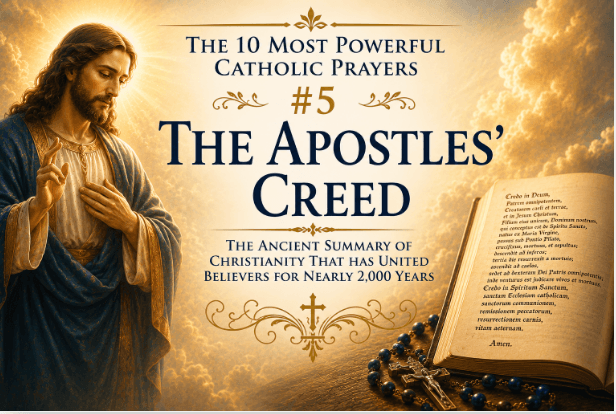
The Apostles' Creed: The Ancient Summary of Christianity That Has United Believers for Nearly 2,000 Years
The Apostles' Creed
I believe in God,
the Father Almighty,
Creator of heaven and earth,
and in Jesus Christ,
His only Son, our Lord,
who was conceived by the Holy Spirit,
born of the Virgin Mary,
suffered under Pontius Pilate,
was crucified, died and was buried;
He descended into hell;
on the third day He rose again from the dead;
He ascended into heaven,
and is seated at the right hand of God the Father Almighty;
from there He will come to judge the living and the dead.
I believe in the Holy Spirit,
the holy Catholic Church,
the communion of saints,
the forgiveness of sins,
the resurrection of the body,
and life everlasting.
Amen.
A Prayer That Tells the Entire Christian Story
Imagine trying to explain Christianity in just a few sentences. What would you say? Who is God? Who is Jesus? Why did He come? What happens after we die? For nearly two thousand years, Christians have answered those questions with the Apostles' Creed. More than simply a prayer, the Creed is a declaration of faith. It summarizes the essential beliefs that Christians have professed from the earliest days of the Church and serves as a reminder of what Catholics believe, why they believe it, and the hope that awaits them.
When Was It Written?
Despite its name, the Apostles' Creed was not written directly by the Twelve Apostles. Rather, it developed gradually from early Christian baptismal formulas used by the Church in the second and third centuries. By around the fourth century, a version very similar to the one Catholics pray today was already widely used throughout the Christian world. The Creed helped preserve authentic Christian teaching at a time when various false teachings and misunderstandings about Jesus and the Trinity were spreading. By reciting it regularly, believers could remain grounded in the truths handed down from the Apostles.
Why Was It Created?
The Apostles' Creed was created primarily as a profession of faith for those preparing to be baptized. Before entering the Church, converts were asked to publicly profess what they believed. The Creed became a concise yet powerful statement of those beliefs. Each line addresses a foundational aspect of Christianity:
God the Father as Creator;
Jesus Christ as Savior;
The Holy Spirit as Sanctifier;
The Church as the family of believers;
Forgiveness, resurrection, and eternal life as God's promises to His people.
In many ways, the Creed serves as a roadmap of salvation history.
Why Catholics Still Pray It Today
The Apostles' Creed remains one of the most important prayers in Catholic life.
Catholics commonly pray it:
At the beginning of the Rosary;
During personal prayer;
In catechism classes;
During retreats and missions;
As a way to reaffirm their faith during difficult times.
In a world filled with confusion, competing ideas, and shifting values, the Creed reminds believers that some truths never change. By praying it regularly, Catholics are not merely repeating ancient words; they are renewing their commitment to the faith that countless saints, martyrs, and ordinary Christians have professed throughout history.
The Apostles' Creed has endured for nearly twenty centuries because it speaks directly to humanity's deepest questions: Where did we come from? Why are we here? What happens after death? And who is Jesus?
For Catholics, the Creed is more than a prayer. It is a declaration of identity, a profession of hope, and a reminder that we belong to a faith that stretches back to the very beginnings of Christianity.
Coming Next: The Glory Be: The Short Prayer That Echoes the Worship of Heaven.
Sign in to share your thoughts