Share this now - someone’s life could change.


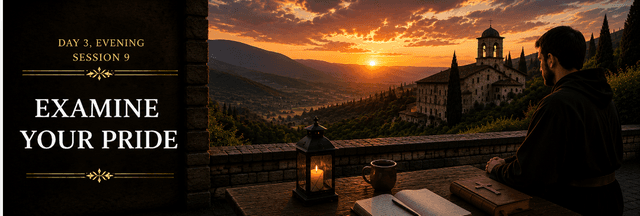
Session 9: Evening - Examine Your Pride
Welcome back, my friend. You have reached the evening of Day 3. Today we have been exploring humility. This morning, we reflected on Jesus' words: “Learn from me, for I am meek and humble of heart.” We looked at Saint Benedict's teaching about surrendering our attachment to our own will, and you chose one way to practice letting go.
🎧 WATCH OR LISTEN TO THIS SESSION
At midday, we reflected on our dependence upon God and upon one another. You were invited to notice the small moments when pride appeared and to practice some surprisingly difficult words: “I was wrong.” “I need help.” “Thank you.” Now the day is ending. Tonight we are going to look back honestly at the moments when humility guided us and the moments when pride took over. This is not an exercise in making yourself feel bad. Humility requires truth, and the truth is that every one of us struggles with pride. The monk does not pretend he has overcome it. He learns to recognize it more quickly and bring it before God. So find a quiet place. Put your phone aside. Allow the day to begin slowing down. Take a slow breath. [PAUSE - 10 SECONDS] And another. [PAUSE - 10 SECONDS] You do not need to defend yourself during these next thirty minutes. You do not need to explain yourself. You simply need to become honest before God.
The Humility of Christ
Our Scripture tonight comes from Philippians 2. Saint Paul tells us to have the same attitude that was in Christ Jesus. He describes Jesus, who possessed everything, yet did not cling to status or privilege. Instead, Christ “emptied himself, taking the form of a servant.” He humbled Himself and became obedient even to death on a cross. Christianity gives us an astonishing picture of greatness. The world often tells us greatness means rising above other people. Jesus shows greatness by lowering Himself to serve them. The world tells us to protect our status. Jesus washes feet. The world tells us to make sure people recognize our importance. Jesus chooses the lowest place. The world tells us to defeat our enemies. Jesus prays for His enemies. This does not mean Jesus was weak. His humility came from strength. He knew who He was, so He did not constantly need to prove Himself. That is one of the great freedoms of humility. When you know that your worth comes from God, you do not have to spend your life demanding that other people confirm it.
Vespers and Becoming Small Again
As evening arrives in a monastery, the monk returns to prayer. The day's work may have gone well or poorly. Perhaps he accomplished something important. Perhaps he made mistakes. Maybe someone praised him. Maybe someone criticized him. But at Vespers, all of that begins to fall away. He stands before God as he truly is. Not his title. Not his accomplishments. Not his reputation. Simply a human being before his Creator. Evening prayer has a way of putting life back into perspective. Think about the things that seemed enormously important earlier today. Some may already feel smaller tonight. An argument. An inconvenience. A mistake. Something someone said. Something you wanted but did not receive. Pride magnifies these things because pride makes everything about us. Humility places them back into a larger picture. You are one person living one day in an enormous world created by God. You are deeply loved, but you are not the center of everything. There is peace in accepting that.
Preparing for Lectio Divina
We will now enter Lectio Divina. If you have the Gospel reading for today, use it. If not, remain with these words from Philippians 2: “He emptied himself, taking the form of a servant.” Tonight, listen especially for anything that challenges your ego, your need for recognition, or your desire to have your own way. Remember our four movements: read, meditate, pray, and rest. We are not studying Scripture tonight. We are allowing Scripture to study us.
Lectio Divina
We begin with Lectio: Read. Slowly read the Gospel passage. Read it once, pause, and then read it again. Notice one word, phrase, or image that draws your attention. Do not force anything. Simply receive what is there. [SILENCE - 2 MINUTES] Now enter Meditatio: Meditate. Return to the word or phrase that stayed with you. What might it reveal about your life today? Does it challenge something in you? Does it comfort you? Does it invite you to change? Let the Scripture remain before you like a mirror. [SILENCE - 2 MINUTES] Now enter Oratio: Pray. Respond honestly to God. If you recognize pride, admit it. If you need help, ask. If you are grateful, give thanks. If you feel resistance, tell God about the resistance. You do not need to hide anything from Him. [SILENCE - 2 MINUTES] Finally, enter Contemplatio: Rest. Stop analyzing. Stop examining. Stop trying to improve yourself for these next two minutes. Simply rest in the presence of God who already knows you completely and loves you. [SILENCE - 2 MINUTES]
Saint Benedict's Ladder of Humility
Saint Benedict devotes much of Chapter 7 of his Rule to what he calls the ladder of humility. The image comes from the ladder Jacob saw in Scripture reaching between earth and heaven. Benedict describes a series of steps through which the monk gradually learns humility. The details matter, but tonight I want you to notice the larger movement. The monk slowly stops placing himself at the center. He becomes more aware of God. He becomes less attached to his own will. He becomes more willing to listen. More willing to obey. More willing to admit weakness. More willing to let go of the need to appear important. This does not happen in a week. It does not happen in a month. Humility is the work of a lifetime. The encouraging part is that every ordinary day gives us dozens of opportunities to practice it.
Where Did Pride Appear Today?
Now let us examine your day. Begin with this morning and slowly move through the hours. Ask yourself: Where did pride appear today? Did you need to be right? Did you become defensive? Did you want recognition? Did you compare yourself with someone else? Did you secretly enjoy feeling superior to another person? Did you judge someone without knowing their story? Did you refuse help because you wanted to appear capable? Did you become irritated because someone interrupted your plans? Did you insist on having something your way simply because it was your preference? Did you exaggerate something to make yourself look better? Did you refuse to apologize? Perhaps pride appeared only in your thoughts. Be honest. God already knows. [SILENCE - 1 MINUTE] If something comes to mind, simply say: “Lord, I see it. Help me change.”
Where Did Humility Appear?
Now look for the opposite. Where did humility appear today? Perhaps you listened instead of interrupting. Maybe you admitted you were wrong. Perhaps you allowed someone else to receive the attention. Maybe you asked for help. Perhaps you accepted an inconvenience without complaining. Maybe you served someone without telling anyone. Perhaps you changed your mind after realizing another person was right. Maybe you quietly surrendered something to God that you could not control. These moments matter. Do not take pride in your humility, of course. Simply recognize grace at work. [SILENCE - 1 MINUTE] Then say quietly: “Thank You, Lord, for helping me let go.”
The Freedom of Being Forgotten
Here is one final practice for tonight. Imagine doing something good tomorrow and receiving absolutely no recognition for it. No one thanks you. No one notices. No one knows. Could you still do it joyfully? This is a powerful test of the heart. We often say we are serving others, but part of us still wants someone to notice. The monk gradually learns to do good because it is good, not because it earns applause. Tomorrow, try doing one good thing that no one needs to know about. Help someone. Clean something. Pray for someone. Give something. Encourage someone anonymously if possible. Let the act belong only to you and God. There is tremendous freedom in discovering that not everything good you do needs an audience.
Closing Prayer and Silence
Let us close Day 3 in prayer. Heavenly Father, tonight I stand before You without titles, accomplishments, possessions, excuses, or defenses. You know me completely. You know the good in me and You know the pride I sometimes hide even from myself. Forgive me for the times today when I needed to be right, needed to be noticed, needed to have my way, or placed myself above another person. Forgive me when I judged, compared, defended, or refused to listen. Thank You for every moment when Your grace helped me choose humility instead. Teach me the humility of Jesus, who did not come to be served but to serve. Help me become secure enough in Your love that I no longer need constant approval from other people. Give me the courage to admit when I am wrong, the wisdom to listen when I am corrected, the generosity to serve without recognition, and the faith to surrender what I cannot control. Make my heart more like the heart of Christ: gentle, strong, truthful, and humble. Amen.
We will now end with three minutes of silence. During this silence, imagine placing your reputation, accomplishments, failures, opinions, and need for approval into God's hands. You do not need to impress Him. You do not need to prove your worth. Simply allow yourself to be known and loved. [SILENCE - 3 MINUTES] When the silence ends, let today's failures end with it. Tomorrow is another beginning. Day 3 has taught us that humility is not weakness. It is freedom from constantly needing life to revolve around us. Tomorrow we begin Day 4, when we will take something that occupies a huge part of most people's lives and learn to see it differently: our work. We will discover how ordinary tasks, responsibilities, and even difficult work can become prayer. For tonight, release the need to be important. Release the need to be right. Release the need to be noticed. Rest quietly before God. You are already known. You are already loved.
Sign in to share your thoughts