Share this now - someone’s life could change.


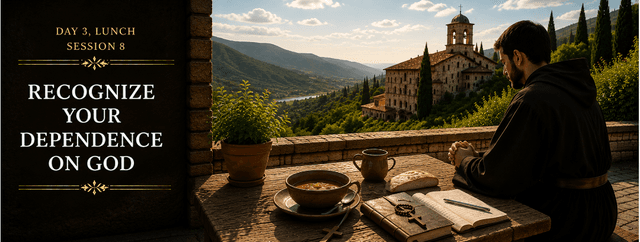
Session 8: Lunch - Recognize Your Dependence on God
Welcome back, my friend. This morning, we began exploring humility. We reflected on the words of Jesus: “Learn from me, for I am meek and humble of heart.” We also looked at Saint Benedict's teaching about letting go of our attachment to our own will. You chose one way to practice surrender today, and now, at the midpoint of the day, we are going to look at humility from another direction: dependence.
🎧 WATCH OR LISTEN TO THIS SESSION
Most of us like feeling independent. We want to believe we can take care of ourselves, solve our own problems, make our own decisions, and control our own future. There is nothing wrong with becoming responsible and capable. But monastic life reminds us of a deeper truth: none of us is truly independent. Every breath is received. Every heartbeat is a gift. The food in front of you came through the work of other people. The language you speak was taught to you. Much of what you know was learned from someone else. You entered this world completely dependent upon others, and throughout your life you will continue to need other people in ways you may not always recognize. Above all, you depend upon God. Humility begins when we stop pretending otherwise. So put your phone aside. If possible, have your lunch in front of you. Take a slow breath. [PAUSE - 10 SECONDS] And another. [PAUSE - 10 SECONDS] Look at the food before you and quietly acknowledge: “I receive more than I create.”
A Prayer of Dependence
Before we eat, let us pray. Heavenly Father, everything I have ultimately comes to me as a gift. My life, my breath, my abilities, my opportunities, the people who love me, and the food before me. Forgive me for the times I live as though I need no one. Forgive me when pride makes me believe that everything I have accomplished was accomplished by me alone. Teach me gratitude. Teach me dependence without fear. Teach me to receive help when I need it and to recognize the countless ways other people make my life possible. Above all, help me remember that I depend upon You. As I receive this food, remind me that I am a creature receiving another gift from my Creator. Amen.
Ten Minutes of Silent Eating
We will now eat in silence for ten minutes. Today, allow the meal itself to teach you humility. Before taking your first bite, look at the food in front of you. Ask yourself: Could I have produced all of this completely by myself? Think about the farmer who grew something on your plate. The person who harvested it. The people who transported it. The person who stocked the store. Perhaps someone cooked it for you. Think about the water you drink. Someone built the systems that bring that water to you. Think about the plate, the fork, the table, the building you are sitting in. Your ordinary meal is connected to the work of countless people you will probably never meet. As you eat, simply receive. Chew slowly. Taste your food. Resist the urge to reach for your phone. If your thoughts wander, gently return to gratitude. Occasionally say quietly in your heart: “Thank You.” We will now eat together in silence. [SILENCE - 10 MINUTES]
The Illusion of Self-Sufficiency
Welcome back. There is something humbling about realizing how dependent we actually are. Our culture often celebrates the self-made person. We admire independence, achievement, strength, and success. But no one is truly self-made. Someone fed you when you could not feed yourself. Someone taught you to speak. Someone taught you to read. Teachers shared knowledge with you. Doctors may have cared for you. Friends encouraged you. People gave you opportunities. Even the strongest person depends upon thousands of people every day without thinking about it. Humility simply recognizes reality. I need others. And that is not a defect. God created human beings for relationship. The monk understands this very clearly because he lives in community. One monk cooks. Another tends the garden. Another welcomes guests. Another cares for the sick. Another cleans. Another leads prayer. Everyone contributes, and everyone receives. No monk can honestly say, “I need no one.” Neither can we.
Seeing Christ in Others
Saint Benedict teaches that the abbot, the leader of the monastery, holds the place of Christ within the community. This does not mean that the abbot is perfect or that every decision he makes is beyond question. Rather, Benedict wants the monk to learn something spiritually important: God can reach us through other people. This requires humility because we often prefer God to work according to our expectations. We may be willing to listen to someone we admire, but what about someone who annoys us? We may accept advice from someone successful, but what about someone younger than us? We may listen carefully to someone who agrees with us, but what about someone who challenges us? Sometimes God uses unexpected people to reveal something we need to see. The question is not whether every person is always right. They are not. The question is whether pride has made us unable to receive anything from anyone. A humble person can learn from almost anyone.
Humility in Ordinary Moments
Most opportunities for humility will not happen inside a church or during prayer. They happen in kitchens, offices, cars, stores, family conversations, and ordinary disagreements. Someone corrects you. Someone interrupts you. Someone knows something you do not know. Someone does something better than you. Someone receives praise while you are overlooked. Someone disagrees with your opinion. Someone asks you to do something inconvenient. Someone points out a mistake you made. These are small moments, but they reveal the heart. Pride immediately wants to defend itself. “That's not what I meant.” “You don't understand.” “I already knew that.” “That's not my fault.” “Let me explain.” Sometimes an explanation is necessary. But sometimes our immediate need to defend ourselves is simply pride protecting its territory. Humility creates a tiny pause before reacting. In that pause we can ask: “Is there something here I need to hear?”
Where Did Pride Appear This Morning?
Now look back over your morning. Do not search for some enormous act of pride. Look at the small moments. Did you become irritated when something did not go your way? Did you need to prove that you were right? Did you interrupt someone? Did you silently judge someone? Did you compare yourself with another person? Did you become frustrated because someone failed to recognize what you did? Did you resist asking for help because you wanted to handle everything yourself? Perhaps you made a mistake and immediately looked for someone else to blame. Ask yourself quietly: “Where did pride appear in me this morning?” [SILENCE - 1 MINUTE] If something comes to mind, do not become discouraged. Simply recognize it. Then quietly say: “Lord, help me see myself truthfully.”
Practice Saying Three Difficult Words
There are three words that pride often finds surprisingly difficult to say: “I was wrong.” Think about how much conflict could disappear if people were more willing to say those words. Not, “I was wrong, but…” Not, “I was wrong because you…” Simply: “I was wrong.” There are three more words humility can teach us: “I need help.” And another two: “Thank you.” These simple phrases acknowledge that we are not perfect, we are not completely independent, and we do not have all the answers. Sometime this afternoon, notice whether you have an opportunity to say one of them sincerely: “I was wrong.” “I need help.” “Thank you.” Do not force it. Simply be ready.
One Person to See Differently
Now think of one person you will probably encounter this afternoon. It could be your spouse, a child, coworker, friend, employee, customer, neighbor, or even a stranger. Perhaps it is someone you find difficult. Instead of asking what that person can do for you, ask: “How might God be asking me to receive this person today?” Maybe you need to listen. Maybe you need to serve. Maybe you need to be patient. Maybe you need to accept help. Maybe you simply need to stop judging. Hold that person in your mind for a moment. [SILENCE - 30 SECONDS] Then pray quietly: “Lord, help me see this person with humble eyes.”
Closing Prayer
Let us close our midday session in prayer. Heavenly Father, thank You for reminding me that I do not walk through life alone. Thank You for every person whose work, love, sacrifice, knowledge, and kindness have helped make my life possible. Forgive me when I take these gifts for granted. Forgive me when pride makes me believe that I have earned everything by myself. Teach me to receive as well as give. Teach me to ask for help when I need it. Teach me to admit when I am wrong. Teach me to accept correction without immediately becoming defensive. Help me recognize that You sometimes speak through people I would not have chosen. When pride appears in me this afternoon, help me notice it. Give me a moment to pause before reacting. And in that moment, remind me of Jesus, meek and humble of heart. Amen.
Remain quiet for one final minute. You do not need to prove anything. You do not need to impress anyone. You are simply a person loved by God, dependent upon His grace and connected to countless other people. [SILENCE - 1 MINUTE] When you return to your afternoon, watch for the small opportunities to practice humility. Receive help. Listen before defending yourself. Say thank you. Admit when you are wrong. And remember: humility is not thinking less of yourself. It is learning to see yourself, others, and God more truthfully. We will meet again this evening to look back over the day and examine the moments when pride or self-will appeared, and the moments when grace helped us choose another way.
Sign in to share your thoughts