Share this now - someone’s life could change.


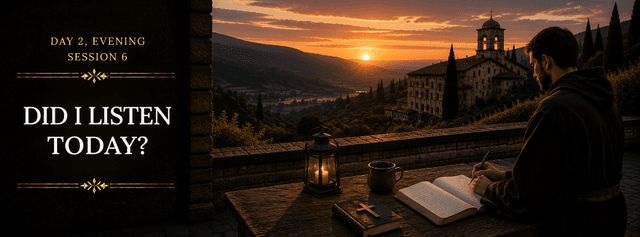
Session 6: Evening - Did I Listen Today?
Welcome back, my friend. You have reached the evening of Day 2. This morning, we began with Samuel hearing his name called in the night and responding with the words, “Speak, Lord. Your servant is listening.” At midday, we explored Saint Benedict's invitation to listen with the ear of the heart. You were also asked to remove one source of unnecessary noise from your afternoon. Perhaps you turned off the radio while driving. Maybe you stayed away from social media for a few hours. Perhaps you put your phone down and gave someone your complete attention. Maybe you tried, but quickly found yourself surrounded by noise again. Whatever happened, you are here now.
🎧 WATCH OR LISTEN TO THIS SESSION
Tonight, we are not going to judge how well you performed. We are going to listen again. Find a quiet place. Put your phone aside. Allow the day to begin slowing down. Take a slow breath. [PAUSE - 10 SECONDS] And another. [PAUSE - 10 SECONDS] Let your shoulders relax. Let the conversations, problems, and responsibilities of today begin to settle. You do not have to solve anything during these next thirty minutes. Tonight, we are simply going to ask: Did I listen today?
Psalm 85
Our evening Scripture begins with Psalm 85. One verse gives us a beautiful prayer for tonight: “I will listen for what God, the Lord, has to say.” Notice the intention in those words. I will listen. The Psalmist chooses to become attentive. He expects God to speak. Throughout the day, we listen to countless voices without making a conscious decision to do so. Advertisements speak to us. News speaks to us. Social media speaks to us. Other people's opinions speak to us. Our fears speak to us. Our memories speak to us. Our desires speak to us. But the Psalmist deliberately turns his attention toward God. “I will listen for what God, the Lord, has to say.” Tonight, make those words your own. Quietly repeat them: “I will listen for what God has to say.” [PAUSE - 20 SECONDS] Again: “I will listen for what God has to say.” [PAUSE - 20 SECONDS] One final time: “Speak, Lord. Your servant is listening.” [SILENCE - 30 SECONDS]
Vespers and Gathering the Day
In the monastic tradition, the evening includes the prayer known as Vespers. As daylight begins to fade, the monk stops his work and returns to prayer. There is wisdom in this rhythm. Without intentional pauses, one part of life simply runs into another. Morning becomes afternoon. Afternoon becomes evening. Evening becomes bedtime. Then we wake up and begin again. Days can disappear this way. Weeks can disappear. Years can disappear. The monastery interrupts that pattern. Bells call the monk back throughout the day. The bell says: Stop. Remember God. Listen again. Vespers gathers everything that happened during the day and places it before God with gratitude. Tonight, imagine hearing that monastery bell. Whatever you were doing before you began this session, the bell has rung. Work is stopping. The day is being gathered together. You are returning to the One who gave you the day in the first place.
Preparing for Lectio Divina
We will now return to the practice you began last night: Lectio Divina. Remember, this is not simply reading Scripture to gather information. It is reading in order to listen. Tonight, use the Gospel reading for the day if you have it available. If not, you can return to the words from 1 Samuel that have guided us throughout Day 2: “Speak, Lord. Your servant is listening.” We will move again through four movements: reading, meditation, prayer, and rest. Do not worry about doing this perfectly. Lectio Divina is not a technique to master. It is a way of slowing down enough to allow Scripture to reach the heart.
Lectio Divina
We begin with Lectio: Read. Slowly read the Gospel passage. Read it once. Pause. Then read it again. Notice a word, phrase, image, or sentence that seems to stay with you. Do not analyze it yet. Simply notice. [SILENCE - 2 MINUTES] Now enter Meditatio: Meditate. Return to the word or phrase that caught your attention. Repeat it slowly. Why might these words matter to you tonight? What part of your life do they touch? Is there an invitation here? A challenge? A comfort? A question? Allow the words to remain with you. [SILENCE - 2 MINUTES] Now enter Oratio: Pray. Respond to God. Speak naturally. You do not need impressive words. If the Scripture challenged you, talk to God about it. If it comforted you, thank Him. If it confused you, say so. If you feel nothing, you can simply pray: “Lord, help me listen.” [SILENCE - 2 MINUTES] Finally, enter Contemplatio: Rest. Put the words aside. Stop analyzing. Stop asking questions. Simply sit quietly before God. Let yourself be loved without needing to accomplish anything. [SILENCE - 2 MINUTES]
Obedience Begins With Listening
Saint Benedict devotes Chapter 5 of his Rule to obedience. Today, the word obedience can sound harsh or restrictive. But there is something important behind it. The Latin root associated with obedience carries the sense of hearing or listening. Before we can obey God, we must first hear Him. Christian obedience is not simply following orders without thinking. It is the response of a heart that has learned to listen. Think again about Samuel. God called. Samuel listened. And eventually Samuel responded. Listening that never changes anything is incomplete. If I hear someone tell me that I have hurt them but refuse to change, I have heard the words without truly listening. If Scripture tells me to forgive and I continually refuse even to try, I have heard without responding. If my conscience repeatedly warns me about something and I continually silence it, I am training myself not to listen. Saint Benedict wants the monk to develop a heart that responds readily to what is good. That does not happen overnight. It develops through small acts of listening and responding, repeated day after day.
Where Did I Listen Today?
Now let us examine your day. Begin with the morning. Remember where you were when you listened to our first session. Remember Samuel. Remember the five minutes of silence. Then allow the rest of your day to move through your mind. Think about the people you encountered. The conversations you had. The decisions you made. Ask yourself: Where did I listen well today? Perhaps someone spoke and you resisted the urge to interrupt. Maybe you noticed someone needed your attention. Perhaps you felt your conscience guiding you and followed it. Maybe you remembered God during a quiet moment. Perhaps you turned off some noise and experienced a few minutes of peace. Where did you listen? [SILENCE - 1 MINUTE] When a moment comes to mind, thank God for it. “Thank You for helping me hear.” [PAUSE - 20 SECONDS]
Where Did I Refuse to Listen?
Now ask the harder question: Where did I refuse to listen? Was someone speaking while you were thinking about what you wanted to say next? Did you interrupt? Did you dismiss someone's feelings? Did you become defensive when someone corrected you? Did your conscience warn you about something and you ignored it? Did you sense that you should apologize, forgive, help, or stop something, but choose not to respond? Perhaps God was inviting you into silence, but you immediately reached for your phone. Do not condemn yourself. Just look honestly. [SILENCE - 1 MINUTE] If something comes to mind, quietly say: “Lord, forgive me for closing my heart. Help me listen better tomorrow.” [PAUSE - 30 SECONDS]
Who Did God Speak Through?
There is one final question for tonight. Who might God have spoken through today? Sometimes we expect God's voice to come through extraordinary experiences while overlooking the ordinary people He places around us. Perhaps your spouse said something you needed to hear. Maybe your child asked for your attention. Perhaps a friend offered advice. Maybe a coworker challenged you. Perhaps a stranger showed you unexpected kindness. Sometimes God speaks through people we would never have chosen as messengers. This requires humility because we often listen most carefully to people who agree with us. Monastic life teaches us to remain open. Ask quietly: “Lord, did You speak to me through someone today?” [SILENCE - 1 MINUTE] If a person comes to mind, do not immediately decide what it means. Simply hold that person and that conversation before God.
Closing Prayer and Silence
Let us close Day 2 in prayer. Heavenly Father, thank You for every voice today that led me closer to truth, goodness, mercy, and love. Thank You for the people who spoke to me, the Scriptures that challenged me, the quiet movements of my conscience, and the moments of silence in which I remembered You. Forgive me for the times I refused to listen. Forgive me when pride made me defensive, when impatience caused me to interrupt, when distraction kept me from noticing another person, and when noise became easier than silence. Teach me to listen with the ear of the heart. Give me the humility to hear correction, the patience to hear another person's pain, the wisdom to recognize Your voice, and the courage to respond when You call. Tonight, I place every conversation into Your hands. The things I said well and the things I wish I had not said. The things I heard and the things I missed. Tomorrow is another opportunity to begin again. Amen.
Now let us finish with three minutes of silence. Do not search for an answer. Do not demand that God speak. Simply become available to Him. “Speak, Lord. Your servant is listening.” [SILENCE - 3 MINUTES] When the silence ends, allow the day to end with it. You have practiced listening. You have noticed how difficult listening can be. And perhaps you have begun to discover that beneath all the noise, there is another voice inviting you deeper. Tomorrow we begin Day 3, and our focus will be humility. We will learn why humility is not thinking less of yourself, but learning to place yourself truthfully before God. For tonight, be still. Listen. And rest.
Sign in to share your thoughts