Share this now - someone’s life could change.


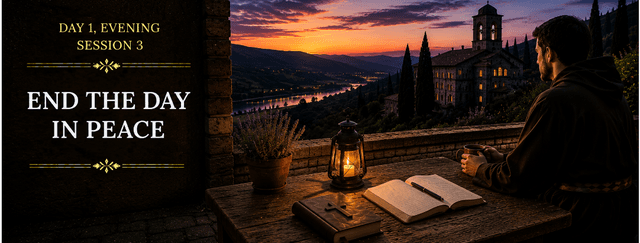
Session 3: Evening - End the Day in Peace
Welcome back, my friend. You have reached the evening of your first day. This morning, we began with one simple truth: God is here. At midday, we practiced finding Him in something as ordinary as eating a meal. Now the day is coming to an end, and we are going to do what monks have done for centuries. We are going to stop, become quiet, look back over the day, and place everything into God's hands.
🎧 WATCH OR LISTEN TO THIS SESSION
Whatever happened today is now part of your story. Perhaps it was a good day. Perhaps it was difficult. Maybe you remembered God many times. Maybe you forgot Him almost completely. Perhaps you were patient with someone. Perhaps you lost your temper. Maybe you accomplished everything you wanted to accomplish. Maybe almost nothing went according to plan. For the next thirty minutes, none of that needs to be fixed. We are simply going to bring the day honestly before God. Find a quiet place. Lower the lights if you can. Put your phone aside. Allow the activity of the day to begin slowing down. Take a slow breath. [PAUSE - 10 SECONDS] Take another. [PAUSE - 10 SECONDS] The work of today is nearly finished. Tomorrow has not yet arrived. Right now, you are simply here with God.
Psalm 4 and the Prayer of Night
Tonight we begin with Psalm 4, a prayer traditionally associated with the evening. Listen to these words: “Know that the Lord works wonders for his faithful one; the Lord hears when I call out to him.” And later the Psalmist says, “In peace I will lie down and fall asleep, for you alone, Lord, make me secure.” There is something beautiful about ending the day this way. During the day, we spend so much time trying to make ourselves secure. We work. We plan. We protect. We organize. We solve problems. We worry about tomorrow. But eventually night comes, and we have to let go. Sleep itself is an act of surrender. For several hours, you will stop working. You will stop planning. You will stop controlling. The world will continue without you. Monastic life reminds us that this is not something to fear. It is something to receive. At the end of the day, the monk entrusts himself to God. He has done what he could. What remains unfinished is placed into God's hands. Tonight, you are invited to do the same.
Understanding Compline
In monastic life, the final prayer of the day is called Compline. The word comes from a Latin word meaning completion. It completes the day's cycle of prayer. Compline is not about accomplishing one more religious task before bed. It is about surrender. The monk looks back over the day, asks for mercy where he has failed, gives thanks for what was good, and then rests in God's protection. There is tremendous wisdom in this practice. Many people carry the entire day into bed with them. Conversations continue in their minds. Problems continue. Arguments continue. Tomorrow's responsibilities begin before today has even ended. The body lies down, but the mind keeps running. Compline says: Enough for today. You have reached the end of this day. You are allowed to stop. There may be problems you did not solve. There may be work you did not finish. There may be people you could not please. There may be things you wish you had done differently. Bring them with you now. We are not going to carry them endlessly. We are going to place them before God.
Preparing for Lectio Divina
For the next several minutes, we will practice an ancient Christian form of prayer called Lectio Divina, which means sacred reading. Monks have practiced this way of praying with Scripture for centuries. Lectio Divina is not about reading quickly or trying to finish a chapter. It is about listening. Traditionally, it moves through four simple movements: reading, meditation, prayer, and contemplation. First, we read and listen carefully. Then we meditate, noticing a word or phrase that touches us. Then we pray, responding to God from the heart. Finally, we rest, becoming quiet in His presence. Tonight, use the Gospel reading for the day if you have it available. If not, you may simply use the words of Jesus from Matthew 11: “Come to me, all you who labor and are burdened, and I will give you rest.” Listen to those words again. “Come to me, all you who labor and are burdened, and I will give you rest.”
Lectio Divina
We begin with Lectio: Read. Slowly read the Gospel passage. Do not rush. Notice if one word, phrase, or image catches your attention. You do not have to understand why. Simply notice it. [SILENCE - 2 MINUTES] Now we move to Meditatio: Meditate. Return to the word or phrase that caught your attention. Repeat it slowly in your mind. What might God be showing you through these words tonight? Do not force an answer. Simply remain with the passage. [SILENCE - 2 MINUTES] Now we move to Oratio: Pray. Speak honestly to God about whatever has come to your heart. Perhaps you need to thank Him. Perhaps you need help. Perhaps you need forgiveness. Perhaps you are tired and have very few words. Speak simply. [SILENCE - 2 MINUTES] Finally, we enter Contemplatio: Rest. Put the words aside. Stop trying to understand. Stop trying to accomplish anything. Simply sit quietly with God. [SILENCE - 2 MINUTES]
Looking Back Over the Day
Now we come to another ancient Christian practice, the examination of conscience, or examen. This is not meant to become an exercise in criticizing yourself. We are not searching the day for reasons to feel guilty. We are learning to see the day truthfully in God's presence. Imagine your entire day from the moment you woke up until right now. See yourself getting out of bed. Remember the morning session. Remember what happened afterward. Think about the people you encountered. Your work. Your meals. Your conversations. Your frustrations. Your moments of peace. Your distractions. Your decisions. Let the day move through your mind slowly, almost like watching a movie. [SILENCE - 1 MINUTE] Now ask God quietly: “Help me see this day as You see it.” [SILENCE - 30 SECONDS]
Where Did I Notice God?
Begin with gratitude. Ask yourself: Where did I notice God today? Perhaps it was something beautiful. A conversation. Someone's kindness. A moment of unexpected peace. A meal. Your work. A laugh. The face of someone you love. Perhaps it was simply one moment when you remembered the practice from this morning and thought, “God is here.” Do not search only for dramatic moments. God often comes quietly. What was good about today? [SILENCE - 1 MINUTE] Now simply say: “Thank You.” [PAUSE - 20 SECONDS]
Where Did I Forget God?
Now ask a more difficult question: Where did I forget God today? Was there a moment when anger took control? Did you gossip? Were you impatient? Did you treat someone as an inconvenience rather than a person? Did pride appear? Did you become consumed by worry? Did you waste time on something you knew was pulling you away from what mattered? Did you ignore someone who needed you? Perhaps you simply lived several hours as though God were not there. Do not make excuses, but do not condemn yourself either. Just look honestly. [SILENCE - 1 MINUTE] If something comes to mind, bring it directly to God. Say quietly: “Lord, I am sorry. Help me begin again.” [PAUSE - 30 SECONDS]
The Grace of Beginning Again
One of the most beautiful lessons of monastic life is that tomorrow we begin again. A monk may have lived in the monastery for fifty years, but when morning comes, he still begins again. Christianity is filled with new beginnings. We fall. We return. We become distracted. We remember. We sin. We repent. We become discouraged. Grace calls us forward again. Do not expect perfection after one day. That is not what this week is about. Today you practiced remembering God. Sometimes you remembered Him. Sometimes you forgot Him. That is enough for Day 1. The important thing is that you are here now. Before you sleep tonight, release the need to have lived today perfectly. Instead ask for the grace to live tomorrow a little more attentively, a little more humbly, and a little closer to God.
Closing Prayer and Three Minutes of Silence
Let us close our first day together. Heavenly Father, thank You for this day. Thank You for every breath, every person, every meal, every opportunity, every challenge, and every moment of grace that I received, including the ones I failed to notice. Thank You for the moments when I remembered You. Forgive me for the moments when I forgot You. Forgive my impatience, my selfishness, my pride, my anger, my distractions, and the ways I failed to love. I place everything unfinished into Your hands. The work I did not complete, the problems I could not solve, the conversations I wish had gone differently, the worries I cannot control, and everything waiting for me tomorrow. I give them to You. Tonight, teach me to rest. Help me trust that while I sleep, You remain awake. While I let go, You remain in control. Give me peaceful rest and, if You grant me another day, help me rise tomorrow ready to listen more closely. Amen.
Now we will end with three minutes of complete silence. There is nothing more you need to accomplish today. Nothing more you need to prove. Nothing more you need to solve during these final moments. Simply rest in God's presence. [SILENCE - 3 MINUTES] When the silence ends, carry these words from Psalm 4 with you: “In peace I will lie down and fall asleep, for you alone, Lord, make me secure.” Your first day is complete. Tomorrow we begin Day 2, and our focus will be one of the most important practices in all of monastic life: listening. For tonight, let go. Be grateful. Rest. And remember: God is here.
Sign in to share your thoughts