Share this now - someone’s life could change.


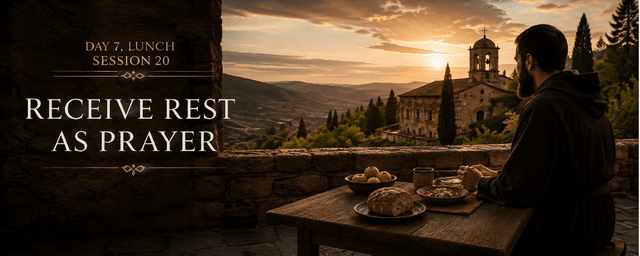
Session 20: Lunch - Receive Rest as Prayer
Welcome back, my friend. This morning, we began our final day together with gratitude. We reflected on the words of Psalm 100: “Enter his gates with thanksgiving.” You looked back over this week and identified three things for which you are grateful.
🎧 WATCH OR LISTEN TO THIS SESSION
Now we have reached the middle of Sunday, and our focus becomes something that sounds easy but can actually be very difficult: rest. Many of us know how to stop working physically without truly resting. We sit down, but immediately pick up our phones. We finish one task and begin thinking about the next. We turn on the television, scroll through social media, check messages, read the news, or fill every quiet moment with something. Our bodies may stop moving, but our minds continue running. Monastic life teaches another kind of rest. It teaches us that sometimes we can simply stop, become quiet, and receive the moment God has given us. For the next thirty minutes, you do not need to accomplish anything. You do not need to improve yourself. You do not need to solve a problem. If possible, have your lunch in front of you. Put your phone aside. Take a slow breath. [PAUSE - 10 SECONDS] And another. [PAUSE - 10 SECONDS] Quietly say: “Lord, teach me how to rest in You.”
A Prayer of Thanks for the Week
Before we eat, let us pray. Heavenly Father, thank You for bringing me to this final day. Thank You for every lesson, every moment of silence, every challenge, every act of surrender, and every opportunity to begin again. Thank You for the people who have walked through this week with me, whether they knew they were part of my journey or not. Thank You for the work I was able to do, the food I received, the crosses You helped me carry, and the love I received from others. Today, teach me to rest. Quiet the voice that tells me I must always be doing something. Help me receive this meal without rushing. Help me receive this day without trying to control it. Help me trust that the world continues even when I stop. Bless this food and everyone whose work brought it to this table. May this meal become a prayer of gratitude. Amen.
Ten Minutes of Silent Eating
We will now eat in silence for ten minutes. This will be our final silent lunch together during these seven days. Think back to the first silent meal of this journey. Perhaps ten minutes seemed unusually long. Maybe you reached instinctively for your phone. Perhaps your mind raced from one thought to another. Today, notice whether anything has changed. Do not try to make this meal spiritual. Simply receive it. Look at the food. Notice the aroma. Taste it. Chew slowly. Allow yourself to enjoy it. You do not need entertainment while you eat. You do not need information. You do not need to accomplish something at the same time. Let eating be enough. Occasionally say quietly: “Thank You.” If thoughts about tomorrow arise, let them pass. Tomorrow will arrive soon enough. If something from yesterday returns, let that pass too. Yesterday is finished. Right now, there is simply this meal, this breath, this moment, and God. We will now eat together in silence. [SILENCE - 10 MINUTES]
Rest Is Not Laziness
Welcome back. It is important to distinguish rest from laziness. Laziness avoids what should be done. Rest comes after accepting our responsibilities and recognizing that we are human beings with limits. Saint Benedict's Rule creates a rhythm. There are times for prayer. Times for work. Times for reading. Times for meals. Times for sleep. The monk does not work every moment because endless work would eventually destroy his ability to pray, serve, think clearly, and live peacefully with others. Our culture sometimes treats exhaustion like an accomplishment. People proudly say they slept four hours, skipped lunch, worked all weekend, or never take vacations. There may be seasons when unusual effort is necessary. But living permanently exhausted is not the same thing as living faithfully. Your body has limits. Your mind has limits. Your attention has limits. Humility accepts those limits. Rest says: “I am a human being, not a machine.”
The Monk's Life Is Meant to Have Joy
Saint Benedict's Rule can sound demanding when we first encounter it. There is discipline, obedience, silence, fasting, work, prayer, and self-denial. But the goal is not misery. Benedict repeatedly shows concern for human weakness, balance, moderation, and joy. The disciplines of monastic life are meant to free the heart from things that control it so that the monk can love God and others more fully. Think about what we have practiced this week. Silence is not about punishing ourselves by removing noise. Silence makes room to listen. Humility is not about thinking badly of ourselves. Humility frees us from constantly needing to prove ourselves. Work as prayer is not about working more. It teaches us to work with attention and then put the work down. Carrying the Cross is not about seeking suffering. It teaches us that suffering does not have to separate us from Christ. Charity is not another burden. It teaches us that life becomes richer when we stop living only for ourselves. And rest is not doing nothing for no reason. Rest creates room for joy.
Can You Receive Something Without Earning It?
There is a deeper spiritual lesson hidden inside rest. Can you receive something you did not earn? We are comfortable with exchange. We work and receive a paycheck. We perform and receive recognition. We accomplish something and feel satisfaction. Grace is different. Grace is received. God's love is not a salary paid because you performed well enough. You cannot earn another sunrise. You cannot purchase another heartbeat. You cannot make God love you more by being productive. This can be difficult for people who have spent their lives accomplishing things. Rest teaches the heart to receive. For a few moments, imagine that there is nothing you need to prove to God today. You are not here because you earned His attention. You are here because He loves you. [SILENCE - 1 MINUTE]
Savor One Gift From the Week
Now think back over these seven days. Do not review every lesson. Let one moment rise naturally. Perhaps it was five minutes of silence. Maybe it was something you wrote in your journal. Perhaps it was realizing how much noise fills your life. Maybe you apologized to someone. Perhaps you handled a frustration differently. Maybe you noticed someone you normally overlook. Perhaps you prayed more honestly than usual. Maybe you experienced peace during a silent meal. Perhaps you discovered something about yourself that surprised you. Choose one gift from the week and simply savor it. Do not analyze it. Do not ask what you should do with it. Just receive it again. [SILENCE - 1 MINUTE] Now quietly say: “Thank You for this gift.”
Practice Doing Nothing
For the next two minutes, we are going to practice something that may feel surprisingly uncomfortable. Do nothing. Do not journal. Do not read. Do not plan. Do not check your phone. Do not even try especially hard to pray. Sit. Breathe. Notice the room. Notice the sounds around you. If a bird sings, hear it. If the room is quiet, hear the quiet. If your mind produces a thought, let it come and go. You are not wasting these two minutes. You are receiving them. Let them belong entirely to God. [SILENCE - 2 MINUTES]
Carry Sabbath Into Your Life
Tomorrow, normal life will begin again. Emails may arrive. Work will return. Responsibilities will continue. The goal of this week was never to turn your home literally into a monastery. It was to discover a rhythm you can carry into ordinary life. One part of that rhythm should be intentional rest. Perhaps you protect part of Sunday from unnecessary work. Maybe you create thirty minutes each evening when the phone goes away. Perhaps you take a quiet walk each week. Maybe you eat one meal without a screen. Perhaps you sit outside for ten minutes after work. Choose something realistic. A spiritual practice that lasts is better than an ambitious one abandoned after three days. Ask yourself: “What small practice of rest can I continue after this week?” [SILENCE - 30 SECONDS]
Closing Prayer
Let us close our final midday session in prayer. Heavenly Father, thank You for the gift of rest. Forgive me for the times I act as though everything depends upon me. Forgive me when I measure my worth by how much I accomplish, how busy I am, or how useful I appear to others. Teach me the humility of stopping. Teach me to work faithfully when it is time to work and to rest peacefully when it is time to rest. Help me put down my phone, quiet unnecessary noise, enjoy the people around me, receive a meal slowly, notice beauty, and remember that life is happening now. Thank You for every gift You have given me during this week. Thank You for meeting me in silence, work, suffering, relationships, meals, prayer, and ordinary moments. Help me carry this rhythm beyond these seven days. May I never become so busy building a life that I forget to receive the life You have already given me. Amen.
Remain silent for one final minute. Do not ask for anything. Do not plan what comes next. Simply receive this moment. [SILENCE - 1 MINUTE] When you are ready, return slowly to your Sunday. Do not rush to fill the quiet. Take some of it with you. Enjoy something simple. Spend time with someone you love. Look around and notice what is good. You have one session remaining in our seven-day journey. Tonight, in Session 21, we will bring the entire week together. We will look back at how these seven days have changed us, practice a final examination of the week, and make a simple commitment for how to continue living this monastic rhythm at home.
Sign in to share your thoughts