Share this now - someone’s life could change.


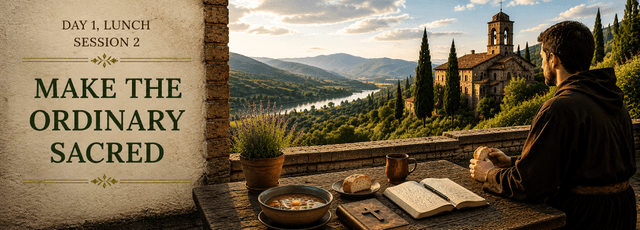
Session 2: Lunch - Make the Ordinary Sacred
Welcome back, my friend. This morning, we began our journey by learning one of the simplest and most important practices of monastic life: remembering that God is present. You began the day with Psalm 63 and the words, “My soul thirsts for You.” You spent time in silence, reflected on Saint Benedict’s teaching about keeping God always before your eyes, and chose one simple way to remember God throughout your day. Now it is midday.
🎧 WATCH OR LISTEN TO THIS SESSION
Before we continue, think back over the last several hours. Did you remember? Maybe you did several times. Maybe you remembered once. Maybe you completely forgot until you started this session. Whatever happened, there is no need to judge yourself. You are here now. And that is one of the beautiful things about monastic prayer. The day continually gives us opportunities to return. Morning prayer begins the day. Midday prayer interrupts the day. Evening prayer gathers the day together. Instead of allowing the entire day to rush past us, we deliberately stop. So whatever you were doing before this session, put it aside for a little while. If possible, have your lunch with you. Put your phone away. Turn off the television. Step away from the news and messages. For the next thirty minutes, we are going to practice something that sounds very simple but can completely change the way you experience ordinary life. We are going to eat. We are going to be silent. And we are going to discover that even something as ordinary as lunch can become prayer.
Offering the Meal to God
Before a monk eats, he remembers that the food before him is a gift. That may seem obvious, but think about how easily we forget it. Most of us eat several times every day. We open the refrigerator. We order something. We grab something quickly. We eat while looking at our phones or watching television. Sometimes we barely even taste what we are eating. Monastic life slows this ordinary experience down. Food becomes an opportunity for gratitude. Hunger reminds us that we are dependent creatures. We cannot sustain ourselves indefinitely. We need food. We need water. We need rest. We need other people. And ultimately, we need God. So before you take your first bite, look at the food in front of you. Think for a moment about everything that had to happen for this meal to reach you. Someone grew it. Someone harvested it. Someone transported it. Someone prepared it. Perhaps you prepared it yourself, but even then, countless people were involved before the ingredients reached your hands. Your meal is not simply food. It is a reminder that your life depends upon gifts you did not create. Let us pray. Heavenly Father, thank You for this food. Thank You for the hands that grew it, prepared it, and brought it to me. Thank You for providing what I need today. As I receive this meal, slow me down. Help me become grateful. Teach me to recognize Your gifts in the ordinary things I often overlook. May this food strengthen me so that I may love You and serve others well throughout the rest of this day. Amen.
Ten Minutes of Silent Eating
We are now going to do something that monks have practiced for centuries. We are going to eat in silence. For the next ten minutes, do not read. Do not scroll through your phone. Do not watch anything. Do not listen to music. Simply eat. At first, you may feel slightly uncomfortable. We have become so accustomed to stimulation that simply eating can feel strangely empty. But this is precisely why we are doing it. Slow down. Notice your food. Taste it. Chew slowly. Pay attention. Allow yourself to receive rather than consume. If your mind begins racing through your afternoon responsibilities, gently return to the meal. If you begin thinking about something that happened this morning, let the thought pass. You do not need to solve anything right now. Every few minutes, quietly remember: God is here. You are not eating alone. You are eating in His presence. Let this simple meal become an act of gratitude. We will now eat together in silence for ten minutes. [SILENCE - 10 MINUTES]
When Ordinary Things Become Prayer
Welcome back. Before we move on, notice how that experience felt. Perhaps you tasted your food more clearly. Perhaps ten minutes seemed incredibly long. Maybe your mind wandered constantly. Maybe you felt peaceful. There is no correct experience. The purpose was simply to become present. Much of monastic spirituality is surprisingly ordinary. People sometimes imagine that monks spend their days having extraordinary spiritual experiences. In reality, monks do many of the same things everyone else does. They wake up. They wash. They eat. They clean. They work. They read. They become tired. They deal with difficult people. They have good days and difficult days. What makes monastic life different is not necessarily what they do. It is the attention with which they try to do it. A monk learns that the ordinary can become sacred when it is received and offered to God. This means your life does not have to become extraordinary before it can become holy. You do not need a different job. You do not need a different house. You do not need to move to a monastery. You do not need to escape your responsibilities. The place where God wants to meet you is often exactly where you already are.
Nothing Is to Be Preferred to the Work of God
Saint Benedict gives his monks a powerful instruction in the Rule: “Let nothing be preferred to the Work of God.” In the monastery, the Work of God refers especially to the regular rhythm of communal prayer. When the bell rings for prayer, the monks stop what they are doing and go to pray. Think about the message behind that practice. A monk might be working on something important. He might be writing. Gardening. Cooking. Repairing something. Talking with someone. But when the bell calls him to prayer, he remembers that his work is not the center of the universe. God is. Most of us do not have monastery bells ringing throughout our homes or workplaces. But perhaps we need our own invisible bells. Moments that call us back. This morning, you chose one way to remember God's presence. Midday prayer itself is another bell. You stopped what you were doing to be here. That interruption matters. The world tells us, “Keep going. Get more done. Answer another email. Make another call. Finish another task.” Monastic wisdom says, “Stop. Remember why you are alive.” There is nothing wrong with productivity. Work is good. Responsibility is good. Achievement can be good. But these things become dangerous when they convince us that we are too busy for God. Saint Benedict reminds us to put first things first. God first. Then everything else begins to find its proper place.
What Is Distracting You?
Now I want you to think about your morning. What pulled your attention away from God? Maybe it was your phone. Maybe work became overwhelming. Perhaps you became irritated with someone. Maybe you were worried about money, your health, your family, or something happening in the world. Perhaps nothing dramatic happened. You simply became busy and forgot. Ask yourself this question: What has occupied most of my mind today? Let the answer come honestly. [SILENCE - 30 SECONDS] Now ask yourself another question: Is this helping me live in God's presence, or is it constantly pulling me away from Him? [SILENCE - 30 SECONDS] We cannot remove every distraction from life. Nor should we. Responsibilities require our attention. People need us. Problems must sometimes be solved. But there are also distractions we voluntarily invite into our lives. We check our phones when we do not need to. We consume endless news. We replay arguments. We compare ourselves with other people. We fill every empty moment with noise. A monk learns that attention is precious. What receives your attention gradually shapes your heart.
Let Go of One Distraction
For the rest of this afternoon, I want you to choose one distraction to release. Just one. Perhaps you will stay off social media until dinner. Maybe you will turn off unnecessary notifications. Perhaps you will stop checking the news. Maybe you will decide not to replay a frustrating conversation in your mind. Perhaps you will drive without the radio for ten minutes. Or maybe you will simply leave your phone in another room while completing an important task. Ask yourself: What can I let go of this afternoon so there is a little more room for God? [SILENCE - 1 MINUTE] Now name it quietly. “This afternoon, I will let go of…” Finish the sentence yourself. [SILENCE - 30 SECONDS] Do not make this complicated. Remember what we learned this morning. Small practices repeated faithfully can reshape a life.
Closing Reflection and Prayer
Before we finish, notice what we have done during these thirty minutes. Nothing spectacular happened. You stopped. You prayed. You ate. You sat in silence. You reflected. And yet this is exactly what we are learning. God does not only meet us in spectacular moments. He meets us in ordinary ones. The monastery simply trains the heart to notice. Your lunch can become prayer. Your work can become prayer. Your drive home can become prayer. Listening carefully to another person can become prayer. Washing a dish can become prayer. The question is not simply, “What am I doing?” The deeper question is, “Am I doing it with God?” Let us pray. Heavenly Father, thank You for this pause in the middle of my day. Thank You for the food I have received and for the countless ordinary gifts I usually overlook. Teach me not to rush through my life. Help me notice You in simple things. Help me remember that my work is important, but it is not more important than You. My phone is useful, but it does not deserve my constant attention. My worries may be real, but they do not deserve control of my heart. Give me the wisdom to know what deserves my attention and the courage to let go of what does not. As I return to my afternoon, help me carry Your presence with me. May the ordinary things I do become offerings of love. Amen.
Remain still for one final minute. You do not need to say anything. Simply remember the words from this morning: God is here. [SILENCE - 1 MINUTE] When you are ready, return to your afternoon. Do the next thing that needs to be done, but try to do it differently. Slowly. Attentively. Gratefully. And with God. We will meet again this evening to look back over the day together.
Sign in to share your thoughts