Share this now - someone’s life could change.


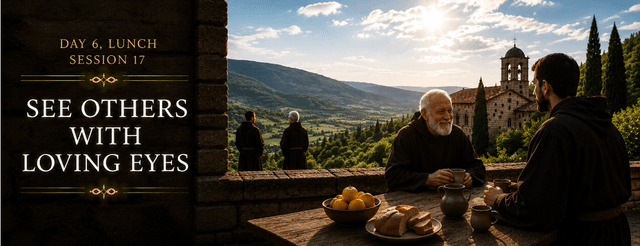
Session 17: Lunch - See Others With Loving Eyes
Welcome back, my friend. This morning, we began Day 6 by looking at community and charity. We reflected on Saint John's words, “Let us love one another, because love is of God.” You were invited to choose one concrete act of love and to pay attention to the people God places in front of you.
🎧 WATCH OR LISTEN TO THIS SESSION - coming soon
Now we have reached the middle of the day, and I want to take that lesson one step deeper. Charity does not begin with our hands. It begins in the heart. Long before we say something unkind, we often think something unkind. Long before we ignore someone, we have stopped seeing them. Long before resentment becomes visible, we have allowed it to grow quietly inside us. The monk learns to pay attention not only to what he does to other people, but also to how he sees them. That will be our practice during this midday session. If possible, have your lunch in front of you. Put your phone aside. Turn off unnecessary noise. Take a slow breath. [PAUSE - 10 SECONDS] And another. [PAUSE - 10 SECONDS] Think briefly about the people you have encountered today. Some may have encouraged you. Some may have irritated you. Some you may barely have noticed. For the next thirty minutes, ask God for one simple gift: loving eyes.
A Prayer for Loving Eyes
Before we eat, let us pray. Heavenly Father, thank You for every person who has crossed my path today. Some are close to me. Others are strangers. Some are easy for me to love, and others test my patience. Help me remember that every person I meet has a life I cannot completely see. They have hopes, fears, wounds, disappointments, responsibilities, and struggles. Forgive me when I judge people too quickly. Forgive me when I reduce someone to their worst moment, their weakness, their appearance, their opinion, or the inconvenience they cause me. Give me the eyes of Christ. Help me see dignity where I might normally see only faults. Help me notice the lonely, the overlooked, the tired, and the hurting. As I receive this food, soften my heart so that I may become more generous toward the people around me. Amen.
Ten Minutes of Silent Eating
We will now eat in silence for ten minutes. Today, while you eat, think about how many people contributed in some way to the meal before you. Someone planted. Someone harvested. Someone transported. Someone stocked a shelf. Someone prepared ingredients. Perhaps someone cooked the meal. Many of those people will never know your name, and you will never know theirs. Yet your life is supported every day by the work of people you do not see. Let this meal become a lesson in community. None of us lives completely alone. We receive from others constantly. As you eat, practice gratitude for these unseen people. Occasionally say quietly in your heart: “Thank You for the people who make my life possible.” If your mind begins judging or replaying a frustrating encounter from this morning, notice it. Do not continue the imaginary argument. Instead, quietly pray: “Lord, bless that person and soften my heart.” Then return to your meal. We will now eat together in silence. [SILENCE - 10 MINUTES]
Charity Begins Before Anyone Sees It
Welcome back. We often measure love by visible actions. Did I help someone? Did I give something? Did I say something kind? Those things matter. But Christian charity begins earlier than that. It begins with how we hold another person in our heart. You can smile at someone while silently despising them. You can perform an act of service while resenting every second of it. You can say polite words while internally judging someone. The monk learns that the interior life matters because our thoughts eventually shape our actions. If we repeatedly rehearse another person's faults, resentment grows. If we constantly imagine their worst motives, compassion disappears. If we reduce someone to a label, we stop seeing the person. This does not mean pretending everyone is good for us or ignoring genuinely harmful behavior. Wisdom sometimes requires distance and boundaries. But even when boundaries are necessary, hatred does not have to rule the heart. We can refuse harmful behavior without refusing another person's human dignity.
Prefer Nothing to Christ
Saint Benedict repeatedly returns to one central principle: prefer nothing whatever to Christ. If Christ truly comes first, then that changes the way we treat other people because Christ repeatedly identifies Himself with those around us, especially those who are vulnerable, forgotten, or in need. Monastic spirituality therefore joins prayer and service together. The monk cannot spend hours praising Christ in the chapel and then treat his brothers with contempt outside it. Neither can we. We cannot say we love God while continually humiliating, using, ignoring, or mistreating the people around us. Sometimes our greatest spiritual test arrives five minutes after prayer ends. Someone says something annoying. Someone makes a mistake. Someone asks for help. Someone interrupts us. Suddenly the beautiful thoughts we had during prayer must become actual charity. That is where spiritual growth becomes real.
Serve One Another
Saint Benedict organizes monastery life so that service is shared. Monks take turns performing necessary duties. No one should think ordinary service is beneath him. There is deep wisdom here. The world often measures importance by how many people serve us. Christianity turns that upside down. Jesus kneels and washes the feet of His disciples. The Lord becomes the servant. Ask yourself: What work do I secretly believe is beneath me? Cleaning? Serving food? Helping someone with something simple? Waiting on another person? Doing a task when no one will notice? Our reaction to humble service can reveal a great deal about us. Sometimes one of the best ways to weaken pride is simply to do something useful for another person without making sure they know we did it.
Who Did You Judge This Morning?
Now look back over your morning. Think about the people you encountered. Ask yourself honestly: “Who did I judge today?” Maybe someone irritated you and you immediately decided what kind of person they were. Perhaps you judged someone's appearance. Their intelligence. Their parenting. Their work. Their beliefs. Their personality. Their mistakes. Maybe you compared yourself with someone and quietly decided you were better. [SILENCE - 1 MINUTE] If someone comes to mind, do not excuse harmful behavior if it occurred. Simply recognize the difference between evaluating an action and condemning an entire person. Quietly pray: “Lord, help me see this person more clearly.”
Choose One Person for Extra Kindness
Now choose one person you are likely to encounter this afternoon. Your original plan for today was to identify someone you could treat with extra kindness. This is the moment to make that concrete. Perhaps it is your spouse. Your child. A coworker. A neighbor. Someone serving you. Someone lonely. Maybe it is the person who irritated you this morning. Ask yourself: “What would kindness actually look like for this person today?” Maybe listening for five uninterrupted minutes. Sending an encouraging message. Saying thank you. Helping with a task. Asking how they are doing and actually listening to the answer. Giving them the benefit of the doubt. Forgiving something small. Smiling. Being patient. Choose one person and one action. [SILENCE - 1 MINUTE] Then quietly say: “Lord, help me love this person well.”
The Person You Find Difficult
Before we finish, bring to mind someone you find difficult. Do not choose someone whose presence would make you unsafe. Simply think of an ordinary difficult relationship. Someone who annoys you. Someone you disagree with. Someone whose personality clashes with yours. Now remember something important: God knows that person completely. God knows the experiences that formed them. The wounds they carry. The fears they hide. The mistakes they regret. The things you know nothing about. This does not mean they are always right. It simply means there is more to their story than what you see. For thirty seconds, do not ask God to change them. Pray only: “Lord, bless them.” [SILENCE - 30 SECONDS] Sometimes those can be very difficult words to pray. That is exactly why they matter.
Closing Prayer
Let us close our midday session in prayer. Heavenly Father, thank You for reminding me that charity begins in the heart. Give me loving eyes this afternoon. Help me notice people instead of looking past them. Guard me from quick judgment. When someone irritates me, give me patience. When someone disagrees with me, help me listen. When someone needs help, make me generous. When someone serves me, make me grateful. When someone is overlooked, help me notice them. When I encounter someone difficult, remind me that You know their entire story even when I know only a small part of it. Teach me to serve without needing recognition. Teach me to forgive without keeping score. Teach me to love without always asking what I will receive in return. Above all, help me prefer nothing to Christ and recognize that loving Christ must change the way I treat the people around me. Amen.
Remain silent for one final minute. Bring to mind the person you chose for extra kindness this afternoon. Do not plan anything complicated. Simply hold them before God and pray: “Lord, let this person experience a little more love today because I crossed their path.” [SILENCE - 1 MINUTE] When you return to your afternoon, watch your heart before you watch your actions. Notice the judgment before it becomes a word. Notice the impatience before it becomes anger. Notice the person others overlook. Then choose charity. Tonight, when we meet again, we will look back over the day and ask: Where did I love today, and where did selfishness get in the way?
Sign in to share your thoughts