Share this now - someone’s life could change.


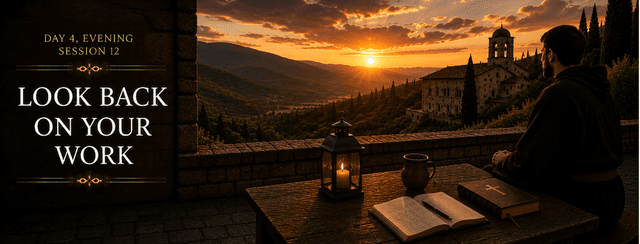
Session 12: Evening - Look Back on Your Work
Welcome back, my friend. You have reached the evening of Day 4. Today, we have been looking at something that occupies a large part of our lives: work. This morning, we reflected on Saint Paul's words: “Whatever you do, do from the heart, as for the Lord.” You chose one task to offer to God. At midday, we practiced working with attention and reflected on the simple idea: Be where your hands are.
🎧 WATCH OR LISTEN TO THIS SESSION
Now the workday is coming to an end. Some things were accomplished. Some things were not. Perhaps you had a productive day. Perhaps the day was filled with interruptions. Maybe you finished the task you offered to God this morning. Maybe you never got to it. Perhaps your work gave you satisfaction. Perhaps it exhausted you. Whatever happened, tonight we practice something just as important as working faithfully: letting the work go. A monk knows when it is time to work, but he also learns when it is time to put down his tools. This can be difficult for us. Even after we stop physically working, our minds often continue. We replay conversations. We think about tomorrow. We worry about unfinished tasks. We check one more email. We make one more list. Tonight, we are going to practice ending the workday. Find a quiet place. Put your phone aside. If possible, lower the lights. Sit comfortably. Take a slow breath. [PAUSE - 10 SECONDS] And another. [PAUSE - 10 SECONDS] Imagine placing all of today's unfinished work outside the door for the next thirty minutes. It will still be there tomorrow if it truly needs your attention. Right now, the work is finished.
Creation and Rest
Our Scripture tonight comes from Genesis 2. After the work of creation, Scripture tells us that God rested. Think about how remarkable that is. God does not rest because He is exhausted. The image teaches us something about the rhythm built into creation itself. There is a time to work and a time to stop. A time to create and a time to receive. A time to act and a time to rest. Human beings often resist this rhythm. We can begin believing that constant activity is a sign of importance. Being busy can even become part of our identity. We say, “I'm so busy,” almost as if busyness proves that our lives matter. But creation itself teaches another lesson. Rest is not simply what happens when we have nothing left to do. If that were the rule, we would never rest because there is always something else that could be done. Rest must sometimes be chosen while work remains unfinished. Tonight, you are going to practice that choice.
Vespers and Giving Thanks for the Day's Labor
In the monastery, evening prayer interrupts work. The monk may be in the middle of something, but when the bell rings, he stops. Imagine that bell ringing now. The workday is ending. Look back at everything you did today. Some tasks may seem important. Others may seem almost meaningless. But each required a portion of your life. Your time is your life measured in hours and minutes. So tonight, rather than thinking only about what remains undone, give thanks for what was done. Perhaps you worked at a job. Perhaps you cared for someone. Maybe you cleaned your home, prepared food, studied, solved a problem, made decisions, exercised, ran errands, or simply handled the ordinary responsibilities of life. Quietly say: “Thank You, Lord, for the work I was able to do today.” [SILENCE - 30 SECONDS] Now think about the people whose work helped you today. Someone produced your food. Someone maintained the roads. Someone provided electricity. Someone answered your call. Someone cleaned a space. Someone delivered something. Someone performed countless tasks you never noticed. Say quietly: “Thank You for the work of others.” [SILENCE - 30 SECONDS]
Preparing for Lectio Divina
We will now enter Lectio Divina. If you have the Gospel reading for today, use it. If not, you can remain with the words from Genesis: “God rested from all the work that he had done.” Tonight, listen especially for what God may be saying to you about work, rest, trust, and your need to control. We will move through the four movements we have been practicing: read, meditate, pray, and rest.
Lectio Divina
Begin with Lectio: Read. Slowly read the Gospel passage. Read it once. Pause. Read it again. Notice a word, phrase, or image that stays with you. Do not rush to interpret it. Simply notice. [SILENCE - 2 MINUTES] Now enter Meditatio: Meditate. Return to the word or phrase that caught your attention. What might it be saying about the way you lived today? Perhaps it speaks about trust. Service. Patience. Rest. Responsibility. Let the words remain with you. [SILENCE - 2 MINUTES] Now enter Oratio: Pray. Respond honestly to God. Talk to Him about your work today. Tell Him what went well. Tell Him what frustrated you. Tell Him what you are worried about tomorrow. If there is something unfinished that is weighing on you, name it. [SILENCE - 2 MINUTES] Finally, enter Contemplatio: Rest. For these next two minutes, do nothing. You have spent much of today doing. Now simply be. You do not need to produce anything for God. You do not need to impress Him. Rest in His presence. [SILENCE - 2 MINUTES]
Stability and Perseverance
One of the distinctive commitments of Benedictine monastic life is stability. A monk commits himself to a particular community and place rather than continually running somewhere else whenever life becomes difficult or boring. There is a lesson here for our work. Much of life is repetition. We wake up and perform many of the same responsibilities again and again. Dishes become dirty again. Rooms need cleaning again. Emails keep arriving. Bills return. People need care again tomorrow. Work that once felt exciting can become ordinary. This is where perseverance becomes important. We sometimes imagine meaningful work should always feel inspiring. But much of a faithful life consists of doing ordinary things well, repeatedly, even when we do not feel inspired. The monk learns that holiness is not found only in extraordinary moments. It is often formed through ordinary faithfulness.
How Did Your Work Affect Your Heart?
Now look back over your day. Ask yourself: How did my work affect my heart today? Did it make you impatient? Did it make you anxious? Did you become so focused on tasks that you ignored people? Did success make you proud? Did difficulty make you angry? Did you complain constantly? Or did your work give you opportunities to serve? Did you practice patience? Did you solve something that helped another person? Did you experience satisfaction from doing something well? Did you remember to offer a task to God? Did you experience even one moment when ordinary work felt prayerful? Let the day pass through your mind. [SILENCE - 1 MINUTE] Then ask: “Lord, what was my work teaching me today?” [SILENCE - 30 SECONDS]
Release What Remains Unfinished
Now think about everything you did not finish. Perhaps there are emails waiting. Tasks incomplete. Problems unresolved. Decisions still needing to be made. Tomorrow may already feel crowded. Picture those unfinished things in your mind. One by one, place them into God's hands. Say quietly: “This can wait until tomorrow.” [SILENCE - 30 SECONDS] Perhaps there is one problem you cannot stop thinking about. Name it. Then say: “Lord, I have done what I can today. I give this to You tonight.” [SILENCE - 1 MINUTE] This is an act of humility. The world continues when you stop working. God does not need you to hold everything together every hour of every day.
Work Is Never More Important Than People
Before we finish, consider one final question: Did work cause me to overlook someone today? Sometimes we become so focused on accomplishing tasks that people begin to feel like interruptions. A child wants attention while we are answering an email. A spouse wants to talk while we are finishing something. A coworker needs help when we are busy. A stranger slows us down. The monk learns that work exists to serve life, not the other way around. There are times when a task genuinely must be completed. But there are also times when love asks us to put the task down. Think about your day. Was there someone you could have listened to more carefully? Someone you rushed? Someone you treated like an inconvenience? [SILENCE - 30 SECONDS] If a person comes to mind, simply make a quiet commitment: “Tomorrow, I will try to be more present.”
Closing Prayer and Rest
Let us close Day 4 in prayer. Heavenly Father, thank You for the work of this day. Thank You for the strength to accomplish what I could. Thank You for the abilities You have given me and for every person whose work made my own possible. Forgive me for the times I worked carelessly, impatiently, selfishly, or only for recognition. Forgive me if I allowed my tasks to become more important than the people around me. Thank You for every moment when my work became service and every moment when I remembered to offer it to You. Tonight, I give You everything unfinished. The emails can wait. The problems can wait. The decisions can wait. Tomorrow's work belongs to tomorrow. Help me trust that I do not have to hold everything together. Teach me the rhythm of faithful work and peaceful rest. Give me perseverance when work becomes repetitive, humility when I succeed, courage when I fail, and wisdom to know when it is time to stop. May the work of my life serve You and serve others, but never become the source of my identity. My deepest identity is found in You. Amen.
We will now end with three minutes of silence. During these minutes, do not plan tomorrow. Do not review your task list. Do not solve today's problems. Let the tools remain on the ground. Let the workday end. [SILENCE - 3 MINUTES] When the silence ends, carry this truth with you into the rest of your evening: You have done enough for today. Tomorrow, if God gives you another day, you can pick up the work again. But tonight, rest. Day 4 is complete. Tomorrow we begin Day 5, and our journey moves toward one of the deepest mysteries of Christian life: the Cross. We will look at suffering, difficulty, sacrifice, and the surprising ways that the things we would never choose can sometimes become the very things through which God changes us. For tonight, put down your work. Give thanks. Let go. And rest.
Sign in to share your thoughts