Share this now - someone’s life could change.


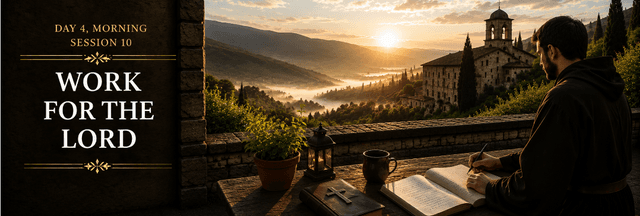
Session 10: Morning - Work for the Lord
Good morning, my friend, and welcome to Day 4. During our first three days together, we have practiced living in God's presence, listening with the ear of the heart, and walking in humility. Today, we turn to something that occupies an enormous part of our lives: work.
🎧 WATCH OR LISTEN TO THIS SESSION
When we hear the word work, we usually think about our job. But today, work means much more than that. Work is answering an email. Preparing a meal. Taking care of a child. Cleaning the house. Running a business. Studying. Fixing something. Paying bills. Caring for an aging parent. Driving someone to an appointment. Washing dishes. Making a difficult phone call. Even if you are retired, your days are still filled with tasks and responsibilities. Monastic life teaches us that these ordinary tasks do not have to compete with our spiritual life. They can become part of it. A monk does not pray only when he is in the chapel. He learns to bring prayer into the kitchen, the garden, the workshop, the library, and every other place he works. Today, we are going to practice doing the same thing. Find a quiet place. Put your phone aside. Sit comfortably. Take a slow breath. [PAUSE - 10 SECONDS] And another. [PAUSE - 10 SECONDS] Think about the work waiting for you today. Instead of seeing it simply as a list of things you have to get through, consider another possibility: What if your work today could become an offering to God?
Whatever You Do
Our Scripture this morning comes from Colossians 3:23: “Whatever you do, do from the heart, as for the Lord and not for others.” Listen again: Whatever you do. Saint Paul does not say only the impressive things. He does not say only religious work. He says whatever you do. That means some of the most ordinary parts of your day can have spiritual meaning. Imagine approaching your work today with one simple thought: “I am doing this for the Lord.” The task itself may not change. The email is still an email. The dishes are still dishes. The meeting is still a meeting. The paperwork is still paperwork. But you change. Your intention changes. Instead of working only for a paycheck, recognition, advancement, approval, or personal satisfaction, your work becomes something you can offer. This does not mean you have to feel inspired by every task. Monks do not love every chore either. Sometimes prayerful work simply means doing what needs to be done faithfully and with care.
Five Minutes of Silence
Before we talk more about work, we are going to stop working completely. For the next five minutes, you do not need to accomplish anything. This is important because many of us have unconsciously connected our worth to productivity. We feel valuable when we are accomplishing something. We feel guilty when we stop. Monastic life has a rhythm of both work and prayer. The monk works, but he also stops. His identity does not come from how much he produces. Neither does yours. During these five minutes, let go of your task list. There will be time for it later. Do not plan. Do not organize. Do not mentally answer emails. Simply sit before God. If thoughts about work appear, notice them and let them pass. Quietly say: “My worth comes from You, not from what I accomplish.” Then become silent. [SILENCE - 5 MINUTES]
Work Is Not Your Identity
Slowly return your attention to where you are. There is an important distinction we need to make before continuing. Your work matters, but your work is not who you are. Our culture often confuses these things. When people meet, one of the first questions they ask is, “What do you do?” We answer with a profession, title, business, or role. Over time, we can begin to believe that our value comes from that answer. But eventually jobs change. Careers end. Businesses succeed or fail. People retire. Positions disappear. Someone younger eventually takes our place. If your identity is built entirely on what you accomplish, these changes can be devastating. The monk reminds us that before you are a worker, executive, parent, teacher, entrepreneur, student, caregiver, or retiree, you are a child of God. Work flows from who you are. It does not create your deepest identity.
Saint Benedict on Work
Saint Benedict gives work an important place in monastic life. Chapter 48 of the Rule begins with a strong statement: “Idleness is the enemy of the soul.” Benedict understood that human beings need meaningful activity. Monks were expected to pray, read, and also perform manual labor. They worked in fields, kitchens, workshops, libraries, and wherever the community needed them. This created a balanced rhythm often described by the phrase ora et labora: prayer and work. The monk does not divide life into two completely separate categories: sacred things and ordinary things. Prayer is sacred, but work can also be offered to God. This is especially powerful when the work is not exciting. Almost anyone can feel motivated when doing something interesting, important, or rewarding. The deeper discipline appears when the task is repetitive, unnoticed, or inconvenient. Cleaning a floor carefully when no one will praise you. Completing paperwork honestly when you would rather rush. Treating a difficult customer patiently. Preparing a meal with love. Returning a shopping cart. Finishing a task you promised to complete. These small acts form character.
Work With Attention
There is another lesson we can learn from monastic work: do one thing at a time. Modern life encourages constant multitasking. We answer messages during meetings. We check our phones while eating. We listen to something while working on something else while thinking about something else entirely. Our bodies are in one place while our minds are somewhere else. The monk tries to bring attention to the task before him. If he is sweeping, he sweeps. If he is cooking, he cooks. If he is reading, he reads. If he is praying, he prays. You may not be able to eliminate multitasking completely, but today try to experience the difference between rushing through a task and giving it your full attention. Attention can transform work into prayer because attention says: This moment matters.
Journaling: Offer Your Work
Take out your journal or notebook. At the top of the page write: DAY 4 - WORK AS PRAYER. Underneath it write this question: What work will I offer to God today? Think about the tasks waiting for you. Perhaps there is one you are looking forward to. More importantly, perhaps there is one you are avoiding. Maybe it is an uncomfortable phone call. Paperwork. Cleaning something. A difficult meeting. Caring for someone. Studying. Exercising. Finishing a project. Choose one specific task. Then write this sentence: “Today, I offer __________ to God.” Fill in the blank. When you begin that task later today, pause for five seconds before starting. Quietly say: “Lord, I offer this work to You.” Then do it as carefully and faithfully as you can. Take a few minutes now to write. [JOURNALING SILENCE - 3 MINUTES]
The Work No One Sees
There is one more challenge for today. Pay special attention to the work no one notices. Much of the most important work in life receives very little recognition. Parents do thousands of things their children never see. People quietly care for aging family members. Someone cleans a room before others arrive. Someone prepares food. Someone fixes a problem before anyone knows it existed. Someone prays for another person without telling them. Someone stays late to finish what needs to be done. The world often celebrates visible accomplishments. Monastic life teaches us the value of hidden faithfulness. God sees the work no one applauds. So if you do something today that no one notices, resist the temptation to become resentful. Quietly say: “This one is for You.”
When Work Becomes Too Important
There is also a warning here. Work can become prayer, but work can also become an idol. Some people use work to avoid silence, relationships, difficult emotions, or God Himself. We tell ourselves we are responsible when in reality we may simply be unable to stop. Saint Benedict's rhythm includes work, but the bell eventually rings. And when it rings, the monk puts down his tools. Ask yourself: Can I stop working when it is time to stop? If the answer is no, that may be something worth noticing this week. Good work serves life. It should not consume it.
Closing Prayer
Let us finish our morning in prayer. Heavenly Father, thank You for the ability to work, create, serve, build, repair, teach, care, organize, and contribute. Thank You for the work that gives me satisfaction and even for the work that sometimes tests my patience. Help me remember today that my worth does not come from what I accomplish. My worth comes from You. Teach me to work faithfully without allowing work to become my master. When I begin a task, help me offer it to You. When the task is boring, give me perseverance. When it is difficult, give me patience. When I succeed, protect me from pride. When I fail, protect me from discouragement. When no one notices what I have done, remind me that You see what is done in love. Help me treat the people I encounter through my work with dignity and kindness. And when it is time to stop working, give me the humility to put down my tools and rest. May everything I do today, whether important or ordinary, become an offering of love. Amen.
Remain silent for one final minute. Think about the task you chose to offer today. See yourself beginning it. Then quietly say: “Lord, this is for You.” [SILENCE - 1 MINUTE] When you are ready, begin your day. Do your work. Do it carefully. Do it honestly. Do it with attention. And whenever you remember, offer it again. “Whatever you do, do from the heart, as for the Lord.” We will meet again at midday, when we will explore how work can steady the heart and how even the simplest tasks can become acts of service.
Sign in to share your thoughts