Share this now - someone’s life could change.


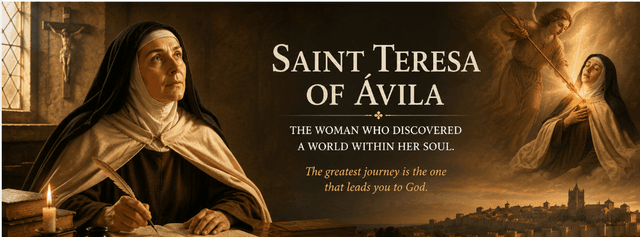
Saint Teresa of Ávila: The Woman Who Discovered a World Within Her Soul
Saint Teresa of Ávila lived nearly 500 years ago, yet her story speaks directly to a problem millions of people face today. We spend enormous amounts of time looking outward. We worry about what people think of us, what we own, what we accomplish, what appears on our screens, and what is happening around us. Teresa discovered another world entirely: the world within the human soul. Her extraordinary experiences of prayer, visions, spiritual struggles, reform, opposition, and mystical encounters with God eventually made her one of the greatest spiritual teachers in Catholic history.
A Girl Fascinated by Heaven
Teresa was born in 1515 in Ávila, Spain, into a large and relatively prosperous family. From childhood, she was fascinated by stories of the saints and martyrs. Teresa and her brother Rodrigo became so captivated by these stories that, while still children, they reportedly tried to leave home hoping to travel to lands where they could become martyrs. Their uncle found them and brought them home. Even as a little girl, Teresa was already thinking about eternity.
Then Teresa Discovered the World
As she grew older, Teresa became interested in things that had little to do with martyrdom. She enjoyed fashionable clothing, friendships, attention, conversation, and popular stories of romance and adventure. She later wrote honestly about her concern with appearance and what other people thought of her. Teresa wasn't born detached from the world. Like most of us, she had to learn what deserved her attention.
Entering the Convent
When Teresa was about 20, she entered the Carmelite Monastery of the Incarnation in Ávila. Her father initially opposed her decision, but Teresa believed religious life was where she belonged. Yet entering a convent didn't instantly make her a saint. She continued struggling with distraction, attachments, friendships, prayer, and the desire to be liked.
Becoming Religious Didn't End the Struggle
This is one reason Teresa's story is so relatable. She spent years as a nun while still struggling to give herself completely to God. Her prayer life could be inconsistent. She sometimes abandoned serious mental prayer for extended periods. She wanted God, but she also wanted comfort and approval. Teresa later looked back on these years with remarkable honesty.
A Serious Illness Nearly Killed Her
Not long after entering religious life, Teresa became extremely ill. Her condition became so severe that she was thought to be near death. At one point she fell into a coma-like state for several days, and preparations were reportedly made for her burial. She survived, but her recovery was long and painful, and for a period she was severely physically impaired.
Suffering Changed Her
Teresa's illnesses remained part of her life, but they also deepened her spiritual understanding. She knew what it meant to feel physically weak and emotionally exhausted. She discovered that closeness to God didn't mean escaping suffering. Sometimes it meant learning how to remain faithful within it.
The Image That Broke Through Her Defenses
One of the great turning points in Teresa's spiritual life occurred when she encountered an image of Christ after His scourging. Looking at the wounded Jesus affected her deeply. Teresa later described being overwhelmed by the realization of what Christ had suffered. She fell before the image and begged Him to strengthen her so she would no longer turn back.
Prayer Became Something Different
Teresa began taking prayer much more seriously. For her, prayer wasn't simply reciting words. It became a relationship. She famously described mental prayer as an intimate friendship, spending time frequently alone with the One whom we know loves us. That simple understanding would become one of her greatest gifts to the Church.
Then the Extraordinary Experiences Began
As Teresa's prayer deepened, she began reporting unusual mystical experiences. She described visions, interior voices, overwhelming experiences of God's presence, and states of prayer in which she sometimes seemed unable to control her body. At times she described feeling physically lifted during intense mystical prayer. These experiences frightened her as much as they amazed her.
Was It Really From God?
Teresa didn't automatically assume every spiritual experience came from God. She worried that she might be deceived. She consulted confessors and spiritual advisers, some of whom were skeptical. At times, their uncertainty caused her considerable distress. Teresa learned that extraordinary experiences needed to be approached with humility and discernment rather than excitement alone.
The Angel and the Flaming Spear
Perhaps Teresa's most famous mystical experience became known as the transverberation of the heart. Teresa described seeing an angel holding a long golden spear tipped with fire. She said the angel seemed to pierce her heart, leaving her overwhelmed by an intense combination of spiritual pain and love for God. Centuries later, sculptor Gian Lorenzo Bernini immortalized the experience in his famous masterpiece The Ecstasy of Saint Teresa.
She Didn't Want People Chasing Visions
Despite her extraordinary experiences, Teresa repeatedly emphasized that visions weren't the goal of prayer. The real test of spiritual growth was whether a person became more humble, loving, obedient, courageous, and willing to serve. A spectacular spiritual experience meant very little if it didn't change how someone lived.
Teresa Decided Something Had to Change
Teresa also became increasingly concerned that Carmelite religious life had become too comfortable and distracted from its original ideals. She believed the order needed greater simplicity, poverty, silence, prayer, and discipline. In 1562, she founded the convent of St. Joseph in Ávila, beginning what became the Discalced Carmelite reform.
Not Everyone Was Happy About It
Reform rarely makes everyone comfortable. Teresa faced criticism, suspicion, opposition, and resistance from both inside and outside religious life. Some believed her reforms were too strict. Others questioned whether a woman should exercise so much influence. Teresa continued anyway.
She Was a Mystic Who Knew How to Get Things Done
Teresa wasn't simply someone who sat quietly having visions. She traveled extensively under difficult conditions, negotiated property matters, dealt with officials, wrote letters, raised money, established convents, managed conflicts, and navigated Church politics. She combined an extraordinary interior spiritual life with remarkable practical ability.
Her Partnership With Saint John of the Cross
Teresa eventually met the younger Carmelite priest Saint John of the Cross, who shared her desire for reform. Together, their work helped establish the Discalced Carmelite movement for both women and men. John would himself become one of Christianity's greatest mystical writers and another Doctor of the Church.
The Interior Castle
One of Teresa's greatest works is The Interior Castle. She asks readers to imagine the soul as a magnificent crystal castle containing many rooms or dwelling places. At the center of that castle is God. The spiritual life is a journey inward, moving through those rooms toward deeper union with Him.
The Door Into the Castle
For Teresa, the doorway into this interior world was prayer. Many people spend their entire lives focused on what is outside themselves and rarely enter deeply into their own souls. Teresa believed that through prayer we begin discovering who we truly are, what prevents us from loving God, and how deeply God desires a relationship with us.
A Woman Declared a Doctor of the Church
Teresa died in 1582. She was canonized in 1622. Then, in 1970, Pope Paul VI declared her a Doctor of the Church, making her one of the first women to receive that distinction. The title recognizes saints whose teachings have made an exceptional contribution to Christian theology and spirituality.
Why Saint Teresa Matters Today
Teresa's message may be more necessary now than ever. We carry devices capable of filling almost every silent moment. The moment we're bored, we reach for something. The moment we're uncomfortable, we distract ourselves. The moment we're alone, we look for noise. Teresa challenges us to stop running from silence and discover what might be waiting there.
You Can Be Surrounded by People and Still Be Far From Yourself
Modern life gives us unprecedented access to everyone else's lives. We can know what strangers ate for breakfast, where celebrities vacationed, what our friends are doing, and what millions of people think about today's controversy. Yet we can remain complete strangers to our own souls. Teresa reminds us that one of life's most important journeys doesn't require a plane ticket. It requires going inward.
Prayer Doesn't Have to Be Complicated
You don't need Teresa's mystical experiences to pray like Teresa. Start by talking honestly to God. Sit quietly. Tell Him what you're afraid of. Tell Him what you're grateful for. Admit where you're struggling. Ask for help. Then stop talking for a moment and simply remain with Him. Teresa's approach to prayer begins less like giving a speech and more like spending time with someone who loves you.
What Saint Teresa Can Teach Us
Create some silence in your life. Stop filling every empty moment with your phone. Pay attention to what is happening inside you. Be honest with God instead of trying to sound religious. Don't confuse emotional experiences with spiritual maturity. Measure your faith by whether you're becoming more loving, humble, patient, courageous, and generous. And don't be afraid to change something simply because other people prefer things the way they are.
Saint Teresa spent years searching, struggling, praying, suffering, questioning, and gradually moving deeper into friendship with God. Eventually, she discovered that the greatest journey of her life wasn't across Spain establishing convents. It was the journey into her own soul. Her message still challenges us nearly five centuries later: You can spend your entire life exploring the world around you and never discover the extraordinary world God placed within you. Sometimes the place we're desperately searching for isn't somewhere else. Sometimes the journey begins by becoming quiet enough to enter within.
Sign in to share your thoughts