Share this now - someone’s life could change.


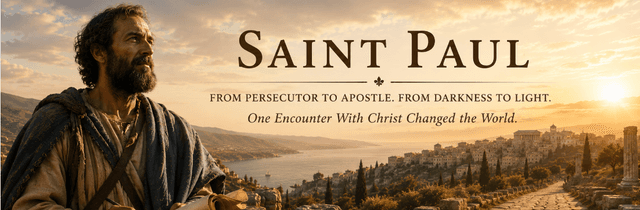
Saint Paul: The Man Who Tried to Destroy Christianity and Then Gave His Life for It
Imagine someone known for hunting down Christians suddenly becoming one of the greatest Christian missionaries in history. That is the extraordinary story of Saint Paul. Before he traveled thousands of miles preaching Jesus, wrote letters that would become part of the Bible, and ultimately gave his life for Christ, Paul was known as Saul, a passionate opponent of the early Christian movement. His story is one of the most dramatic transformations in Christianity and a powerful reminder that no person's past has to determine their future.
Before Paul There Was Saul
Saul was born in Tarsus, an important city in the Roman world. He was Jewish, a Roman citizen, highly educated, and deeply committed to his religious beliefs. He studied Jewish law and identified himself as a Pharisee. When the new movement centered on Jesus began spreading, Saul didn't simply disagree with it. He believed it was dangerous and needed to be stopped.
The Persecutor of Christians
The Bible first introduces Saul during the killing of St. Stephen, Christianity's first martyr. Stephen was stoned to death after proclaiming his faith in Jesus, and Saul approved of his execution. Saul then began actively persecuting Christians. He entered homes, dragged believers away, and helped imprison them. To the earliest Christians, Saul wasn't a future apostle. He was someone to fear.
The Road That Changed Everything
Saul eventually received authorization to travel to Damascus and arrest followers of Jesus there. But on the road, everything changed. According to the Acts of the Apostles, a brilliant light suddenly surrounded him and Saul fell to the ground. Then he heard a voice asking: "Saul, Saul, why are you persecuting me?" Saul asked who was speaking. The answer changed his life: "I am Jesus, whom you are persecuting."
The Powerful Man Becomes Helpless
When Saul stood up, he couldn't see. The man who had confidently traveled toward Damascus to arrest Christians suddenly had to be led into the city by the hand. For three days he remained blind and neither ate nor drank. Think about the reversal. Saul believed he could clearly see the truth, but now he was physically blind. Everything he thought he understood about Jesus had been shattered in a matter of moments.
The Man Asked to Help His Enemy
In Damascus lived a Christian named Ananias. According to Acts, the Lord told Ananias in a vision to go to Saul. Understandably, Ananias was afraid. He had heard what Saul had done to Christians. Yet Ananias obeyed. He entered the house, placed his hands on the man who had come to persecute people like him, and called him "Brother Saul." Saul's sight was restored, he was baptized, and one of Christianity's greatest enemies began becoming one of its greatest apostles.
From Persecutor to Preacher
Almost immediately, Saul began proclaiming the very message he had traveled to Damascus to destroy: Jesus is the Son of God. People were stunned. They knew who he was. They knew why he had come. Now the persecutor was standing alongside the people he had persecuted. His transformation was so dramatic that many people initially didn't trust him. Paul would spend the rest of his life demonstrating that his conversion was real.
His New Life Wasn't Easy
Following Jesus didn't suddenly make Paul's problems disappear. In many ways, his suffering intensified. Paul described being beaten, imprisoned, whipped, stoned, threatened, hungry, exhausted, and repeatedly placed in danger. He experienced rejection from some people who remembered his past and hostility from others who opposed his preaching. Yet the man who had once tried to silence Christians refused to stop talking about Christ.
The Man Who Survived Being Stoned
During one missionary journey, Paul was attacked in the city of Lystra. A hostile crowd stoned him and dragged him outside the city, believing he was dead. But Paul survived. Instead of deciding that missionary work had become too dangerous, he got up and continued his mission. It is difficult to imagine a more dramatic demonstration of how completely his priorities had changed.
Shipwrecked but Still Going
Paul's journeys eventually brought him toward Rome, but even that journey became a struggle for survival. Acts describes a violent storm at sea that lasted for days. The ship carrying Paul and hundreds of others eventually wrecked near Malta. Everyone aboard survived. After reaching shore, Paul was gathering wood when a venomous snake fastened onto his hand. Those watching expected him to die, but Paul shook the snake into the fire and suffered no apparent harm.
Thousands of Miles for One Mission
Paul traveled throughout large portions of the Roman world spreading Christianity. He preached in cities including Antioch, Philippi, Thessalonica, Corinth, Athens, and Ephesus. He spoke to Jews, Greeks, intellectuals, workers, government officials, prisoners, wealthy people, and the poor. Christianity was no longer confined to a small group in Judea. Paul became one of the central figures carrying the message of Jesus into the wider world.
The Prisoner Who Wouldn't Stop Preaching
Paul was repeatedly imprisoned because of his missionary activity. But even prison couldn't stop his mission. Some of the letters traditionally associated with his imprisonment became part of the New Testament. Paul could be chained physically, but his message continued traveling. Nearly two thousand years later, billions of people have encountered words written in letters bearing his name.
The Letters That Changed Christianity
Romans, Corinthians, Galatians, Philippians, Thessalonians, and other New Testament letters are associated with Paul. Through them, Christians encounter teachings about grace, faith, love, suffering, salvation, the Church, spiritual gifts, resurrection, and life in Christ. One of the Bible's most famous descriptions of love comes from Paul's First Letter to the Corinthians: love is patient, kind, not jealous or boastful, and enduring. The former persecutor became one of history's most influential writers about Christian love.
The Thorn Paul Couldn't Escape
Despite the extraordinary events surrounding his ministry, Paul also spoke openly about weakness. He described a mysterious "thorn in the flesh" that he begged God to remove. We don't know exactly what it was. God's answer, according to Paul, wasn't simply to remove the problem but to teach him that divine grace was sufficient and that power could be made perfect in weakness. Paul learned that faith didn't require him to become invulnerable. Sometimes weakness itself could teach him dependence on God.
Paul's Final Journey
Christian tradition holds that Paul eventually reached Rome and was martyred during the persecution of Christians under Emperor Nero, probably sometime in the 60s AD. Because he was a Roman citizen, tradition says he was executed by beheading rather than crucifixion. The man who once participated in the persecution of Christians ultimately became one of the Christians willing to die rather than deny Jesus.
Why Saint Paul Matters Today
Paul's story speaks powerfully to anyone carrying regret. Many people secretly believe their past has disqualified them from becoming the person God wants them to be. Maybe they've hurt someone. Destroyed a relationship. Wasted years. Made terrible decisions. Walked away from faith. Paul forces us to reconsider that conclusion. If one of Christianity's greatest persecutors could become one of its greatest apostles, then transformation is possible for anyone.
Your Worst Chapter Doesn't Have to Be Your Last
Paul couldn't erase what he had done. He couldn't bring Stephen back or pretend Christians hadn't suffered because of him. What he could do was decide what happened next. Instead of allowing guilt to paralyze him, Paul allowed grace to transform him. He spent the rest of his life building the faith he had once tried to destroy.
What Saint Paul Can Teach Us
Stop believing you must have a perfect past to have a meaningful future. Admit when you're wrong. Be willing to change direction even if people don't understand you. Don't allow embarrassment to keep you trapped in an old version of yourself. Keep going when following God becomes difficult. Use your abilities for something greater than yourself. And when you fall, get back up.
Saul left for Damascus intending to arrest Christians. He arrived blind and completely changed. Eventually, the persecutor became Paul the Apostle, and his words helped carry Christianity across the world. His life leaves us with one of the most hopeful messages in the entire story of the saints: God doesn't only use people with perfect histories. He transforms people who are willing to give Him their future. Your past may explain where you've been, but it doesn't have to decide where you're going.
Sign in to share your thoughts