Share this now - someone’s life could change.


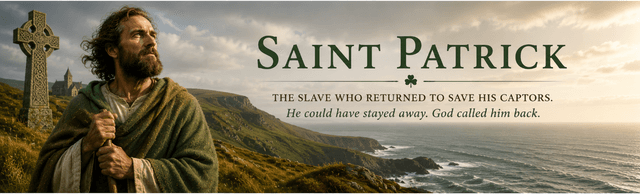
Saint Patrick: The Slave Who Returned to Save His Captors
Every March 17, millions of people wear green, celebrate Irish culture, and recognize the name Saint Patrick. But the real story of Patrick is far more powerful than shamrocks and parades. He wasn't originally Irish. As a teenager, he was kidnapped from his home, carried across the sea, sold into slavery, and forced to spend years tending animals in isolation. He eventually escaped and returned to his family. Then he did something almost unimaginable: he voluntarily returned to the land where he had been enslaved because he believed God was calling him to bring Christianity to its people.
The Teenager Who Lost Everything
Patrick was born in Roman Britain around the end of the fourth century. He grew up in a Christian family, but by his own later account, faith didn't mean very much to him when he was young. Then, at about 16 years old, his life was shattered. Irish raiders attacked his homeland, captured Patrick along with many others, and transported them across the sea to Ireland.
A Slave in a Foreign Land
Patrick was sold into slavery and forced to work as a shepherd. Imagine being 16, separated from your parents, living among strangers, unable to go home, and not knowing whether you would ever see your family again. Much of Patrick's time was spent outdoors in the cold and rain watching animals. He was isolated, powerless, and alone.
The Place Where Patrick Found God
Something unexpected happened during those lonely years. The teenager who had paid little attention to God began praying constantly. Patrick later wrote that his faith grew stronger during captivity and that he prayed many times throughout the day and even during the night. The place that could have destroyed him spiritually became the place where his relationship with God came alive.
Six Years in Captivity
Patrick remained enslaved for about six years. Then, according to his own account, he experienced a message in a dream telling him that his escape was near and that a ship was waiting for him. Patrick took an enormous risk. He fled from his master and traveled a great distance across Ireland toward the coast.
The Escape
After traveling roughly 200 miles, Patrick reached a ship. At first, the captain refused to take him aboard, but Patrick was eventually allowed to join the voyage. After years of slavery, he finally left Ireland. His journey home was difficult, but eventually Patrick was reunited with his family. For most people, that would have been the end of the story. Escape the nightmare. Go home. Never return.
Then Came the Dream
Patrick's life took another extraordinary turn. After returning home and deepening his Christian faith, he described experiencing a vision in which he received what he called the "Voice of the Irish." In the vision, he imagined the people of Ireland calling to him and begging him to return and walk among them again. The country he probably wanted to forget had become the country he believed God was asking him to serve.
Would You Go Back?
Think about what Patrick was being asked to do. Return to the place where you were kidnapped. Return to the people among whom you were enslaved. Return to the island where six years of your youth were stolen from you. Most of us would understand if Patrick had said no. Instead, after preparation for ministry, he returned as a Christian missionary.
The Slave Returned as a Missionary
Patrick came back to Ireland not seeking revenge but hoping to bring people to Christ. He traveled through communities, preached, baptized converts, helped establish Christian communities, and trained religious leaders. His mission wasn't without danger. Patrick wrote of facing opposition, threats, imprisonment, and the possibility of death. Yet he continued.
Did Patrick Drive the Snakes Out of Ireland?
One of the most famous legends says Patrick drove all the snakes from Ireland. The story is beloved, but scientists believe Ireland probably had no native snake population during Patrick's lifetime. The snakes are often understood symbolically as representing paganism or evil. The historical Patrick's accomplishment was arguably more remarkable than the legend: he helped Christianity take deep root in Ireland.
What About the Shamrock?
Another famous tradition says Patrick used a three-leaf shamrock to explain the Trinity: one God in three Persons, Father, Son, and Holy Spirit. Historians cannot confirm that Patrick actually used the shamrock this way, but the story became deeply connected with his legacy and helped turn the shamrock into one of Ireland's most recognizable symbols.
Patrick Wasn't Afraid to Challenge Power
Patrick didn't simply preach comfortable messages. In one surviving letter, he fiercely condemned a British warlord named Coroticus after his soldiers killed and kidnapped newly baptized Christians. Patrick demanded that the captives be released. The former slave had become a defender of other people being carried into slavery.
The Man Who Refused to Hate
Perhaps the most extraordinary part of Patrick's story isn't any miracle or legend. It's that he returned. Patrick could have spent the rest of his life hating Ireland for what happened to him. Instead, the place associated with his deepest suffering became the focus of his life's mission. He refused to allow what others had done to him to determine what kind of man he would become.
From Captive to Patron Saint
Patrick spent decades serving the Irish people and is traditionally believed to have died around the middle of the fifth century. Over time, he became recognized as Ireland's patron saint and one of the most famous Christian missionaries in history. Today, his name is celebrated around the world, often by people who know almost nothing about the extraordinary life behind it.
Why Saint Patrick Matters Today
Almost everyone carries something from the past. Maybe someone betrayed you. A relationship ended badly. You were rejected, mistreated, humiliated, abandoned, or deeply hurt. The natural response is often resentment. We replay what happened and allow another person's actions to continue occupying our minds years later. Patrick shows another possibility. Your wounds can become part of your purpose instead of becoming your prison.
Your Worst Experience Can Become Something More
Patrick couldn't change the fact that he had been kidnapped. He couldn't recover the six years stolen from him. But he could decide what those years would mean. The lonely fields where he once watched sheep became the place where he learned to pray. The country where he had been a slave became the country he chose to serve. The people he might have hated became the people he loved enough to return to.
What Saint Patrick Can Teach Us
Don't allow bitterness to become your identity. Pray when you feel alone. Look for what God might be teaching you during difficult seasons. Forgive people even when forgiveness seems undeserved. Don't assume painful experiences are useless. Sometimes the very thing you wish had never happened can eventually give you the compassion, strength, or understanding needed to help someone else.
Saint Patrick escaped Ireland once, but the greatest act of his life was going back. Not as a prisoner. Not as a victim. Not seeking revenge. He returned freely as a missionary determined to bring hope to the people connected with his suffering. His story leaves us with a challenging question: Is there something painful in your past that God could transform into a purpose for your future? Patrick couldn't rewrite what happened to him. But with God, he transformed what happened next.
Sign in to share your thoughts