Share this now - someone’s life could change.


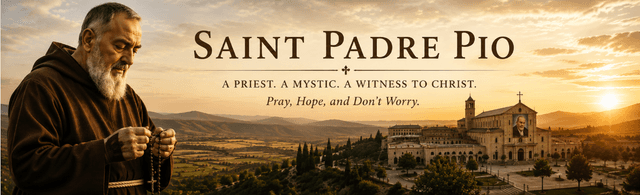
Saint Padre Pio: The Priest Who Bore the Wounds of Christ
Saint Padre Pio's story can sound like something from the Middle Ages, yet he lived until 1968. People who met him are still within living memory, photographs and recordings of him exist, and millions continue to visit the place where he lived. His life included extraordinary suffering, the stigmata, reported healings, mystical experiences, spiritual battles, and an astonishing ability to draw people back to God. But beneath all the extraordinary stories was a simple priest who spent countless hours praying, celebrating Mass, hearing Confessions, and telling people to trust God.
A Boy Who Wanted God
Padre Pio was born Francesco Forgione in 1887 in Pietrelcina, a small town in southern Italy. His parents were poor farmers, and faith was at the center of family life. From childhood, Francesco showed an unusual devotion to prayer and expressed a desire to dedicate his life to God. At 15, he entered the Capuchin Franciscans and eventually took the name Pio. He was ordained a priest in 1910 and became known simply as Padre Pio.
A Life Filled With Suffering
Padre Pio's path was anything but easy. He struggled with poor health for much of his life and experienced long periods of physical suffering. Yet suffering became central to his spirituality. Instead of seeing pain as proof that God had abandoned him, he tried to unite his suffering with the suffering of Christ and offer it for others. That perspective would become especially important when something extraordinary happened to his body.
The Day the Wounds Appeared
On September 20, 1918, while praying before a crucifix at the friary in San Giovanni Rotondo, Padre Pio experienced an intense mystical event. Afterward, visible wounds appeared on his hands, feet, and side corresponding to the wounds traditionally associated with Christ's crucifixion. This phenomenon is known as the stigmata. Padre Pio would bear these wounds for approximately 50 years. They brought him enormous attention, but he reportedly found that attention deeply uncomfortable.
The Mystery of the Stigmata
Doctors examined Padre Pio's wounds, Church authorities investigated him, believers traveled enormous distances to see him, and skeptics questioned what was happening. The wounds remained one of the most controversial and fascinating aspects of his life. Padre Pio himself did not want people focused on the phenomenon. He wanted them focused on Jesus. Shortly before his death in 1968, the visible wounds disappeared, reportedly leaving little or no scarring.
The Priest Who Could Spend Hours Hearing Confessions
One of the most remarkable parts of Padre Pio's ministry had nothing to do with supernatural phenomena. It happened inside the confessional. People traveled from around the world and sometimes waited days for the opportunity to confess their sins to him. Padre Pio could be demanding and direct, but people also experienced extraordinary mercy through his ministry. He believed genuine Confession required genuine repentance, and countless people credited an encounter with him with changing the direction of their lives.
Did Padre Pio Know People's Sins?
Many remarkable stories came from those who went to Confession with Padre Pio. Some claimed he reminded them of sins they had forgotten or deliberately withheld. Others said he seemed to know personal details they had never told him. These accounts contributed to the belief that Padre Pio possessed an extraordinary spiritual gift sometimes called the reading of souls. Whether people came because of curiosity, desperation, or faith, Padre Pio repeatedly redirected them toward repentance, prayer, and Christ.
Stories of Miraculous Healings
Throughout his ministry, people attributed remarkable healings to Padre Pio's prayers and intercession. Accounts involved serious illnesses, injuries, and conditions that families believed had changed unexpectedly after asking him to pray. The Church examines alleged miracles carefully, and miracles attributed to Padre Pio's intercession played a role in his eventual canonization. For those devoted to him, however, the point wasn't that Padre Pio possessed magical powers. They believed God worked through his prayers.
The Mystery of Bilocation
Some of the strangest stories surrounding Padre Pio involve bilocation, the reported phenomenon of appearing in two places at once. Witnesses claimed to encounter Padre Pio far from his monastery while others maintained he had never physically left. Stories circulated involving soldiers, pilots, sick people, and individuals who said Padre Pio appeared during moments of danger or desperate need. These accounts remain among the most mysterious elements of his story.
His Battles Were Not Only Physical
Padre Pio also described intense spiritual struggles. He believed he experienced attacks and temptations from evil forces, sometimes describing them in startlingly physical terms. Other friars reported hearing unexplained disturbances from his room. For Padre Pio, spiritual warfare wasn't an abstract theological idea. He believed the struggle between good and evil was real, and his response was prayer, the Eucharist, Confession, and complete trust in Christ.
A Mass People Never Forgot
For Padre Pio, the center of everything was the Mass. People traveled great distances simply to attend a Mass celebrated by him. His Masses could be lengthy because he prayed with intense concentration and emotion, particularly during the consecration. Those who witnessed them often described the experience as unforgettable. The man famous for miracles consistently pointed beyond himself toward the Eucharist.
He Wanted to Heal Bodies Too
Padre Pio's concern for suffering wasn't limited to prayer. He dreamed of creating a hospital that would combine excellent medical treatment with compassion for the whole person. In 1956, the Casa Sollievo della Sofferenza, meaning the Home for the Relief of Suffering, opened in San Giovanni Rotondo. What began as Padre Pio's dream grew into a major hospital and medical center. It remains one of the most tangible parts of his legacy.
The Church Tested Him
Padre Pio's relationship with Church authorities was not always easy. Because of the enormous attention surrounding him and questions about the supernatural claims associated with his ministry, restrictions were placed on him at different times. For periods, his public ministry was limited. This must have been extraordinarily difficult, yet he remained within the Church rather than walking away from it. His response to these trials became another important part of his example of obedience and perseverance.
The Final Days of Padre Pio
On September 20, 1968, Padre Pio marked 50 years since receiving the stigmata. Three days later, on September 23, he died at the age of 81. The priest who had spent decades hearing Confessions, celebrating Mass, praying for the suffering, and attracting enormous crowds was gone. But devotion to him only continued to grow.
From Controversial Friar to Canonized Saint
Pope John Paul II, who had personally encountered Padre Pio decades earlier as a young priest, canonized him in 2002 before an enormous crowd in Rome. Today, Padre Pio is one of the most widely recognized modern Catholic saints, and San Giovanni Rotondo has become a major pilgrimage destination.
Why Padre Pio Matters Today
We live in a world that wants quick answers and immediate solutions. If suffering appears, we want it removed. If prayer doesn't produce instant results, we can assume it isn't working. Padre Pio's life offers a different perspective. He didn't pretend suffering was easy or desirable. He showed that suffering doesn't have to be meaningless. Even during pain, uncertainty, criticism, and spiritual struggle, we can continue praying, serving, loving, and trusting.
Pray, Hope, and Don't Worry
Padre Pio is famously associated with the simple advice: "Pray, hope, and don't worry." Those words sound almost too simple until you consider the life of the man saying them. He experienced illness, physical pain, controversy, restrictions, spiritual struggles, and enormous responsibility. His message wasn't coming from someone who had an easy life. It came from someone who learned that worry couldn't control tomorrow, but faith could change how he lived today.
What Padre Pio Can Teach Us
You don't need to experience a miracle to learn from Padre Pio. Go to God when you're afraid. Return when you've failed. Go to Confession when you've fallen into sin. Pray even when you don't feel anything. Attend Mass with greater attention. Help someone who is suffering. Stop assuming every difficulty means you're on the wrong path. And when something is beyond your control, place it in God's hands instead of allowing it to consume you.
Padre Pio carried visible wounds for decades, but every one of us carries wounds that other people may never see. Fear. Regret. Grief. Loneliness. Family problems. Financial pressure. Mistakes. Uncertainty about the future. Padre Pio's life doesn't promise that every wound will suddenly disappear. It offers something deeper: your suffering does not have to separate you from God. It can become the very place where you discover how deeply you need Him. Perhaps that's why, decades after his death, Padre Pio's simple message still speaks so powerfully to millions: Pray. Hope. And don't worry.
Sign in to share your thoughts