Share this now - someone’s life could change.


Saint Maximilian Kolbe: The Priest Who Gave His Life for a Stranger
Imagine standing in Auschwitz as ten prisoners are selected to die by starvation. One of the condemned men begins crying out that he has a wife and children. Then another prisoner does something almost unimaginable. He steps forward and says, in effect, take me instead. That prisoner was a Catholic priest named Maximilian Kolbe. He didn't know whether history would remember his decision. He simply saw another human being facing death and chose to give his own life so that man might live.
A Boy Given an Extraordinary Choice
Maximilian Kolbe was born Raymond Kolbe in 1894 in what is now Poland. As a boy, he could be mischievous and difficult enough that his mother once asked him what would become of him. The question deeply affected him. Kolbe later described an extraordinary experience in which the Virgin Mary appeared to him holding two crowns: one white, representing purity, and one red, representing martyrdom. She asked which he would choose. Young Raymond chose both.
Giving His Life to God
Kolbe eventually entered the Conventual Franciscans and took the religious name Maximilian. He was highly intelligent and earned doctorates in philosophy and theology. He also possessed enormous energy and ambition, but his ambition wasn't centered on becoming wealthy or famous. He wanted to use every available means to bring people closer to Christ, especially through devotion to Mary.
A Saint Who Understood the Power of Media
One of the most fascinating things about Kolbe is how modern his thinking was. He understood that if you wanted to reach people, you had to communicate through the technologies they were actually using. He established publications, built a major printing operation, and helped create a Franciscan community called Niepokalanów that became an enormous center of Catholic evangelization. At its height, the community included hundreds of friars working in publishing and ministry.
He Wanted to Reach Millions
Kolbe wasn't satisfied with waiting for people to walk into a church. He wanted to take the message to them. His publications reached enormous audiences. He also dreamed about using radio and other emerging technologies for evangelization. If Kolbe were alive today, it's easy to imagine him thinking seriously about websites, videos, podcasts, social media, and every other tool capable of reaching people around the world.
The Missionary Who Went to Japan
Kolbe's ambitions didn't stop in Poland. In 1930, despite poor health and limited resources, he traveled to Japan. He established a monastery near Nagasaki and began publishing a Japanese version of his Marian magazine. Interestingly, the monastery was built on the side of a mountain that some considered an inconvenient location. Years later, when the atomic bomb devastated Nagasaki, the monastery survived largely protected by the mountain.
Europe Falls Into Darkness
Kolbe eventually returned to Poland. Then, in September 1939, Nazi Germany invaded, beginning World War II in Europe. The peaceful religious community at Niepokalanów suddenly found itself living under occupation. Kolbe and his fellow friars helped shelter people displaced by the war, including Jews. He continued his religious work despite the danger surrounding him.
Arrested by the Nazis
Kolbe was arrested by German forces in 1939 but later released. He could have tried to protect himself by remaining quiet. Instead, he continued his ministry. In February 1941, the Gestapo arrested him again. This time he was imprisoned and eventually transported to Auschwitz.
Prisoner 16670
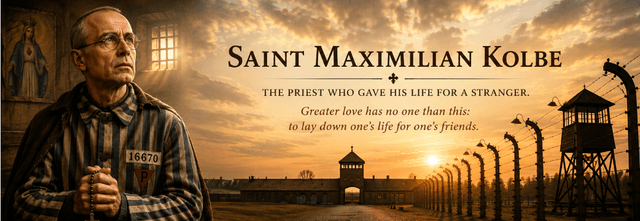
At Auschwitz, Maximilian Kolbe was no longer treated as a respected priest, scholar, missionary, or publisher. He became prisoner number 16670. Like countless others, he experienced brutal labor, hunger, humiliation, violence, and the constant possibility of death. Fellow prisoners later remembered him sharing food, encouraging others, hearing Confessions, and praying with those around him. Everything had been taken from him except his ability to decide what kind of man he would be.
The Escape That Condemned Ten Men
In July 1941, a prisoner from Kolbe's barracks was believed to have escaped. Auschwitz authorities responded with a terrifying punishment. Ten men would be selected to die in an underground starvation bunker as a warning to everyone else. The prisoners stood in formation while the condemned men were chosen.
One Man Began Crying for His Family
Among those selected was Polish army sergeant Franciszek Gajowniczek. When his name was called, he cried out in anguish about his wife and children. He knew he was being sent to a slow and agonizing death. Then something happened that stunned those watching.
Kolbe Stepped Out of Line
Maximilian Kolbe stepped forward. In Auschwitz, simply leaving formation could have meant immediate death. Yet Kolbe calmly approached the Nazi officer. He pointed toward Gajowniczek and asked to take his place. When asked who he was, Kolbe identified himself as a Catholic priest and explained that he was older and wanted to die instead of the man who had a wife and children.
The Nazis Said Yes
Perhaps just as astonishingly, the request was accepted. Gajowniczek was returned to the line. Kolbe joined the other condemned prisoners. The priest who had spent his life preaching about love was now being asked to demonstrate what that love meant when it cost everything.
The Starvation Bunker
The ten men were stripped and locked inside an underground bunker without food or water. Guards were accustomed to hearing screaming and desperation from people condemned to starvation. According to testimony about Kolbe and the others, something different happened in their cell. Kolbe led the prisoners in prayer and hymns. Instead of dying completely alone in despair, the men prayed together.
He Wouldn't Die
Days passed. One by one, the prisoners died. Kolbe survived longer than expected. After roughly two weeks, the guards needed the bunker emptied. On August 14, 1941, Kolbe and the few remaining survivors were killed by lethal injection. Witness testimony describes Kolbe calmly offering his arm to the executioner. He was 47 years old.
The Man He Saved Walked Out of Auschwitz
Franciszek Gajowniczek survived Auschwitz. He also survived the war. The man whose life Kolbe saved eventually returned to his family and lived for decades afterward. He spent much of his later life telling people about the priest who had voluntarily taken his place.
The Two Crowns
For Catholics familiar with Kolbe's childhood story, the ending of his life carries extraordinary meaning. As a boy, he said he had chosen two crowns from Mary: the white crown of purity and the red crown of martyrdom. Decades later, inside one of the darkest places humanity had created, Maximilian Kolbe gave his life for another person.
Recognized by the Church
Pope Paul VI beatified Maximilian Kolbe in 1971. In 1982, Pope John Paul II canonized him and proclaimed him a martyr of charity. Franciszek Gajowniczek, the man whose life Kolbe had saved, was present at the canonization. Imagine that moment: the man who should have died in Auschwitz standing in St. Peter's Square as the man who died in his place was declared a saint.
Why Saint Maximilian Kolbe Matters Today
Most of us will never face a decision as dramatic as Kolbe's. But every day presents smaller versions of the same question: Will I live only for myself, or am I willing to sacrifice something for another person? Our time. Our comfort. Our money. Our attention. Our pride. Our plans. Our willingness to forgive. Kolbe's final sacrifice didn't suddenly appear out of nowhere. It was the culmination of a lifetime spent learning to give himself away.
You Can't Always Choose What Happens to You
Kolbe couldn't stop the Nazis from invading Poland. He couldn't control his arrest. He couldn't choose whether he was sent to Auschwitz. He couldn't make the camp disappear. But there was one thing the Nazis couldn't take from him: the freedom to decide how he would respond. In a place designed to strip human beings of dignity, Kolbe performed an act of extraordinary human dignity.
What Saint Maximilian Kolbe Can Teach Us
Don't wait for a heroic moment before learning how to love. Start with the person in front of you. Give your time when you'd rather keep it. Defend someone who is being mistreated. Forgive when resentment feels easier. Help someone who cannot repay you. Use whatever talents and technology you have to spread something good. And remember that courage is usually built through hundreds of small decisions before the great decision ever arrives.
The word love is used constantly, but Maximilian Kolbe gave it a definition that is difficult to ignore. Love isn't merely something we feel. Love is what we're willing to give. In Auschwitz, surrounded by cruelty and death, one prisoner saw another man's terror and stepped forward. He couldn't save everyone. But he could save one person. And he did. Saint Maximilian Kolbe's life leaves us with a question that reaches far beyond Auschwitz: If love never costs us anything, how deeply are we really loving? His answer wasn't written in a book. He gave it with his life.
Sign in to share your thoughts