Share this now - someone’s life could change.


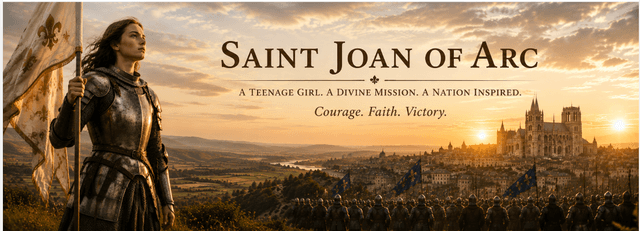
Saint Joan of Arc: The Teenage Girl Who Changed History
Saint Joan of Arc wasn't born into royalty, wealth, or power. She was born around 1412 into a farming family in the small French village of Domrémy during one of the darkest periods in French history. France and England were locked in the Hundred Years' War, large areas of France were controlled by its enemies, and the French monarchy itself was in crisis. Joan couldn't read or write, had no military training, and had never commanded anyone. Yet before she turned 20, this teenage girl would stand before a future king, ride into battle, help change the direction of a war, face imprisonment and interrogation, and die for what she believed God had asked her to do.
A Country Falling Apart
Joan grew up surrounded by the consequences of war. Villages were attacked, families were displaced, and France was deeply divided. The English and their Burgundian allies controlled significant territory, including Paris, while Charles, the French heir known as the Dauphin, had not yet been crowned king. To most people, the political and military situation looked nearly hopeless. Into this enormous conflict stepped a teenage farm girl with an extraordinary claim.
The Voices That Changed Her Life
Joan later testified that when she was about 13, she began experiencing what she described as heavenly voices and visions. She identified those who spoke to her as St. Michael the Archangel, St. Catherine of Alexandria, and St. Margaret of Antioch. At first, the experiences encouraged her to live faithfully. Eventually, Joan believed she was being given an astonishing mission: help drive the English from France and bring Charles to Reims so he could be crowned king.
Imagine Being Seventeen
Think about how unbelievable this must have sounded. Joan was a teenage girl from a small village claiming that God wanted her involved in one of Europe's greatest political and military conflicts. She had no army, no money, no powerful family, and no obvious path to the royal court. Almost every practical reason imaginable existed for her to stay home. Joan went anyway.
The Journey to the Future King
Joan approached Robert de Baudricourt, a local military commander, asking for help reaching Charles. Initially, he rejected her. Joan persisted. Eventually, she was given an escort and traveled through dangerous territory to meet the Dauphin at Chinon in 1429. Tradition tells of Charles attempting to test her by blending into the crowd, only for Joan to identify him. Whatever the exact circumstances, the meeting impressed Charles enough that Joan was examined by theologians and eventually allowed to accompany French forces.
The Teenage Girl Goes to War
Joan entered military life wearing armor and carrying a banner. She became a powerful symbol of hope to French soldiers whose morale had been devastated by years of defeat. Joan wasn't simply telling people to fight. She urged soldiers to turn away from immoral behavior, attend Mass, confess their sins, and place their trust in God. Her presence transformed morale. Suddenly, an army that had been losing believed victory might actually be possible.
The Miracle at Orléans
The city of Orléans was under English siege and had become strategically crucial. Joan arrived with French forces in April 1429. Within days, French troops launched a series of attacks against English positions. Joan was wounded by an arrow but returned to encourage the soldiers. On May 8, the English lifted the siege. It was an astonishing victory. The teenage girl whom almost nobody had taken seriously had become a national hero.
From Village Girl to the Coronation of a King
Joan insisted that the next great objective should be taking Charles to Reims, the traditional location where French kings were crowned. French forces advanced through enemy-held territory, and on July 17, 1429, Charles VII was crowned King of France in Reims Cathedral. Joan stood nearby holding her banner. In less than a year, a teenage farm girl had gone from an obscure village to standing beside the newly crowned king of France.
Her Greatest Victories Wouldn't Last Forever
Joan's success did not make her invincible. Attempts to retake Paris failed, and political support for continued military action became complicated. In May 1430, while defending Compiègne, Joan was captured by Burgundian forces. She tried to escape captivity more than once, even jumping from a tower and surviving the fall. Eventually, she was transferred to the English, who desperately wanted to destroy the young woman who had become such a powerful symbol for France.
The Trial of a Teenage Girl
Joan was placed on trial for heresy before an ecclesiastical court operating under strong English influence. She faced experienced clerics and interrogators while still only about 19 years old. Joan had no formal theological education, yet transcripts of the trial reveal remarkable intelligence, courage, and presence of mind. Her interrogators repeatedly attempted to trap her with complicated theological questions.
One of the Most Famous Answers in History
At one point, Joan was asked whether she knew herself to be in God's grace. It was a dangerous question. Claiming certainty could be interpreted as pride or theological error, while saying no could undermine her claims. Joan responded brilliantly: "If I am not, may God put me there; and if I am, may God so keep me." Her answer has echoed through history as an extraordinary example of wisdom under pressure.
Alone, Imprisoned, and Afraid
It's easy to imagine Joan as fearless because we know how her story ends. But courage doesn't mean never feeling fear. Joan was imprisoned, chained, threatened, interrogated, and placed under enormous psychological pressure. She had gone from riding beside soldiers and standing beside a king to sitting alone in a prison cell. Yet even in her vulnerability, she continued insisting that her mission had come from God.
Burned at the Stake at Nineteen
On May 30, 1431, Joan was taken to the marketplace in Rouen and burned at the stake. She was approximately 19 years old. Witness accounts describe her calling upon Jesus as she died and asking that a cross be held where she could see it. The girl who had helped change the direction of France's war died publicly as a condemned heretic.
But Her Story Wasn't Over
Twenty-five years after Joan's death, a new Church investigation reviewed her trial. In 1456, the original judgment was overturned and Joan was declared innocent of the charges against her. Nearly five centuries later, in 1920, Pope Benedict XV canonized Joan of Arc as a saint. The teenage girl condemned by one court became one of the most recognizable saints in Christianity.
Why Joan of Arc Matters Today
Most of us will never lead an army or stand before a king, but almost everyone knows what it feels like to be underestimated. We're told we're too young, too old, too inexperienced, too ordinary, too uneducated, or simply not the right person. Joan's story challenges that thinking. She didn't wait until she felt qualified. She acted according to what she believed God was asking of her, even when the assignment seemed impossibly larger than she was.
Courage Doesn't Mean You Won't Be Afraid
Joan's life also teaches an important lesson about courage. Courage isn't the absence of fear. Courage is deciding that something matters more than your fear. Joan faced soldiers, commanders, politicians, judges, imprisonment, and eventually death. She couldn't control what others did to her. She could control whether she abandoned what she believed.
Success Doesn't Always Look Like Winning
There's another powerful lesson hidden in Joan's story. She helped achieve extraordinary victories, yet her own life appeared to end in complete defeat. She was captured. Her enemies condemned her. She died before seeing France ultimately win the Hundred Years' War. If we judged her life only by her final day, we might call it a tragedy. History tells a different story. Sometimes we plant seeds whose results we will never live long enough to see.
What Saint Joan Can Teach Us
You don't need Joan's visions or her battlefield courage to learn from her. Stand up when something is wrong. Don't allow other people's opinions to determine what you're capable of becoming. Pray when you're confused. Keep going when you're underestimated. Be willing to take the first step before you know how the entire journey will unfold. And when doing the right thing becomes difficult, remember that difficulty doesn't necessarily mean you're doing the wrong thing.
Joan of Arc lived only about 19 years, yet six centuries later the world still knows her name. She had no fortune, political title, formal education, or powerful family. What she possessed was conviction, courage, faith, and an extraordinary willingness to act. Her story leaves us with a challenging question: What might God be asking you to do that fear keeps telling you you're not capable of doing? Joan's life reminds us that you don't need to be powerful before you make a difference. Sometimes you simply need enough faith to take the next step.
Sign in to share your thoughts