Share this now - someone’s life could change.


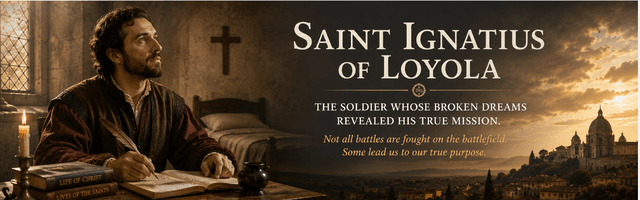
Saint Ignatius of Loyola: The Soldier Whose Broken Dreams Revealed His True Mission
Before Saint Ignatius of Loyola became one of the most influential spiritual leaders in Catholic history, he wanted something very different. He wanted adventure, recognition, romance, military glory, and the admiration of others. He dreamed about becoming a great knight, not a saint. Then a cannonball shattered his leg and destroyed the future he had imagined for himself. What looked like the worst moment of his life became the beginning of an entirely new one.
A Young Man With Big Ambitions
Ignatius was born Íñigo López de Loyola in 1491 in the Basque region of Spain. He came from a noble family and grew up surrounded by ideas of honor, chivalry, military achievement, and courtly life. As a young man, he enjoyed fine clothes, weapons, gambling, romance, and the pursuit of status. He wanted people to notice him, and he imagined himself performing heroic deeds that would bring him glory.
The Battle That Changed Everything
In 1521, French forces attacked the fortress of Pamplona. The Spanish defenders were badly outnumbered, and some wanted to surrender. Ignatius refused. He persuaded the others to keep fighting. During the battle, a cannonball struck him, severely injuring one leg and damaging the other. The ambitious soldier who had imagined himself winning glory on the battlefield suddenly found himself helpless on the ground.
His Dreams Were Shattered With His Leg
The French reportedly admired Ignatius's courage and allowed him to be carried back to his family's castle at Loyola. His injuries were severe. His leg had been badly damaged, and the medical treatment of the 16th century was brutal. Bones had to be reset, and Ignatius endured painful procedures. At one point, his condition became so serious that those around him feared he would die.
He Was Still Worried About How He Looked
Even after surviving, Ignatius remained deeply concerned about his appearance. A bone protruded from his injured leg, and he feared the deformity would interfere with wearing the fashionable boots and clothing of a nobleman. He reportedly asked doctors to cut away the protruding bone even though it meant undergoing additional agony. It is a remarkably human detail. The future saint was still thinking about how other people would see him.
He Asked for Something to Read
Recovery meant months in bed with almost nothing to do. Ignatius loved stories about knights, romance, and heroic adventures, so he asked for books to entertain himself. But the castle didn't have the books he wanted. Instead, he was given books about the life of Christ and the lives of the saints. With few other options, he began reading.
Something Unexpected Started Happening
At first, Ignatius continued daydreaming about worldly adventures and winning the admiration of a noblewoman. But after reading about saints such as Francis of Assisi and Dominic, another kind of dream began appearing in his imagination. He started asking himself: What if I lived like them? What if I gave my life completely to God?
The Discovery That Changed His Life
Ignatius noticed something fascinating about his thoughts. When he fantasized about wealth, romance, glory, and worldly achievement, he enjoyed the thoughts while imagining them, but afterward he often felt empty. When he imagined serving Christ and living like the saints, however, the sense of peace remained afterward. Ignatius began realizing that not every desire affected his soul in the same way.
Learning to Recognize God's Direction
That observation became the beginning of what Ignatius would later develop into his teaching on spiritual discernment. He learned to pay attention not simply to what felt good in the moment but to where thoughts and desires ultimately led him. Did they leave him restless, selfish, and empty? Or did they lead toward peace, faith, courage, love, and God? That insight would eventually help millions of people make important decisions about their own lives.
The Soldier Becomes a Pilgrim
When Ignatius recovered enough to travel, he left behind much of his former lifestyle. He journeyed to the Benedictine monastery at Montserrat, where he made a general confession and spent a night in prayer. In a dramatic symbolic act, the former soldier laid down his sword and dagger. The weapons that had represented his old dreams of glory were no longer going to determine his future.
The Cave at Manresa
Ignatius then spent months near the town of Manresa, where he devoted himself intensely to prayer, fasting, penance, and spiritual reflection. He often prayed in a cave. But this period wasn't simply peaceful. Ignatius experienced severe spiritual struggles, doubts, scruples, and even despair. He had given up his old life, but becoming a new man didn't happen instantly.
The Spiritual Exercises Are Born
During these experiences, Ignatius began recording insights about prayer, temptation, decision-making, and discerning God's will. Those notes eventually developed into the Spiritual Exercises, one of the most influential guides to Christian prayer and discernment ever written. Rather than simply telling people what to believe, Ignatius created a structured way to help them personally encounter Christ and examine the direction of their lives.
He Had to Go Back to School
Ignatius believed he was called to help others spiritually, but there was a problem. He lacked the education necessary for the work he wanted to do. So the former soldier did something humbling. As an adult, he went back to school, sometimes studying alongside students much younger than himself. Eventually, his education brought him to the University of Paris.
The Roommates Who Changed the World
In Paris, Ignatius met several men who would become his closest companions. Among them were Peter Faber and Francis Xavier. Xavier initially had ambitious plans of his own and reportedly wasn't easily persuaded by Ignatius. But eventually a small group formed around a shared desire to serve God.
What Does It Profit a Man?
Ignatius repeatedly challenged Francis Xavier with the words of Jesus: "What does it profit a man to gain the whole world and forfeit his soul?" Xavier eventually experienced his own transformation and became one of the greatest missionaries in Christian history. Ignatius was discovering that sometimes changing the world begins by helping change the direction of one person's life.
The Birth of the Jesuits
Ignatius and his companions eventually formed the Society of Jesus, better known as the Jesuits. Pope Paul III formally approved the order in 1540. Ignatius became its first superior general. The man who once dreamed of commanding soldiers now led a completely different kind of mission.
A Movement That Spread Around the World
The Jesuits became known for missionary work, education, intellectual scholarship, spiritual formation, and service to the Church. Jesuit missionaries traveled throughout Europe, Asia, Africa, and the Americas. Jesuit schools and universities eventually appeared around the world. A movement that began with a wounded soldier reading books in bed grew into one of the most influential religious orders in Catholic history.
Finding God in All Things
One of the great themes associated with Ignatian spirituality is learning to find God in all things. God isn't present only inside a church or during formal prayer. He can be encountered in work, relationships, decisions, difficulties, study, service, nature, and ordinary daily responsibilities. Ignatius wanted people to become attentive to where God might already be working in their lives.
Why Saint Ignatius Matters Today
Ignatius's story speaks directly to anyone whose life hasn't gone according to plan. Maybe you lost a job. A relationship ended. A business failed. An opportunity disappeared. Your career changed. Something you worked toward for years suddenly became impossible. When that happens, it can feel as though your future has been destroyed. Ignatius shows that sometimes what has actually been destroyed is only one version of your future.
The Cannonball Moment
Almost everyone eventually experiences a cannonball moment. Something hits your life that you didn't expect and certainly didn't want. You can spend years wishing it had never happened, or you can eventually begin asking a different question: What can I do with my life from here? Ignatius couldn't undo the battle of Pamplona. But he could decide what happened after it.
Pay Attention to What Leaves You Empty
Ignatius also gives us an incredibly practical lesson for modern life. Notice what happens after you get what you think you want. After hours on social media, do you feel better or worse? After chasing recognition, are you satisfied or already looking for more? After buying something you desperately wanted, how long does the excitement last? Then notice the things that leave a deeper peace: helping someone, praying, creating something meaningful, spending time with people you love, serving, forgiving, or doing something you know is right.
What Saint Ignatius Can Teach Us
Don't assume a destroyed plan means a destroyed life. Pay attention to what brings lasting peace rather than temporary excitement. Ask God for direction before major decisions. Be willing to change course when you realize you're heading the wrong way. Don't be too proud to start over. And don't underestimate what God can build from the pieces of a dream that didn't work out.
Ignatius thought he knew what his life was supposed to become. Then a cannonball destroyed the plan. Without that battlefield injury, the world might never have known Saint Ignatius of Loyola, the Spiritual Exercises, or the Jesuits. What looked like a catastrophe became the doorway to his calling. His life leaves us with a powerful question: What if the interruption you're fighting isn't the end of your story, but the beginning of a completely different one? Sometimes the life we never planned becomes the life we were meant to live.
Sign in to share your thoughts