Share this now - someone’s life could change.


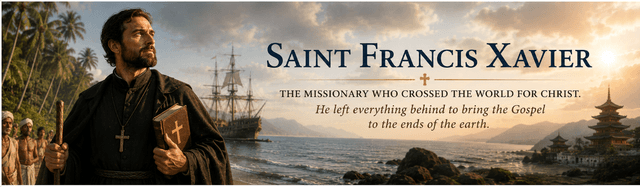
Saint Francis Xavier: The Missionary Who Crossed the World for Christ
Before Saint Francis Xavier became one of the greatest missionaries in Christian history, he was an ambitious young man with plans of his own. He was intelligent, educated, athletic, and determined to build a successful life. He had little interest in giving everything up to become a missionary. Then he met another future saint named Ignatius of Loyola, who kept challenging him with one question from Jesus: What does it profit a man to gain the whole world and lose his soul? Francis eventually took that question seriously, and it changed the direction of his life.
Born Into Privilege
Francis Xavier was born in 1506 at Xavier Castle in the Kingdom of Navarre, in what is now Spain. His family belonged to the nobility, but political conflict dramatically changed their circumstances while Francis was young. Still, he received opportunities most people of his time could only imagine. At about 19, he traveled to Paris to study at one of Europe's great universities.
A Young Man With Big Plans
Francis was talented and ambitious. He studied philosophy, became a teacher, and seemed headed toward a respected academic career. He wanted achievement and recognition. Becoming a poor missionary traveling to distant lands wasn't part of the plan.
Then He Met Ignatius
At the University of Paris, Francis shared accommodations with Ignatius of Loyola. Ignatius was older and had already undergone the dramatic conversion that followed his battlefield injury. He believed Francis had tremendous potential, but Francis initially resisted Ignatius's spiritual influence.
The Question Francis Couldn't Escape
Ignatius repeatedly challenged Francis with the words of Jesus from the Gospel: "What will it profit a man if he gains the whole world and forfeits his life?" Francis could pursue success, reputation, and comfort, but what would any of it ultimately mean? Slowly, Ignatius's words broke through his resistance.
Seven Men Make a Promise
In 1534, Francis joined Ignatius and several companions at Montmartre in Paris, where they made religious vows and committed themselves to serving God. That small group eventually became the foundation of the Society of Jesus, better known as the Jesuits. Francis had no idea that his decision would soon send him thousands of miles from everything familiar.
A Mission He Almost Didn't Receive
When Portugal requested Jesuit missionaries for its territories in Asia, Francis wasn't originally the first person chosen. Another Jesuit became ill and couldn't go. Ignatius turned to Francis. Suddenly, Francis Xavier was being asked to leave Europe for a mission from which he might never return. He accepted.
Leaving Everything Behind
In 1541, Francis departed from Lisbon. Travel in the 16th century was nothing like modern travel. There were no airplanes, reliable communications, modern medicine, or quick trips home. Ocean voyages could last months. Disease, storms, shipwreck, hunger, and death were constant possibilities. When Francis sailed away from Europe, he was leaving behind almost everything he knew.
The Long Journey to India
The voyage toward India took many months. Francis traveled around Africa and across the Indian Ocean, finally reaching Goa in 1542. He found a world completely different from Europe, with unfamiliar languages, customs, religions, climates, and cultures. Instead of turning around, Francis began working.
He Went Where People Needed Him
Francis preached, taught children, cared for the sick, visited prisoners, baptized converts, and traveled among communities along India's coast. He often lived simply and endured exhausting conditions. Language was a constant challenge, so he worked with translators and learned enough local language to teach basic Christian prayers and beliefs.
He Refused to Stay Comfortable
Francis could have remained in established Portuguese settlements where life was easier. Instead, he repeatedly pushed farther. He traveled through parts of India and Southeast Asia, including Malacca and the Moluccas. Every journey brought new dangers and difficulties, but Francis believed the message he carried was worth the risk.
Then He Heard About Japan
While in Asia, Francis met a Japanese man named Anjirō, later baptized as Paulo de Santa Fé. Their conversations fascinated Francis. He learned about Japan's culture, education, and religious traditions and became convinced that Christianity should be introduced there. Once again, Francis headed toward somewhere almost completely unknown to him.
Entering Japan
Francis arrived in Japan in 1549. The mission was difficult. Japanese culture was sophisticated, and Francis quickly realized that approaches effective elsewhere wouldn't necessarily work there. He had to learn, adapt, listen, and better understand the people he hoped to reach.
He Learned an Important Lesson
Francis initially arrived dressed with the simplicity expected of a missionary committed to poverty. But he discovered that some Japanese leaders interpreted his poor appearance as evidence that his message wasn't important. Francis adjusted his approach when meeting influential leaders, presenting himself more formally and bringing gifts. He understood something essential about communication: the message doesn't change, but sometimes the way we present it must.
A Missionary Willing to Learn
Francis wasn't perfect, and like other missionaries of his era, some of his assumptions reflected the world in which he lived. But his willingness to cross cultural boundaries was extraordinary for his time. He traveled into societies he barely understood because he believed every person deserved the opportunity to hear about Christ.
China Became His Final Dream
After Japan, Francis became convinced that China was crucial to the future of Christianity in Asia. China was enormously influential throughout the region, and Francis believed reaching it could open doors far beyond its borders. But entering China was extremely difficult for foreigners.
Waiting Across the Water
In 1552, Francis reached Shangchuan Island off the coast of China. Mainland China was visible in the distance. After traveling thousands upon thousands of miles across oceans and continents, his next great mission seemed almost within reach. He waited for someone who had promised to help him enter the country.
He Never Made It
The arrangement failed. Francis became seriously ill while waiting on the island. With few comforts and far from the home he had left more than a decade earlier, Francis Xavier died on December 3, 1552. He was only 46 years old. China remained across the water.
Did He Fail?
At first glance, Francis's final mission might look like failure. He wanted to enter China and never did. But by the time he died, he had already traveled enormous distances, preached across cultures, helped establish Christian communities throughout Asia, and inspired missionaries who would continue traveling long after him. His unfinished mission became an invitation for others to continue.
A Body That Became Part of His Story
After Francis's death, his body was eventually transported to Goa, where most of his remains are preserved in the Basilica of Bom Jesus. Over the centuries, devotion to him spread throughout the Catholic world, especially in places touched by missionary activity.
One of History's Greatest Missionaries
Francis Xavier was canonized in 1622 alongside Ignatius of Loyola, Teresa of Ávila, Philip Neri, and Isidore the Farmer. He later became recognized as a patron saint of Catholic missions. The ambitious university student who once dreamed of worldly success became a man remembered because he was willing to leave that success behind.
Why Saint Francis Xavier Matters Today
Most of us won't be asked to board a 16th-century sailing ship and travel across the world. But we all have comfort zones. We have people we avoid, places we're afraid to go, conversations we don't want to have, and risks we'd rather not take. Francis challenges us to ask whether comfort has quietly become more important than purpose.
The World Is Still Waiting
Francis understood that faith isn't something meant only to be kept privately inside ourselves. If something has changed your life for the better, there is a natural desire to share it. That doesn't mean forcing beliefs on people. It means being willing to speak, serve, listen, answer questions, and live in a way that makes people curious about what motivates you.
What Saint Francis Xavier Can Teach Us
Don't allow comfort to become the goal of your life. Go where you're needed. Learn from people who are different from you. Adapt the way you communicate without abandoning what you believe. Use your talents for something larger than personal success. And don't assume an unfinished mission means your life was unsuccessful. Sometimes our job is to begin something another person will finish.
Francis Xavier began as a young man trying to build an impressive life. Then Ignatius asked him to consider what all that success was ultimately worth. Francis eventually answered the question with his actions. He left his career, homeland, friends, language, comfort, and security behind and spent the rest of his life carrying his faith across the world. He died looking toward a country he desperately wanted to reach but never entered. Yet nearly five centuries later, his mission continues. His life leaves us with a powerful question: What do you believe in strongly enough that you're willing to leave your comfort behind for it?
Sign in to share your thoughts