Share this now - someone’s life could change.


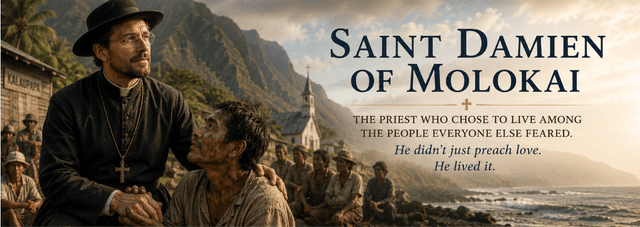
Saint Damien of Molokai: The Priest Who Chose to Live Among the People Everyone Else Feared
The Priest Who Chose Not to Leave
Imagine being sent to an isolated settlement filled with people suffering from a terrifying and misunderstood disease. You are told you can visit them, serve them, and offer them hope, but staying too long could eventually cost you your own life. Most people would understand if you kept your distance. Saint Damien of Molokai did the opposite. He went to live among people with leprosy who had been separated from their families and society. He ate with them, touched them, bandaged their wounds, built their homes, buried their dead, and became one of them. Eventually, Damien contracted the disease himself. He didn't simply preach that every human life had value. He proved what he believed by the way he lived.
A Farmer's Son With a Calling
Damien was born Jozef De Veuster in 1840 in rural Belgium. He grew up in a Catholic farming family and was expected to continue working on the family farm. But Jozef felt drawn toward religious life. He joined the Congregation of the Sacred Hearts of Jesus and Mary and took the religious name Damien.
The Mission That Wasn't Supposed to Be His
Damien's older brother, Pamphile, was also a member of the congregation and had been preparing to become a missionary in Hawaii. Then Pamphile became ill and could no longer make the journey. Damien saw an opportunity. Although he had not yet been ordained a priest, he asked permission to go in his brother's place. Permission was granted, and in 1863 Damien left Europe for Hawaii. He would never return home.
A Young Priest Far From Everything Familiar
Damien was ordained a priest in Honolulu in 1864. He began serving Catholic communities on the islands, traveling great distances and enduring difficult conditions. He learned the Hawaiian language and immersed himself in the lives of the people he served. But another crisis was growing across the islands.
The Disease Everyone Feared
Hansen's disease, commonly known at the time as leprosy, was spreading in Hawaii. Medical understanding of the disease was limited, treatments were ineffective, and fear was enormous. In an attempt to control its spread, Hawaiian authorities began forcibly separating people diagnosed with the disease from their families and sending them to an isolated settlement on the Kalaupapa Peninsula of Molokai.
Sent Away From Everyone They Loved
Imagine being diagnosed with a disease and then being told you must leave your spouse, children, parents, friends, home, and community, perhaps forever. That was the reality faced by many people sent to Molokai. They weren't simply battling illness. They were experiencing rejection, loneliness, grief, and the feeling that the rest of society wanted them to disappear.
The Bishop Needed a Volunteer
The Catholic bishop responsible for the islands knew the people on Molokai needed spiritual and practical help, but he also understood the danger of asking a priest to live there permanently. Several priests could rotate through the settlement rather than one man remaining continuously. Damien volunteered to go.
He Arrived on Molokai
On May 10, 1873, Father Damien arrived at Kalaupapa. What he encountered was heartbreaking. Hundreds of people suffering from Hansen's disease lived in extremely difficult conditions. Many had lost hope. Alcohol abuse, violence, inadequate housing, sickness, and death were part of life in the settlement. Damien quickly realized that Sunday Mass alone wasn't going to solve the problem.
He Didn't Keep His Distance
Fear of disease had caused many people to treat those with leprosy as though they were dangerous objects rather than human beings. Damien refused to do that. He lived among them. He shared meals with them. He visited their homes. He touched them. He cleaned and bandaged wounds. He treated them as friends and members of his community.
He Became More Than Their Priest
Damien wasn't content simply to preach. He became a carpenter, builder, organizer, nurse, advocate, teacher, and even undertaker. He helped construct houses, churches, roads, and other facilities. He worked to improve sanitation and access to clean water. When someone died, Damien helped make coffins, dig graves, and ensure the person received a dignified burial.
Giving Dignity Back to People
One of Damien's greatest accomplishments wasn't something that could easily be measured. He helped restore dignity. The residents of Molokai had been treated as people society needed to remove. Damien treated them as people worth loving. He organized community life, encouraged music and worship, helped improve living conditions, and reminded people that illness had not taken away their human worth.
He Called Them "We"
At first, Damien could speak about the people suffering from leprosy as "you." He was healthy. They were sick. But over the years something changed even before the disease entered his own body. Damien increasingly identified himself with the community. Their problems became his problems. Their suffering became his concern. Molokai wasn't simply somewhere he worked. It became his home.
The Moment Everything Changed
After more than a decade on Molokai, Damien began noticing disturbing symptoms. One famous story says he accidentally placed his foot into extremely hot water and felt no pain. Loss of sensation was a warning sign. Eventually, the diagnosis became clear. Father Damien had contracted Hansen's disease.
"We Lepers"
Damien now stood before his congregation not merely as their priest but as someone who shared their illness. He famously began referring to "we lepers." Those two words capture much of what makes his story extraordinary. He had gone to Molokai voluntarily to live among people the world kept at a distance. Now his body carried the same disease.
He Could Have Regretted Everything
Imagine the thoughts that could have consumed him. If only I hadn't come here. If only I had kept more distance. If only I had stayed in Europe. Damien knew his decision to remain on Molokai had probably contributed to the disease that would eventually kill him. Yet he didn't abandon the people or spend his remaining years consumed by regret.
He Kept Serving
As the disease progressed, Damien's body weakened and changed. His face and limbs were affected, and ordinary tasks became more difficult. Yet he continued celebrating Mass, caring for people, organizing the settlement, writing letters, and fighting for better conditions. Now when he comforted someone suffering from the disease, he wasn't speaking from the outside. He understood.
His Work Attracted the World's Attention
News of Damien's extraordinary ministry spread internationally. Supporters sent money and supplies. His work drew attention to the conditions on Molokai and helped encourage greater assistance for the residents. Damien hadn't gone there seeking fame, but his willingness to stay when others wanted to leave became impossible to ignore.
Other Heroes Eventually Joined Him
Damien wasn't the only person who sacrificed for the people of Molokai. Others came to continue and expand the work, including Mother Marianne Cope, who would later become Saint Marianne Cope. She and the Franciscan Sisters cared for patients and continued serving after Damien's death. Damien's willingness to go first helped inspire others to follow.
His Final Days
By 1889, Damien's disease had advanced significantly. His body was failing, but his concern remained focused on the people around him. On April 15, 1889, Father Damien died on Molokai. He was only 49 years old. He had spent approximately 16 years living among the people of the settlement.
He Came as a Stranger and Died as One of Them
Damien arrived on Molokai as a healthy Belgian missionary. He died there as a member of the very community he had come to serve. The people who had once been abandoned by society had watched a man voluntarily share their lives all the way to the end.
From Molokai to Sainthood
Damien's reputation spread far beyond Hawaii. His sacrifice was admired by Catholics and non-Catholics alike. In 2009, Pope Benedict XVI canonized him as Saint Damien of Molokai. Today, he is recognized as a patron of people affected by Hansen's disease and those living with serious or stigmatized illnesses.
Why Saint Damien Matters Today
Most of us won't be asked to move to an isolated colony and risk contracting a deadly disease. But Damien's life forces us to confront a simpler question: Who are the people we prefer not to see? Every society has people who are ignored, avoided, judged, forgotten, or treated as though their problems make them less valuable.
It's Easy to Love From a Distance
It's easy to say we care about suffering people. It's harder when helping them requires our time, comfort, money, attention, or inconvenience. Damien didn't love the people of Molokai from thousands of miles away. He moved into their neighborhood. He learned their names. He entered their homes. He touched their wounds. He buried their dead.
People Need More Than Solutions
Damien couldn't cure Hansen's disease. Medical science at the time didn't give him that power. But he could make sure people didn't suffer completely alone. Sometimes we hesitate to help because we can't solve someone's entire problem. Damien reminds us that presence itself can be powerful. You may not be able to fix someone's illness, grief, loneliness, addiction, poverty, or family crisis. But you can refuse to abandon them.
What Saint Damien Can Teach Us
Notice the people everyone else overlooks. Treat every person with dignity regardless of appearance, illness, status, or circumstances. Don't wait until you can solve someone's entire problem before helping. Be willing to get uncomfortable. Give people your presence, not merely your advice. And remember that the greatest acts of love often happen where there is no applause and no obvious reward.
Saint Damien didn't become extraordinary because he could perform some spectacular feat. He became extraordinary because he stayed. He stayed when disease frightened everyone. He stayed when conditions were terrible. He stayed when the work was exhausting. And when he eventually became sick himself, he stayed until the end. His life leaves us with a question worth carrying into our own lives: Who needs you to stop standing at a safe distance and simply stand beside them? Sometimes changing someone's world begins with letting them know they haven't been forgotten.
Sign in to share your thoughts