Share this now - someone’s life could change.


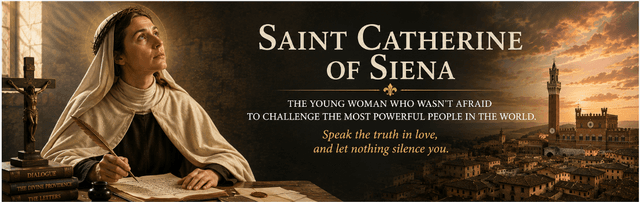
Saint Catherine of Siena: The Young Woman Who Wasn't Afraid to Challenge the Most Powerful People in the World
Saint Catherine of Siena never became a queen, politician, scholar, or military leader. She never held an official position of power. Yet this young woman from an ordinary family became influential enough to advise popes, confront political leaders, negotiate during conflicts, care for victims of disease, and challenge the Catholic Church to reform itself. She lived only 33 years, but she proved something extraordinary: you don't need a title to have influence when you have the courage to speak the truth.
Born Into an Enormous Family
Catherine was born in Siena, Italy, in 1347. She was one of the youngest children in a very large family. Her father, Jacopo Benincasa, worked as a cloth dyer, and her mother, Lapa, managed their busy household. Catherine wasn't born into the nobility or raised with any expectation that she would someday communicate with some of Europe's most powerful people.
The Vision That Changed Her Childhood
According to accounts of her life, Catherine was about six years old when she experienced her first extraordinary vision. While walking with her brother, she reportedly saw Christ seated in glory above the Church of San Domenico, accompanied by Saints Peter, Paul, and John. The experience deeply affected her and strengthened a desire to give her life completely to God.
Her Family Had Other Plans
As Catherine grew older, her family expected her to marry. Catherine wanted something completely different. She had privately vowed herself to God and resisted her family's attempts to arrange a marriage. Her refusal created serious tension at home.
She Cut Off Her Hair
When her family encouraged her to make herself attractive for marriage, Catherine responded dramatically. She cut off her hair as a sign that she wasn't interested in pursuing the future they had planned for her. Her family was furious. According to traditional accounts, they punished her by giving her exhausting household responsibilities and removing the privacy she had used for prayer.
Finding a Cell Inside Her Own Heart
Catherine couldn't always escape physically into solitude, so she developed an idea that would become central to her spirituality. She imagined creating an interior cell within her own soul where she could remain with God even while surrounded by activity. It was an extraordinary lesson: silence doesn't always require escaping the world. Sometimes we have to learn how to carry silence within us.
A Different Kind of Religious Life
Eventually, Catherine's family accepted her decision. She joined the Mantellate, a group of lay Dominican women devoted to prayer and service. Catherine didn't enter a traditional enclosed convent. She continued living in Siena while dedicating herself intensely to God.
Years of Deep Prayer
For a period, Catherine withdrew significantly from ordinary social life and devoted herself to prayer, fasting, and spiritual growth. She later described extraordinary mystical encounters with Christ. But eventually, Catherine believed God was asking her to do something that might have been harder for her than solitude: go back out into the world.
Prayer Had to Become Service
Catherine began caring for the sick, helping the poor, visiting prisoners, and serving people others avoided. Her spirituality wasn't meant to remain hidden inside private experiences. If her prayer was genuine, Catherine believed it had to change the way she treated people.
She Served People Others Wouldn't Touch
Stories from Catherine's life describe her caring for people suffering from serious and sometimes repulsive illnesses. In one famous account, she cared for a woman with a severe disease despite the woman's difficult treatment of her. Catherine continued serving even when the work was unpleasant and unappreciated.
The Black Death Was Still Haunting Europe
Catherine lived in the aftermath of the devastating Black Death, which had killed an enormous portion of Europe's population beginning just before her birth. Disease, poverty, political conflict, and social instability were realities of her world. Catherine didn't respond by retreating permanently from suffering. She moved toward it.
People Began Coming to Her
As Catherine's reputation for holiness and wisdom spread, people began seeking her advice. Remarkably, her followers included priests, scholars, nobles, artists, and ordinary citizens. Catherine had little formal education, yet educated people listened to her because they recognized something powerful in her spiritual insight.
The Woman Who Wrote to Kings and Queens
Catherine began dictating letters to political and religious leaders throughout Europe. She wrote to kings, queens, cardinals, priests, military figures, and popes. Her letters could be compassionate, encouraging, and startlingly direct. Catherine wasn't impressed by titles. If she believed someone needed correction, she told them.
She Wasn't Afraid to Challenge the Pope
During Catherine's lifetime, the papacy was based in Avignon, France, rather than Rome. The situation had become deeply controversial. Catherine believed Pope Gregory XI should return the papacy to Rome. She wrote to him and eventually traveled to Avignon herself.
Imagine Standing Before the Pope
Catherine was still a young laywoman with no major official position in the Church. Yet she stood before one of the most powerful men in Europe and urged him to act courageously. She encouraged Gregory XI to return to Rome and pursue reform within the Church. In 1377, Gregory did return the papacy to Rome. Catherine wasn't the only influence on his decision, but her role became one of the defining episodes of her life.
She Loved the Church Enough to Criticize It
Catherine's willingness to challenge Church leaders didn't come from hatred of the Church. It came from deep love for it. She believed corruption, cowardice, and poor leadership damaged souls and weakened the Church's mission. For Catherine, loyalty didn't mean pretending problems didn't exist. Sometimes love required telling uncomfortable truths.
The Mystical Marriage
Among Catherine's extraordinary spiritual experiences was what she described as a mystical marriage to Christ. According to tradition, Christ appeared to her and placed a ring on her finger that remained visible to Catherine but not to others. The experience represented her complete spiritual union and commitment to Him.
The Stigmata
Catherine also reportedly received the stigmata while praying in Pisa in 1375. Unlike the visible wounds associated with saints such as Francis of Assisi and Padre Pio, Catherine said her wounds were invisible during her lifetime. According to tradition, they became visible after her death.
Then the Church Entered Another Crisis
Shortly after Gregory XI's death, the Church entered the Western Schism, during which rival claimants asserted they were the true pope. Catherine supported Pope Urban VI in Rome and worked intensely to encourage unity. She wrote letters, advised leaders, prayed, and eventually moved to Rome.
Her Body Began to Fail
Catherine's intense fasting and demanding lifestyle took a severe toll on her health. By early 1380, she was extremely weak. She continued praying and working for the Church even as her body failed. On April 29, 1380, Catherine died in Rome. She was only 33 years old.
Thirty-Three Years Were Enough to Change History
Catherine was canonized in 1461. In 1970, Pope Paul VI declared her a Doctor of the Church, making her one of the first women ever given that distinction. She was later named one of the patron saints of Europe. The daughter of a cloth dyer who received little formal education became one of the most respected spiritual teachers in Catholic history.
Why Saint Catherine Matters Today
Our world constantly tells us influence comes from numbers. How many followers do you have? What's your title? How much money do you make? How powerful is your network? Catherine had none of those modern measurements of influence. What she had was conviction, courage, faith, compassion, and a willingness to speak when silence would have been easier.
Courage Isn't the Same as Being Loud
Catherine wasn't courageous simply because she confronted powerful people. Her courage was rooted in prayer. Before she tried changing the world around her, she spent years allowing God to change the world inside her. That distinction matters. Speaking loudly is easy. Speaking truthfully, lovingly, and for the right reasons is much harder.
Sometimes Love Requires Speaking Up
There are times when staying silent is easier. We don't want conflict. We don't want people angry with us. We don't want to risk friendships, careers, reputations, or approval. Catherine reminds us that love isn't always quiet agreement. Sometimes loving someone means respectfully telling them something they don't want to hear.
What Saint Catherine Can Teach Us
Don't assume you need an important title before your voice matters. Develop your interior life before trying to influence everyone around you. Serve people who can do nothing for you in return. Speak truth without losing love. Don't confuse loyalty with silence when something is wrong. Pray before making important decisions. And when you believe God is asking you to act, don't allow your age, background, or lack of status to become an excuse.
Catherine of Siena lived only 33 years. She cared for the sick, served the poor, counseled ordinary people, confronted political leaders, advised popes, worked for peace, challenged corruption, and left writings that Catholics still study nearly 650 years later. She didn't wait until she was powerful enough, educated enough, old enough, or important enough. She simply began doing what she believed God was asking her to do. Her life leaves us with a powerful question: What good could you begin doing today if you stopped waiting for someone else to tell you that you're qualified?
Sign in to share your thoughts