Share this now - someone’s life could change.


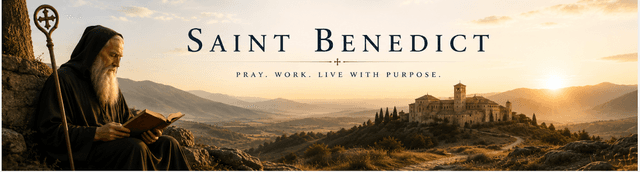
Saint Benedict: The Man Who Changed the World by Walking Away From It
What if one of the most influential men in history became powerful by walking away from power? More than 1,500 years ago, a young man named Benedict looked at the world around him and saw something that might feel surprisingly familiar today. Society was unstable. Morality was weakening. Political power was shifting. People were chasing pleasure, status, wealth, and influence. Benedict could have joined them. Instead, he walked away. That decision would eventually help change the course of Western civilization.
The Young Man Who Chose Something More
Saint Benedict was born around 480 AD in Nursia, in what is now Italy. He came from a respected family and was sent to Rome for his education. But the life he saw there disturbed him. Rather than allowing himself to be pulled into the culture around him, Benedict left Rome and eventually sought solitude in a cave near Subiaco. Imagine that choice. A young man with opportunities ahead of him walks away from comfort and ambition to live alone in a cave. He wasn't running from life. He was searching for the meaning of it.
Three Years in a Cave
For roughly three years, Benedict lived in solitude, praying, fasting, battling temptation, and learning to surrender his will to God. According to tradition, a monk named Romanus secretly brought him food, lowering it down to Benedict's cave by a rope. But Benedict's isolation wouldn't last. People began hearing about the young holy man living in the mountains. They came looking for him. Some wanted advice. Others wanted prayer. Eventually, men wanted to live as he lived. Without seeking followers, Benedict began attracting them.
The Poisoned Cup
One of the most famous miracles associated with Saint Benedict involved an attempt to kill him. According to Pope St. Gregory the Great's account, monks who resented Benedict's strict way of life placed poison in a cup of wine and presented it to him. Benedict made the Sign of the Cross over the cup, and the cup shattered. Benedict immediately understood what had happened. The man they wanted dead simply walked away.
The Poisoned Bread and the Raven
Another attempt was reportedly made with poisoned bread. Benedict recognized the danger and called upon a raven that he regularly fed. He commanded the bird to take the poisoned loaf away and leave it somewhere no one could be harmed. The raven eventually carried it away. This remarkable story is one reason the raven and poisoned cup became enduring symbols connected with Saint Benedict.
Miracles That Followed His Life
Stories of extraordinary events continued throughout Benedict's life. Tradition tells of Benedict miraculously providing water for monks living in a difficult location. He was said to have recovered an iron tool that had fallen into deep water, causing its blade to rise and reattach to its handle. Accounts also credit him with healing the sick, discerning hidden actions, foreseeing future events, and even helping restore a child to life through intense prayer. But perhaps Benedict's greatest miracle wasn't any single supernatural event. It was what happened to the people who began following his way of life.
The Rule That Changed Everything
Benedict eventually established monasteries, including the famous monastery at Monte Cassino. But he gave his followers something even more lasting: the Rule of Saint Benedict. It wasn't an enormous book or complicated philosophy. It was a practical way of living. Pray. Work. Listen. Practice humility. Control your appetites. Welcome strangers. Care for the sick. Respect others. Live in community. Use your time wisely. Don't make everything about yourself. The Benedictine tradition is often summarized by the Latin phrase Ora et Labora: Pray and Work.
Finding God in Ordinary Life
Benedict understood something we often forget: holiness isn't only found in dramatic moments. It is built through what you repeatedly do every day. How you wake up. How you work. How you treat people. How you respond when you're frustrated. How you use silence. How you pray when nobody is watching. How you serve when nobody applauds. Benedict showed that ordinary moments can become extraordinary when they are offered to God.
The Man Who Helped Preserve Civilization
After Benedict's death around 547 AD, the movement inspired by his Rule continued spreading across Europe. Benedictine monasteries became centers of prayer, education, agriculture, hospitality, learning, and culture. Monks copied manuscripts by hand, helping preserve important religious and classical texts through centuries of upheaval. Monastic communities cared for travelers, cultivated land, educated people, and created islands of stability in an unstable world. Benedict never commanded an army. He never ruled a country. He never built a business empire. Yet his influence survived kingdoms.
A Patron Saint of Europe
The influence of Benedict became so significant that in 1964 Pope Paul VI proclaimed Saint Benedict a principal patron of Europe. Think about that. A young man who walked away from Rome and lived in a cave eventually became recognized as one of the great spiritual fathers of European civilization. Benedict didn't change the world by chasing power. He changed it by changing himself and then teaching others how to live.
Why Saint Benedict Matters Today
Look at our world today. Our phones rarely stop. Social media constantly demands attention. Success is measured in followers, money, appearance, influence, and achievement. Many people are connected to thousands of others yet struggle to sit silently for ten minutes. Saint Benedict offers a radically different message. You don't have to follow the noise. You don't have to chase everything the world tells you to chase. You don't have to become famous to live an extraordinary life. You can become stronger through discipline, wiser through silence, and more fulfilled through service.
The Saint Benedict Medal
Today, millions of Christians recognize the Saint Benedict Medal, one of the best-known devotional medals in the Catholic tradition. Its symbols and letters point to prayers centered on Christ, the Cross, and rejecting evil. It isn't supposed to be treated as a magical object or good-luck charm. Its meaning comes from the faith it represents: trust in Christ and resistance to evil. That distinction would have mattered deeply to Benedict. His strength wasn't supposed to come from an object. It came from God.
The Greatest Lesson Benedict Left Us
Perhaps the most powerful thing about Saint Benedict's life is that he never set out to become historically important. He simply tried to become holy. He withdrew from a culture he believed was pulling him away from God. He learned to pray. He learned discipline. He battled temptation. He served others. He formed communities. He taught people how to combine prayer with ordinary work. More than 1,500 years later, we're still talking about him.
Build a Life Worth Following
The world tells us to build a following. Benedict built a life worth following. The world tells us to make more noise. Benedict discovered the power of silence. The world tells us to seek comfort. Benedict embraced discipline. The world tells us to put ourselves first. Benedict taught humility, obedience, hospitality, and service. Maybe that's why his message has survived for fifteen centuries.
What If You Lived Like Benedict for Just One Week?
You don't have to move into a monastery. You don't have to abandon your career, family, home, or phone. Start smaller. Begin your morning with God before looking at your phone. Spend a few minutes in silence. Treat your work as something you can offer to God. Listen more than you speak. Eat with greater discipline. Serve someone without expecting recognition. Read Scripture. Examine your conscience before bed. Forgive quickly. Pray regularly. Then do it again tomorrow. Check out MonkAtHome.com
Saint Benedict discovered that an extraordinary spiritual life can be built from very ordinary days lived intentionally. His world was chaotic. So is ours. Perhaps the answer isn't always to escape the world. Perhaps it's to learn how to live differently within it. That may be Saint Benedict's greatest miracle of all: more than 1,500 years later, his life is still showing us how.
Sign in to share your thoughts