Share this now - someone’s life could change.


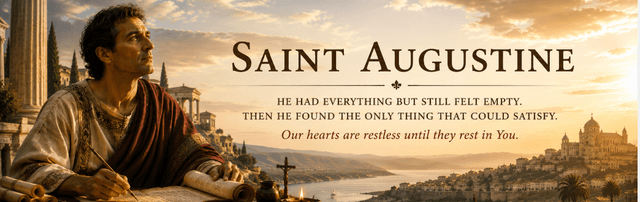
Saint Augustine: The Man Who Had Everything but Still Felt Empty
Saint Augustine's story is powerful because he didn't spend his entire life doing everything right. Before becoming one of the greatest thinkers and saints in Christian history, Augustine spent years chasing pleasure, relationships, success, intellectual recognition, and answers almost everywhere except Christianity. He made choices he later deeply regretted, resisted his mother's faith, and struggled to control his desires. Yet the restless young man who spent years running from God eventually became one of the most influential Christians who ever lived.
A Brilliant Young Man With Big Ambitions
Augustine was born in 354 in Thagaste, in Roman North Africa, in what is now Algeria. His father, Patricius, was initially a pagan, while his mother, Monica, was a devoted Christian. Augustine was exceptionally intelligent, and his family recognized his potential. He received an excellent education and eventually pursued rhetoric, a field that could bring prestige, influence, and a successful career in the Roman world. Augustine wanted to become somebody.
The Life His Mother Feared
As Augustine grew older, he moved away from the Christian faith Monica desperately wanted him to embrace. He pursued sexual relationships and lived with a woman for many years, with whom he had a son named Adeodatus. Augustine later wrote openly about the desires and ambitions that controlled much of his youth. He wasn't simply searching for pleasure. He was searching for happiness, truth, love, recognition, and meaning, but nothing seemed capable of completely satisfying him.
A Mother Who Refused to Stop Praying
While Augustine wandered, Monica prayed. She prayed for her son year after year, even when there seemed to be little reason for hope. Augustine explored philosophies and religious movements that took him further from Christianity. Yet Monica refused to give up. According to a famous tradition, a bishop reassured the grieving mother that a son surrounded by so many tears and prayers would not easily be lost. Monica would eventually live long enough to witness the conversion she had prayed for.
Looking Everywhere for the Truth
Augustine was intellectually restless. Christianity initially seemed too simple to him, and he was troubled by questions about evil, Scripture, and the nature of God. He became involved with Manichaeism, a religious movement that promised sophisticated answers to some of his questions. Eventually, Augustine became disappointed with it as well. He continued searching through philosophy, skepticism, and intellectual study. His mind was constantly moving, but his heart still wasn't at peace.
Success Didn't Solve the Problem
Augustine eventually became a respected teacher of rhetoric and traveled to Rome and then Milan, one of the most important cities in the Roman Empire. Professionally, his life was moving upward. He was intelligent, ambitious, connected, and building the kind of career many people would envy. Yet inwardly, something remained unresolved. Augustine was discovering one of life's hardest truths: getting what you thought you wanted doesn't necessarily give you what you were really looking for.
The Bishop Augustine Couldn't Ignore
In Milan, Augustine encountered St. Ambrose, the city's influential bishop. Augustine initially went to hear Ambrose because of his reputation as an excellent speaker. But something unexpected happened. Augustine came to evaluate the bishop's speaking ability and found himself listening to the message. Ambrose showed him that Christianity could be intellectually serious and that Scripture could be understood more deeply than Augustine had previously realized. Slowly, some of Augustine's objections began falling away.
He Believed but Still Couldn't Let Go
Augustine's greatest obstacle eventually wasn't intellectual. It was personal. He increasingly believed Christianity might be true, but accepting it meant changing the way he lived. He famously described wanting purity while simultaneously not wanting it quite yet. Augustine understood something many people still experience: sometimes we don't reject God because we lack evidence. Sometimes we're afraid of what accepting God might require us to change.
The Battle Inside Augustine
The conflict became unbearable. Augustine later described feeling divided against himself. Part of him wanted to surrender to God, while another part wanted to hold onto his old life. He knew what direction he believed he should take, but he couldn't seem to make himself take it. His conversion wasn't simply an intellectual conclusion. It became a battle of the will.
Take Up and Read
One day in Milan, Augustine withdrew into a garden, overwhelmed and weeping. Then he heard what sounded like a child's voice repeatedly saying in Latin, "Tolle lege" — "Take up and read." Augustine interpreted the words as a command. He picked up a collection of Paul's writings and read the first passage his eyes encountered, which urged the reader to abandon sinful desires and put on Christ. Augustine later said he didn't need to read further. Something inside him had changed.
The Moment He Finally Stopped Running
After years of searching, arguing, questioning, resisting, and struggling, Augustine surrendered. The brilliant young man who had tried to find fulfillment through pleasure, philosophy, ambition, relationships, and intellectual achievement finally embraced Christianity. In 387, Augustine was baptized by St. Ambrose in Milan. His son Adeodatus was baptized as well.
His Mother's Prayer Was Finally Answered
Shortly afterward, Augustine and Monica prepared to return to North Africa. While waiting at Ostia, they shared an extraordinary conversation about God and eternal life that Augustine later described in his Confessions. Monica told him that the great desire of her life had been fulfilled: she had seen her son become a Christian. Soon afterward, Monica became ill and died. The mother who had prayed for Augustine for years lived just long enough to see the answer.
From Convert to Bishop
Augustine returned to North Africa intending to live a quiet religious life, but that plan didn't last. He was ordained a priest and eventually became Bishop of Hippo. The man who once resisted Christianity now spent his life explaining and defending it. He preached, cared for his people, debated theological opponents, and wrote works that would influence Christianity for more than 1,500 years.
The Book That Made His Struggles Immortal
Augustine's Confessions became one of the most famous spiritual autobiographies ever written. What makes it extraordinary is its honesty. Augustine didn't present himself as someone who had always been holy. He examined his ambition, pride, lust, selfishness, mistakes, relationships, and restless search for happiness. Readers across the centuries have recognized themselves in his struggle.
The Restless Heart
Perhaps Augustine's most famous insight appears near the beginning of the Confessions. Speaking to God, Augustine explains that the human heart remains restless until it rests in Him. That single idea summarizes much of Augustine's life. He kept trying to fill the restlessness with something else. Pleasure wasn't enough. Success wasn't enough. Intellectual achievement wasn't enough. Recognition wasn't enough. He eventually concluded that his deepest hunger was for God.
One of Christianity's Greatest Minds
Augustine went on to write enormously influential works, including The City of God and On the Trinity. His thinking shaped Christian discussions about grace, free will, sin, salvation, the Church, human nature, and society. The restless young man who once questioned Christianity became a Doctor of the Church and one of the most important theologians in Christian history.
Why Saint Augustine Matters Today
Augustine could have been born in our generation. His world offered different technology, but the human temptations were remarkably familiar. Chase pleasure. Become successful. Find the right relationship. Gain recognition. Learn more. Achieve more. Experience more. Then maybe you'll finally feel complete. Augustine tried many versions of that formula and discovered that the emptiness kept returning.
Your Questions Don't Frighten God
Augustine also shows that questioning isn't necessarily the enemy of faith. He asked difficult questions. He explored competing ideas. He doubted. He argued. He searched. His journey toward Christianity wasn't based on shutting down his mind but continuing to pursue truth until he became convinced he had found it. His story offers hope to anyone who wants to believe but still has serious questions.
What Saint Augustine Can Teach Us
Be honest about what you're chasing. Ask whether the things consuming your life are actually giving you peace. Don't confuse temporary pleasure with lasting happiness. Keep searching for truth even when the answers challenge the way you're living. Don't assume your mistakes have placed you beyond God's reach. And never underestimate the power of praying patiently for someone you love.
Augustine spent years searching for something that would finally satisfy him. Eventually he realized the problem wasn't that he hadn't experienced enough, achieved enough, or learned enough. He was trying to fill a spiritual hunger with things that could never completely satisfy it. His life leaves us with a question that is every bit as relevant today as it was more than 1,600 years ago: What are you hoping will finally make you feel complete? Augustine searched almost everywhere before finding his answer. And once he found it, the man who had spent years running from God spent the rest of his life running toward Him.
Sign in to share your thoughts