Share this now - someone’s life could change.


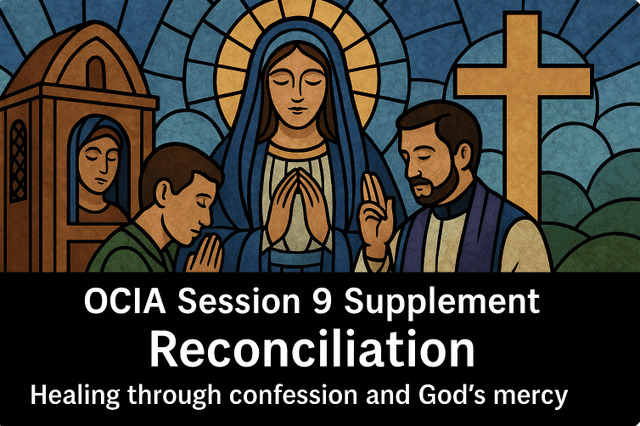
OCIA Session 9 Supplement - Reconciliation - Healing through confession and God’s mercy
Every one of us carries wounds. Some are from choices we regret. Some are from sins we keep hidden. Some are from moments when we knew the right thing but failed to do it. The Sacrament of Reconciliation, often called Confession, is God’s remedy for these wounds. It is not about shame or humiliation. It is about freedom, healing, and mercy. Jesus tells us in John 10:10, “I came that they may have life, and have it abundantly.” Confession is one of the most powerful ways He restores that abundant life.
Let’s start with Scripture. After His resurrection, Jesus appeared to the apostles. John 20:22-23 records what happened: “He breathed on them and said, ‘Receive the Holy Spirit. If you forgive anyone’s sins, their sins are forgiven; if you do not forgive them, they are not forgiven.’” With these words, Jesus gave His Church the authority to forgive sins in His name. This is the foundation of the sacrament. When you confess to a priest, you are not simply speaking to another human being. You are speaking to Christ, who acts through His minister. The priest is an instrument, but the forgiveness comes from God Himself.
Why is confession necessary? Some people say, “Can’t I just confess my sins directly to God?” Of course, we can always pray and ask for forgiveness. But Jesus gave us the sacrament for a reason. First, we need to hear the words of absolution with our own ears: “I absolve you from your sins.” Those words bring peace and certainty. Second, sin wounds not only our relationship with God but also with His Church. Confession restores us to communion with both. St. James writes, “Therefore confess your sins to each other and pray for each other so that you may be healed” (James 5:16). Healing comes through honesty, humility, and God’s mercy working through His Church.
Think of sin like spiritual baggage. Over time, it weighs us down. We try to carry it ourselves, but it becomes exhausting. Confession is like handing that baggage to Jesus. He takes it, and in its place, He gives us grace. Psalm 103:12 says, “As far as the east is from the west, so far has He removed our transgressions from us.” That is what happens in Reconciliation - your sins are not just forgiven, they are removed.
Here’s a humor break: many Catholics get nervous about going to confession, as if the priest has a perfect memory and will be shocked by what they hear. The truth is, priests hear confessions all the time, and they have heard it all. What surprises them is not the sin but the courage of people coming back to God. Most priests will tell you confession is one of the most joyful parts of their ministry because they get to witness God’s mercy in action.
How does confession work? It is simple. You enter the confessional or reconciliation room. You begin with the Sign of the Cross. You confess your sins honestly, without excuses. The priest may give you some counsel and then assigns a penance - usually a prayer or small act of reparation. Then he speaks the words of absolution: “I absolve you from your sins in the name of the Father, and of the Son, and of the Holy Spirit.” At that moment, the burden of sin is lifted, and grace fills your soul. You walk out forgiven, renewed, and free.
Confession is not meant to be a once-a-year event. The Church encourages us to go regularly - monthly if possible. Why? Because the more often we experience God’s mercy, the more quickly we grow in holiness. Frequent confession strengthens us against temptation, gives us greater peace of conscience, and keeps us aware of how much we need God’s grace. Proverbs 28:13 says, “Whoever conceals their sins does not prosper, but the one who confesses and renounces them finds mercy.”
Take a moment to reflect. Is there something weighing on your heart - a sin, a pattern, or a wound you have carried for too long? Imagine laying it at the feet of Jesus and hearing Him say, “Your sins are forgiven. Go in peace.” That is what confession offers.
Here’s your practical challenge this week: make an examination of conscience. Set aside quiet time and ask the Holy Spirit to help you review your thoughts, words, and actions. You can use the Ten Commandments or the Beatitudes as a guide. Write down anything you feel you need to bring to confession. Then, if you are ready, go to confession. If you are not ready yet, pray daily for the courage to trust in God’s mercy.
In closing, remember this: Reconciliation is not about condemnation, it is about restoration. God does not want you to carry your sins like chains. He wants to break those chains and set you free. Jesus says in Luke 15:7 that there is rejoicing in heaven over one sinner who repents. Imagine that - every time you go to confession, heaven throws a party. Next time, we will explore the sacrament of Marriage, where God’s love becomes a covenant between husband and wife, a living sign of Christ’s love for His Church. Until then, do not be afraid. God’s mercy is bigger than your worst sin, and His arms are always open.
Sign in to share your thoughts