Share this now - someone’s life could change.


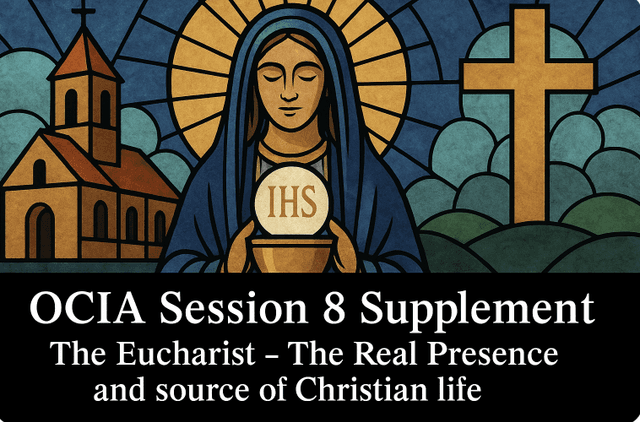
OCIA Session 8 Supplement - The Eucharist - The Real Presence and source of Christian life
The Eucharist - The Real Presence and source of Christian life
When Catholics talk about the Eucharist, we aren’t talking about a mere symbol, a ritual, or a community meal. We are talking about the heart of our faith. The Church calls the Eucharist “the source and summit of the Christian life” (CCC 1324). Every sacrament points toward it, and every act of faith flows from it. Why? Because in the Eucharist, we receive Jesus Christ Himself - Body, Blood, Soul, and Divinity.
This belief comes directly from Jesus’ own words. At the Last Supper, He took bread and said, “This is my body, which is given for you. Do this in remembrance of me” (Luke 22:19). He took the cup and said, “This cup is the new covenant in my blood, which is poured out for you” (Luke 22:20). He didn’t say, “This represents my body” or “This is like my blood.” He said, “This is.” In John 6, Jesus speaks even more boldly: “I am the living bread that came down from heaven. Whoever eats this bread will live forever… For my flesh is real food and my blood is real drink” (John 6:51, 55). Many of His followers struggled with this teaching, but Jesus did not soften His words. He meant exactly what He said.
From the very beginning, Christians took Jesus at His word. The earliest Church Fathers spoke of the Eucharist as the real presence of Christ. St. Ignatius of Antioch, writing around 107 AD, said: “The Eucharist is the flesh of our Savior Jesus Christ.” St. Justin Martyr, in the mid-2nd century, described how Christians gathered for Mass on Sundays, heard the Scriptures, and then received bread and wine that had become Christ’s Body and Blood. The belief we hold today is the same belief the first Christians held: Jesus is truly present.
So what happens at Mass? During the consecration, when the priest repeats the words of Jesus at the Last Supper, the bread and wine are transformed. The Church calls this mystery transubstantiation - the substance changes, even though the appearances of bread and wine remain. It may look and taste the same, but in reality, it has become the Body and Blood of Christ. This is why Catholics treat the Eucharist with such reverence. When you approach the altar, you are not receiving ordinary food. You are receiving the King of Kings, the Lord of Lords, the Savior of the world.
Here’s a humor break: sometimes kids preparing for First Communion think the Eucharist tastes like a “holy cracker.” Adults may laugh, but that’s exactly the point - the taste doesn’t reveal what it really is. What matters is faith. It may look simple, but the miracle is hidden in plain sight.
Why does the Eucharist matter so much? Because food sustains life, and this is food for eternal life. Just as your body cannot live without nourishment, your soul cannot thrive without the Eucharist. Jesus said it plainly: “Whoever eats my flesh and drinks my blood has eternal life, and I will raise them up at the last day” (John 6:54). That’s why the Church insists that Sunday Mass is not optional. It is essential. To miss the Eucharist is to miss the very heartbeat of Christian life.
The Eucharist also transforms us. St. Augustine once told his congregation: “Behold what you are. Become what you receive.” In other words, when you receive Christ in the Eucharist, you are called to become more like Him - to be His presence in the world. The Eucharist is not only communion with Jesus but communion with His Body, the Church. That’s why we call it “Communion.” At every Mass, people of every age, race, and background stand side by side to receive the same Christ. The Eucharist breaks down barriers and makes us one.
Think about this: the same Jesus who was born in Bethlehem, who preached on the hills of Galilee, who died on the cross and rose from the tomb - that same Jesus comes to you in the Eucharist. Not figuratively, not symbolically, but really and truly. The Creator of the universe humbles Himself to come under the appearance of bread and wine, just to be close to you. That is love beyond comprehension.
Here’s a challenge for reflection. Next time you are at Mass, pay close attention during the consecration. When the priest lifts up the host and says, “This is my body,” look with the eyes of faith and whisper in your heart, “My Lord and my God.” Those words, spoken by the apostle Thomas when he saw the risen Jesus (John 20:28), are the perfect response to the mystery of the Eucharist.
Practical challenge for the week: prepare for Sunday Mass by reading the Gospel ahead of time. Then, after receiving Communion, don’t rush your prayer. Take a few moments in silence to thank Jesus for coming to you. Speak to Him heart to heart. Tell Him your worries, your hopes, and your gratitude. That moment after Communion is one of the holiest times in your week.
In closing, remember: the Eucharist is not just part of Catholic life - it is the center. Without it, our faith loses its source and summit. With it, we are fed by Christ Himself, strengthened for the journey, and united as one body. As Jesus promised, “Whoever eats this bread will live forever” (John 6:51). Next time, we’ll explore the Sacrament of Reconciliation, where God’s mercy meets our weakness and heals our hearts. Until then, treasure the gift of the Eucharist, and let it remind you daily that God’s love is not far away - it is as close as the altar.
Sign in to share your thoughts