Share this now - someone’s life could change.


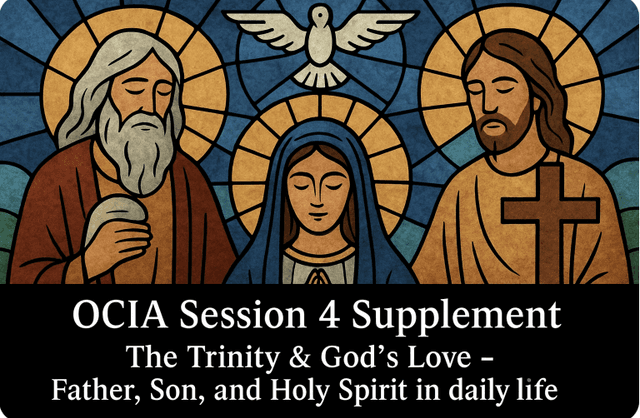
OCIA Session 4 Supplement - The Trinity & God’s Love - Father, Son, and Holy Spirit in daily life
The Trinity & God’s Love - Father, Son, and Holy Spirit in daily life
If you want to understand Christianity, you have to start with the Trinity. The Trinity is not just a doctrine tucked away in a theology textbook - it is the heart of who God is. The Church teaches that God is one in essence and three in Persons: the Father, the Son, and the Holy Spirit. This is what makes Christianity unique. Muslims believe in one God. Jews believe in one God. But Christians believe in one God who is a Trinity of love. 1 John 4:8 says, “God is love.” Not just that God loves or does loving things, but that God is love itself. For love to exist, there has to be a relationship - someone who loves, someone who is loved, and the love shared between them. This is why the Trinity is not just a puzzle but the foundation of love itself. The Father eternally loves the Son. The Son eternally loves the Father. The Holy Spirit is the bond of love between them. And when you were baptized, you were brought into that very relationship.
The Bible reveals the Trinity from the beginning. In Genesis, God says, “Let us make man in our image, after our likeness” (Genesis 1:26). Notice the “us” and “our.” That’s a hint of divine communion. At Jesus’ baptism, the Trinity is revealed openly: Jesus the Son is baptized in the Jordan, the Spirit descends like a dove, and the Father’s voice declares, “This is my beloved Son, with whom I am well pleased” (Matthew 3:16-17). Before ascending to heaven, Jesus commands His disciples to “Go therefore and make disciples of all nations, baptizing them in the name of the Father and of the Son and of the Holy Spirit” (Matthew 28:19). These passages make it clear that God is one and yet exists as three divine Persons.
But here’s the key: the Trinity is not just a mystery for theologians. It has everything to do with your daily life. Because you are made in the image of God, you are made for relationship, community, and love. That’s why loneliness hurts so deeply and why love brings such joy. God Himself is a communion of love, and we are created to share in it. Jesus tells us in John 14:23, “If anyone loves me, he will keep my word, and my Father will love him, and we will come to him and make our home with him.” Imagine that - the Father, Son, and Holy Spirit making their home in you. The Trinity is not far away in heaven. Through the Spirit, the Trinity dwells in your heart.
Every time you make the Sign of the Cross, you are proclaiming this great mystery. It’s not just a quick motion before meals or a nervous habit before a test. It’s a prayer that places you in the heart of the Trinity. When you touch your forehead, you remember the Father who created you. When you touch your chest, you remember the Son who redeemed you. When you touch your shoulders, you remember the Spirit who strengthens you. This is why Catholics begin and end so many prayers with the Sign of the Cross. It’s like stepping into God’s embrace.
The Trinity also shapes how we pray. We pray to the Father, through the Son, in the Holy Spirit. That’s why so many Catholic prayers end with the words, “through Christ our Lord. Amen.” We are speaking to the Father, but we approach Him through the Son who opened the way, and it is the Spirit who moves within us to pray. St. Paul explains this in Romans 8:26: “The Spirit helps us in our weakness. We do not know what we ought to pray for, but the Spirit himself intercedes for us through wordless groans.” Prayer is not just us talking to God - it is the Trinity drawing us into God’s own conversation of love.
Here’s a humor break: the Trinity is sometimes explained with analogies, but they can be a bit tricky. St. Patrick used the shamrock - three leaves, one stem. Others use water - liquid, ice, and steam. Or the sun - the star itself, its light, and its warmth. These can help a little, but they always fall short. In fact, most priests joke that Trinity Sunday is the hardest homily of the year, because no analogy really captures the full mystery. The important thing to remember is this: the Trinity is not meant to be solved like a math problem, but experienced like love.
The Trinity also shows us how to live. Just as the Father, Son, and Spirit are united in love, we are called to live in unity with one another. Jesus prayed, “That they may all be one, just as you, Father, are in me, and I in you, that they also may be in us” (John 17:21). That means unity in your family, your friendships, your parish, and the wider Church is not optional - it is a reflection of God Himself. When you forgive someone, when you build community, when you serve together, you are living out the life of the Trinity.
Take a moment for reflection. Close your eyes and make the Sign of the Cross slowly. Think of the Father who knows you by name, the Son who gave His life for you, and the Spirit who fills you with strength and peace. Imagine their love surrounding you like light. Pray with 2 Corinthians 13:14: “The grace of the Lord Jesus Christ, the love of God, and the fellowship of the Holy Spirit be with you all.”
Here’s your challenge for the week: begin and end each day with a deliberate, reverent Sign of the Cross. Read John chapters 14–16, where Jesus speaks about the Father and the Spirit. Write down one verse that strikes you and carry it with you. At Mass, notice how often prayers are addressed to the Father, through the Son, in the Spirit. You may be surprised at how much the Trinity shapes the liturgy.
In closing, remember this: the Trinity is not an abstract puzzle but the beating heart of our faith. You were created by the Father, redeemed by the Son, and filled with the Spirit. To be Catholic is to live within that love. You are not just learning about God - you are being drawn into His very life. Next time, we will explore the Church - the Body of Christ and our Catholic identity. There we’ll see how the Trinity’s love becomes visible in the community of believers that stretches across the whole world.
Sign in to share your thoughts