Share this now - someone’s life could change.


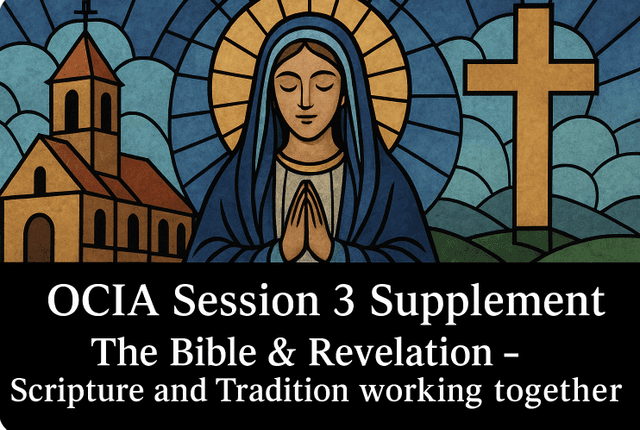
OCIA Session 3 Supplement - The Bible & Revelation - Scripture and Tradition working together
The Bible & Revelation - Scripture and Tradition working together
When you think about how God speaks to us, what comes to mind? Many people would immediately say, “The Bible.” And they’d be right - but not completely. Catholics believe that God’s voice comes to us through two inseparable channels: Sacred Scripture and Sacred Tradition. They are like the two lungs of the Church - you need both to breathe. Without Scripture, the Church would lose her foundation. Without Tradition, the Bible would become just another ancient book. Together, they are God’s living Word for His people.
Let’s start with the Bible. The Bible isn’t one book - it’s a library. It contains 73 books written over centuries by many different authors, but all inspired by one Divine Author, the Holy Spirit. St. Paul explains this clearly: “All Scripture is inspired by God and is useful for teaching, for reproof, for correction, and for training in righteousness” (2 Timothy 3:16). That means every time you open your Bible, you are not just reading history - you are encountering the living God. Hebrews 4:12 says, “The word of God is living and effective, sharper than any two-edged sword.” Notice it says living. Not once alive, but alive today, able to pierce your heart right now.
At Mass, this becomes very real. When the lector reads from the Scriptures, it is not a history lecture. It is God Himself speaking to you in this moment. That’s why the Church responds, “Thanks be to God.” We are thanking God because He has spoken directly to us through His Word.
Now, let’s talk about Tradition. Some people misunderstand this word. Tradition with a small “t” might mean family customs like Grandma’s recipes or cultural habits. But Tradition with a capital “T” means the living transmission of the faith, passed down from the apostles through the Church. Remember, the Bible didn’t drop out of the sky with a leather cover and a table of contents. The early Christians were guided by the Holy Spirit in handing on the teachings of Jesus. Over time, the Church discerned which writings were inspired, and that’s how we got the Bible. Without the Church, we wouldn’t even know which books belong in it.
St. Paul points to this reality when he tells the Thessalonians: “Stand firm and hold to the traditions that you were taught by us, either by word of mouth or by our letter” (2 Thessalonians 2:15). Notice he says both spoken and written traditions matter. This is why Catholics trust not only in the written Word, but also in the living faith of the Church, carried forward through the centuries. Tradition is how we received the sacraments, the liturgy, the creeds, and the practices that shape Catholic life. For example, you won’t find a verse that says “Mass at 9:00 a.m. with coffee and donuts after.” But you will find the Last Supper, where Jesus commanded: “Do this in memory of me” (Luke 22:19). The Mass, handed down faithfully for 2,000 years, is the living Tradition of that command.
Of course, reading the Bible can be confusing at times. Why does it jump from genealogies to poetry to laws about goats to parables about seeds? The key is to read it through the lens of the Church. Think of the Church like a pair of glasses - without them, the Bible may be blurry or misinterpreted, but with them, everything comes into focus. The Catechism puts it this way: “Sacred Tradition and Sacred Scripture make up a single sacred deposit of the Word of God” (CCC 97). That means Scripture and Tradition are never in competition. They always work together.
Let’s pause for a humor break. Many Catholics own a giant family Bible - the kind so heavy it could double as a coffee table. The problem? No one ever opens it! The Bible is not meant to be a decoration. It is meant to be lived. Another common mistake is trying to read it from page one straight through, only to get stuck in Leviticus or Numbers. That doesn’t make you a bad Catholic. It just means you started at the wrong place. Think of the Gospels as dessert. Start with Matthew, Mark, Luke, or John, and let your appetite for the rest of Scripture grow from there.
Here’s a fun fact about Catholic unity. Every Sunday at Mass, Catholics all over the world hear the exact same readings. That means you could be at Mass in Los Angeles, Mexico City, Rome, or a tiny parish in Africa, and you would hear the same passages proclaimed. That’s powerful. It shows the universality of the Church. When we hear the lector say, “The Word of the Lord,” and respond, “Thanks be to God,” we are joining millions of voices around the globe. That’s not just tradition - that’s family.
Here’s an exercise for reflection: On one side of a page, write “Scripture.” On the other, write “Tradition.” Under Scripture, jot down one Bible story, parable, or verse that has impacted your life. Maybe it’s Psalm 23: “The Lord is my shepherd,” or John 3:16: “For God so loved the world.” Under Tradition, write one Catholic practice you admire or hope to learn - maybe the Rosary, Eucharistic Adoration, or a feast day celebration. Then reflect on how these two work together to guide your faith.
This week’s challenge is simple: look up the Gospel reading for the coming Sunday (you can find it online or in your parish bulletin). Read it quietly before Mass. When you hear it proclaimed at church, notice if anything strikes you differently. You may be surprised how much more alive it feels when you’ve prayed with it beforehand.
In closing, remember this: Scripture and Tradition are not rivals but partners. The Bible without the Church can become just another book. The Church without the Bible loses her heartbeat. Together, they form the living Word of God for His people. St. John tells us why this matters: “These are written so that you may believe that Jesus is the Messiah, the Son of God, and that through believing you may have life in his name” (John 20:31). When we read with the Church, Scripture becomes more than ink on paper. It becomes the voice of God echoing in our hearts.
Next time, we’ll dive into the greatest mystery of all - the Trinity. One God, three Persons - Father, Son, and Holy Spirit - and what that means for your daily life. Until then, open your Bible, embrace the Church’s Tradition, and let God speak to you with both lungs of faith.
Sign in to share your thoughts