Share this now - someone’s life could change.


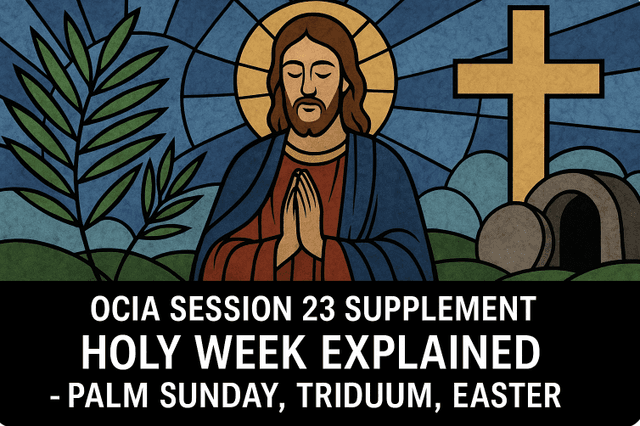
OCIA Session 23 Supplement - Holy Week Explained - Palm Sunday, Triduum, Easter
Holy Week Explained - Palm Sunday, Triduum, Easter
Holy Week is the greatest and most sacred week of the entire Christian year. It is the heart of our salvation story, the week when we walk step by step with Jesus through His Passion, death, and resurrection. The Catechism calls the Paschal Mystery - Christ’s suffering, death, and resurrection - the central event of our faith. Everything else in the Church flows from it. Holy Week is not just a retelling of history - it is entering into the mystery so that we can experience its power in our own lives.
It begins with Palm Sunday, when we remember Jesus’ triumphal entry into Jerusalem. Crowds spread palm branches before Him and shouted, “Hosanna! Blessed is he who comes in the name of the Lord!” (John 12:13). The King of Kings entered not on a warhorse, but on a humble donkey, fulfilling the prophecy of Zechariah 9:9. Yet within days, the same crowd that shouted “Hosanna” would cry out “Crucify Him.” Palm Sunday reminds us how quickly human hearts can change, and it challenges us to ask: am I faithful to Christ only when it is easy, or also when it is hard?
Then we enter the Sacred Triduum - three days that are one great liturgy: Holy Thursday, Good Friday, and the Easter Vigil. On Holy Thursday, we celebrate the Last Supper, where Jesus instituted the Eucharist and the priesthood. He took bread, gave thanks, broke it, and said, “This is my body given for you; do this in remembrance of me” (Luke 22:19). He also washed His disciples’ feet, showing that leadership in His kingdom means service. At the end of the Holy Thursday Mass, the Blessed Sacrament is taken in procession and placed in a side chapel, where the faithful keep watch in prayer, remembering Jesus in the Garden of Gethsemane. His words echo: “Could you not keep watch with me for one hour?” (Matthew 26:40).
Good Friday is the only day of the year when the Church does not celebrate Mass. Instead, we gather for the Passion of the Lord. We listen to the account of Christ’s suffering and death from John’s Gospel. We venerate the cross, kissing or touching it, recognizing it not as an instrument of death but as the throne of victory. Isaiah 53:5 foretold it: “He was pierced for our transgressions, he was crushed for our iniquities; the punishment that brought us peace was on him, and by his wounds we are healed.” Good Friday is a day of fasting and silence, but it is also a day of hope - because we know that death will not have the final word.
On Holy Saturday, the Church waits in stillness. It is a day of silence and anticipation, recalling Jesus in the tomb. Then, as night falls, we gather for the Easter Vigil - the high point of the liturgical year. The Vigil begins in darkness. A fire is lit, the Paschal candle is blessed and carried into the church, and the deacon proclaims, “The light of Christ.” As candles are lit one by one, the church fills with light, symbolizing Christ’s victory over darkness. We listen to readings that trace the entire history of salvation, from creation to resurrection. Then comes the Gloria, the bells ring, and Alleluia returns as the Gospel proclaims the resurrection. This is the night when catechumens are baptized, confirmed, and receive the Eucharist for the first time. St. Paul writes in Romans 6:4, “We were therefore buried with him through baptism into death in order that, just as Christ was raised from the dead through the glory of the Father, we too may live a new life.” The Easter Vigil is the moment when new life bursts forth for the entire Church.
Finally comes Easter Sunday - the day of resurrection, the greatest feast of all. The tomb is empty, the stone is rolled away, and the angel declares, “He is not here; he has risen, just as he said” (Matthew 28:6). Easter is not just a day, but a season of fifty days, celebrating the victory of Christ over sin and death. It is the foundation of our hope and the reason we can live as people of joy.
Here’s a humor break: Catholics sometimes joke that if you attend all the liturgies of Holy Week, you practically live at church for three days straight. Palm branches, washing feet, long readings, venerating the cross, lighting candles - it is a full workout of body and spirit. But that is exactly the point - Holy Week is meant to be experienced with our whole selves, not just our minds. It engages all the senses to draw us into the mystery.
Take a moment to reflect: where do you see yourself in the Holy Week story? Are you in the crowd on Palm Sunday, full of enthusiasm but easily swayed? Are you with Peter, full of good intentions but quick to deny under pressure? Are you with Mary at the foot of the cross, faithful to the end? Or are you like the women on Easter morning, running to share the Good News? Wherever you are, Jesus meets you there.
Here’s your practical challenge: make a plan to participate in the Triduum this year. Go to Holy Thursday Mass, keep watch in prayer afterward, attend the Good Friday liturgy, and join the Easter Vigil if possible. If you cannot attend all of them, choose at least one. Prepare your heart by reading the Passion narratives in Matthew 26–27, Mark 14–15, Luke 22–23, or John 18–19. Let the story of Christ’s love shape your own story.
In closing, remember this: Holy Week is not a drama we watch from the sidelines. It is the mystery of our salvation, made present here and now. Palm Sunday, the Triduum, and Easter are not separate events but one continuous act of love - Christ’s love for you. Next time, we will take time for a retreat reflection, preparing our hearts for the Easter Vigil and the joy of new life in Christ. Until then, walk with Jesus through Holy Week, and let His Passion, death, and resurrection transform your life.
Sign in to share your thoughts