Share this now - someone’s life could change.


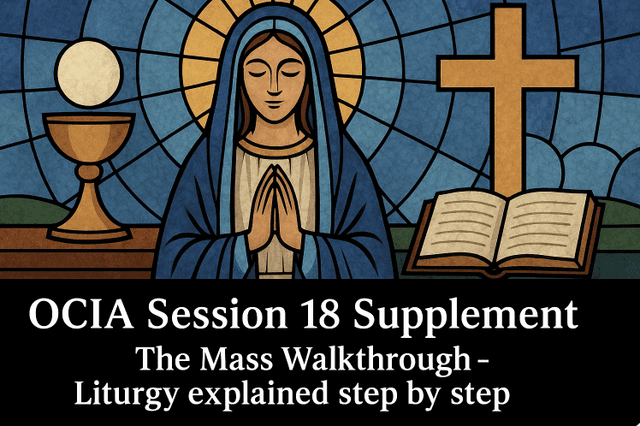
OCIA Session 18 Supplement - The Mass Walkthrough - Liturgy explained step by step
The Mass Walkthrough - Liturgy explained step by step
The Mass is the heart of Catholic life. It is not simply a ritual or a weekly tradition but the source and summit of our faith. Everything in Catholic life flows toward the Eucharist and flows out from it. When we step into Mass, we step into something far greater than ourselves. Revelation 4 gives us a glimpse of heavenly worship: angels and saints gathered around the throne of God crying out, “Holy, holy, holy is the Lord God Almighty.” At Mass, heaven and earth unite. We join in that same eternal worship.
For many people who are new to the Church, the Mass can feel confusing. There is standing, sitting, kneeling, responses, and songs. Why so many repeated prayers? Why incense, holy water, bells, and gestures? The truth is, nothing in the Mass is random. Every action, every prayer, every gesture has meaning, rooted in Scripture and tradition. Once you understand it step by step, the Mass unfolds as a rich encounter with Christ.
Mass begins with the Introductory Rites. The priest and servers process in, often led by the cross. This is not just a practical way to enter - it symbolizes that we are a pilgrim people following Christ. We stand, ready to worship. The priest greets us with words from Scripture such as “The Lord be with you,” and we reply, “And with your spirit,” recognizing Christ at work through the priest. Then we acknowledge our sins in the Penitential Act, asking God’s mercy together, followed by the Kyrie - “Lord, have mercy.” On many Sundays, we then sing the Gloria, the hymn the angels sang at Christ’s birth: “Glory to God in the highest.” The opening prayer, called the Collect, gathers all our intentions into one as we begin.
Then comes the Liturgy of the Word. God speaks to us through Scripture. Usually, we hear an Old Testament reading, a Psalm, a New Testament letter, and then the Gospel. The Responsorial Psalm is our chance to reply to God with His own inspired words. When the Gospel is proclaimed, we stand, because it is the very voice of Christ. Before it is read, we make the small sign of the cross on our forehead, lips, and heart, silently asking God to keep His Word in our thoughts, our words, and our hearts. The homily follows, where the priest or deacon opens up the meaning of the readings and helps us apply them to our lives. As Romans 10:17 says, “Faith comes from hearing the message, and the message is heard through the word about Christ.” Then, together, we proclaim the Creed - the Nicene Creed on Sundays - uniting our voices with Christians across the centuries. The Universal Prayer, or Prayer of the Faithful, concludes this part, lifting up the needs of the Church and the world.
The Liturgy of the Eucharist is the heart of the Mass. Bread and wine are brought forward, simple gifts that will soon become the very Body and Blood of Christ. At the Last Supper, Jesus said, “Do this in memory of me” (Luke 22:19). Every Mass fulfills that command. The priest prays over the gifts, and the Eucharistic Prayer begins. We join the angels in the Sanctus - “Holy, Holy, Holy” - echoing Isaiah and Revelation. Then the priest prays the words of consecration, and in that sacred moment, through the power of the Holy Spirit, the bread and wine are changed. This is transubstantiation: they become Christ Himself, body, blood, soul, and divinity. When the priest elevates the Host and the Chalice, we adore Jesus present among us. The prayer continues with the Memorial Acclamation - “We proclaim your Death, O Lord, and profess your Resurrection until you come again.” The Eucharistic Prayer ends with the Great Amen, a strong “Yes” from the congregation.
Then we pray the Our Father, the prayer Jesus Himself taught us. We exchange the Sign of Peace, not just as a friendly handshake but as a real sign of reconciliation and unity in Christ. The priest breaks the Host, symbolizing Christ broken for us, as we sing the Lamb of God: “Behold the Lamb of God who takes away the sin of the world” (John 1:29). Then comes the moment of Holy Communion. The priest lifts the Host and says, “The Body of Christ.” Our response, “Amen,” is not casual. It is a profession of faith: “Yes, I believe this is truly Jesus.” Receiving Communion is receiving Christ Himself, the bread of life, who strengthens us for eternal life as He promised in John 6:51: “I am the living bread that came down from heaven. Whoever eats this bread will live forever.”
After Communion, we take time for silence and thanksgiving, resting in God’s presence. The Mass then concludes with a prayer and blessing. The priest sends us forth with words like, “Go forth, the Mass is ended.” The word “Mass” comes from the Latin “missa,” which means “sent.” We are not meant to stay in church but to go into the world, carrying Christ with us into our homes, workplaces, and communities.
Think of the Mass not as an obligation but as a divine encounter. At every moment - from gathering to hearing the Word, to receiving Christ in the Eucharist, to being sent on mission - Jesus is inviting us deeper into His love. This week, prepare for Sunday Mass by reading the Gospel ahead of time. Arrive a little early, pray in silence, and ask God to open your heart. During Mass, pay special attention to one part you may usually overlook - maybe the Gloria, the Creed, or the quiet after Communion. Afterward, take a few minutes to thank God before leaving.
In closing, remember this: the Mass is heaven on earth. It is the sacrifice of Christ made present, the banquet of His love, the place where the Church gathers as one body. Once you begin to see its depth and beauty, Mass will never be just a routine again. Next time, as we begin Phase 3 of OCIA - Purification and Enlightenment - we will focus on Conversion and Discipleship, reflecting on what it means to follow Christ as a lifelong journey. Until then, immerse yourself in the Mass, for it is truly the summit of Christian life.
Sign in to share your thoughts