Share this now - someone’s life could change.


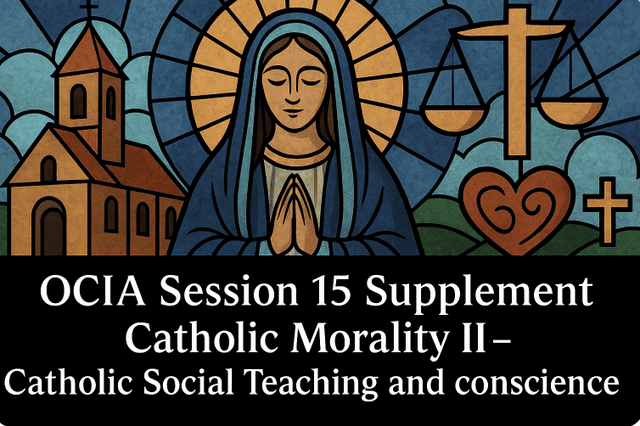
OCIA Session 15 Supplement - Catholic Morality II - Catholic Social Teaching and conscience
Catholic Morality II - Catholic Social Teaching and conscience
Catholic morality is not only about our personal relationship with God. It is also about how we live in the world - how we treat others, how we work for justice, and how we form our conscience to make good decisions. The Church calls this Catholic Social Teaching, and it is one of the treasures of our faith. It reminds us that faith is not something private but something that must be lived in society.
At the heart of Catholic Social Teaching is the dignity of the human person. Genesis 1:27 tells us, “God created mankind in his own image, in the image of God he created them; male and female he created them.” Every person - regardless of age, race, wealth, or ability - is made in the image of God. That means every person has infinite worth. From this flows the Church’s defense of life from conception to natural death, care for the poor, concern for workers, and protection of the vulnerable.
The Church has developed seven key principles of social teaching: the dignity of the human person, the call to family and community, the rights and responsibilities of people, the option for the poor and vulnerable, the dignity of work and the rights of workers, solidarity with others, and care for God’s creation. These are not political ideas but Gospel truths lived out in society. Jesus said in Matthew 25:40, “Whatever you did for one of the least of these brothers and sisters of mine, you did for me.” Serving the poor, welcoming the stranger, and protecting the weak is not optional - it is Christ’s command.
Another key part of morality is conscience. The Catechism defines conscience as “man’s most secret core and his sanctuary. There he is alone with God whose voice echoes in his depths” (CCC 1776). Conscience is not simply what we feel or what seems right at the moment. It must be formed and guided by truth. This means we have a responsibility to educate our conscience by studying Scripture, Church teaching, and prayer. Romans 2:15 describes the law written on the human heart - but to hear it clearly, we must tune out noise and sin.
Here’s a humor break: people sometimes joke, “Let your conscience be your guide,” as if it is like Jiminy Cricket from Pinocchio. The problem is, if your conscience has not been formed well, it can mislead you. A conscience filled with God’s Word and guided by the Holy Spirit, however, becomes a compass that always points toward Christ.
Conscience also requires courage. Sometimes doing what is right will not be popular. Sometimes it will even be costly. Think of St. Thomas More, who chose to follow his conscience and lost his life rather than betray his faith. Think of modern Christians who stand for justice, even when it means opposition. Conscience is the inner voice that says, “Do what is right, no matter what.”
Take time this week to reflect: are you forming your conscience daily through prayer, Scripture, and the sacraments? Do you allow God’s truth to shape your decisions, or do you mostly go by convenience and opinion? Ask yourself: how do I live out the dignity of others in my daily life - in how I speak, how I act, and how I use my time and money?
Here’s your practical challenge: read Matthew 25:31-46 - the parable of the sheep and the goats. Reflect on how Jesus identifies Himself with the hungry, the thirsty, the stranger, the naked, the sick, and the imprisoned. Choose one way this week to serve Christ in one of these groups - perhaps volunteering, donating, or simply offering compassion to someone in need. Also, commit to learning more about one aspect of Catholic Social Teaching, such as care for creation or the dignity of workers.
In closing, remember this: Catholic morality is not only about avoiding sin but about actively building a world that reflects God’s love and justice. Conscience is the inner sanctuary where God speaks, but it must be formed and followed with courage. Next time, we will turn to prayer - exploring the many ways Catholics lift their hearts to God in conversation and intimacy. Until then, let God’s truth guide your conscience, and let His love inspire your actions in the world.
Sign in to share your thoughts