Share this now - someone’s life could change.


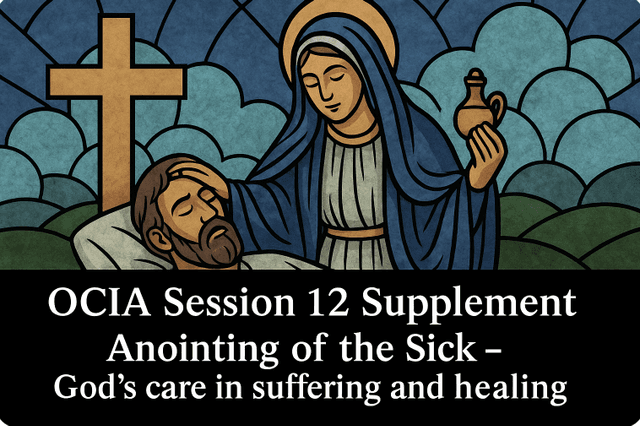
OCIA Session 12 Supplement - Anointing of the Sick - God’s care in suffering and healing
Anointing of the Sick - God’s care in suffering and healing
Sickness and suffering are among the hardest parts of human life. No one likes to feel weak, in pain, or helpless. Yet in those moments, God does not abandon us. He draws near with compassion. The Sacrament of the Anointing of the Sick is one of the most powerful ways God shows His care. It is not just for the final moments of life - though it is sometimes called “last rites” - but for anyone seriously ill, preparing for surgery, growing weak with age, or in danger of death. Through this sacrament, Christ comes as the Divine Physician, bringing healing, forgiveness, and peace.
Scripture reveals the roots of this sacrament. James 5:14-15 says, “Is anyone among you sick? Let them call the elders of the church to pray over them and anoint them with oil in the name of the Lord. And the prayer offered in faith will make the sick person well; the Lord will raise them up. If they have sinned, they will be forgiven.” From the very beginning, the Church understood that anointing with oil, combined with prayer, brought both physical and spiritual healing. Jesus Himself constantly healed the sick - the blind saw, the lame walked, the deaf heard. His healing ministry continues today through this sacrament.
Anointing of the Sick is a sacrament of healing, like Reconciliation. When the priest lays his hands on the sick person, prays, and anoints them with holy oil, it is Christ Himself who touches them. Sometimes physical healing happens. Sometimes it does not. But always, spiritual healing takes place. The sacrament strengthens the sick, forgives their sins, and unites their suffering with Christ’s own suffering on the cross. St. Paul writes in Colossians 1:24, “Now I rejoice in what I am suffering for you, and I fill up in my flesh what is still lacking in regard to Christ’s afflictions, for the sake of his body, which is the church.” This does not mean Christ’s suffering was incomplete. It means that our suffering, joined with His, becomes redemptive. It has meaning and power when united to His sacrifice.
Here’s a humor break: some Catholics avoid calling the priest when someone is sick because they think it means the end is near. It has become a running joke that when Father shows up with oil, everyone panics. But the truth is, Anointing of the Sick is not about giving up - it is about receiving God’s strength. The sacrament can be received more than once, and it should be celebrated whenever serious illness or frailty occurs. It is a gift, not a sentence.
The anointing itself is simple but profound. The priest places his hands on the sick person, prays for them, and anoints their forehead and hands with the Oil of the Sick, blessed by the bishop during Holy Week. He prays: “Through this holy anointing may the Lord in his love and mercy help you with the grace of the Holy Spirit. May the Lord who frees you from sin save you and raise you up.” In that moment, the sick are lifted into God’s love and peace.
The sacrament also reminds us of something important - suffering is not meaningless. In our culture, we often avoid talking about pain, illness, or death. Yet the Christian faith sees suffering as a place where Christ meets us most intimately. The cross was the ultimate sign of weakness in the world’s eyes, but it became the place of victory. In the same way, when we suffer with faith, we are drawn deeper into Christ’s love. The Anointing of the Sick makes this reality visible and tangible.
Take a moment to reflect: have you ever seen someone face sickness or suffering with peace and faith? Perhaps it was a parent, a grandparent, or a friend. Their strength was not from themselves but from Christ living in them. The sacrament gives that same strength to all who receive it.
Here’s your practical challenge for the week: pray for those who are sick, especially in your parish or family. If you know someone preparing for surgery or living with serious illness, encourage them to receive the Anointing of the Sick. If you are healthy, thank God for your health and ask Him to prepare you to face illness with faith when it comes. Read Psalm 23 slowly: “Even though I walk through the darkest valley, I will fear no evil, for you are with me.” Carry those words in your heart.
In closing, remember this: Anointing of the Sick is not about fear, it is about hope. It reminds us that even in our weakest moments, Christ is present. He is the healer of body and soul, and He promises never to leave us. Next time, we will reflect on Mary and the saints - our heavenly companions who show us how to follow Christ and intercede for us with love. Until then, pray for the sick, trust in God’s mercy, and know that your suffering can be united with Christ’s for the salvation of the world.
Sign in to share your thoughts