Share this now - someone’s life could change.


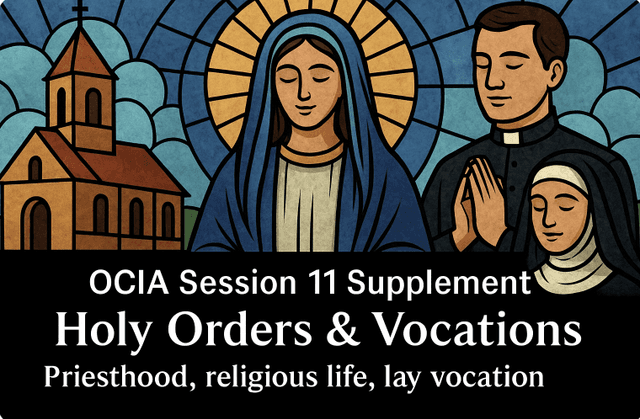
OCIA Session 11 Supplement - Holy Orders & Vocations - Priesthood, religious life, lay vocation
Holy Orders & Vocations - Priesthood, religious life, lay vocation
Every person has a calling. It might not always feel that way, but God has a purpose for each life. Some are called to marriage, some to religious life, some to the priesthood, and others to live as single lay people dedicated to service. Together, these vocations make up the living fabric of the Church. St. Paul tells us in Ephesians 4:11-12, “Christ himself gave the apostles, the prophets, the evangelists, the pastors and teachers, to equip his people for works of service, so that the body of Christ may be built up.” Each vocation is a different thread, but all are woven together in Christ.
Let’s begin with Holy Orders. This sacrament is the way Christ continues His mission through ordained ministers. There are three degrees of Holy Orders: deacon, priest, and bishop. Bishops are the successors of the apostles, entrusted with teaching, sanctifying, and governing the Church. Priests are co-workers with bishops, celebrating the sacraments and shepherding God’s people. Deacons are ordained to serve through preaching, baptizing, witnessing marriages, and helping in works of charity. When a man receives Holy Orders, the Church teaches that he is marked with an indelible spiritual character. This means ordination cannot be undone - it configures him permanently to Christ, the High Priest.
Jesus instituted this sacrament at the Last Supper when He told His apostles, “Do this in memory of me” (Luke 22:19). He gave them authority to consecrate the Eucharist, forgive sins, and shepherd the Church. Later, in John 20:21, He said, “As the Father has sent me, I am sending you.” Priests and bishops act in the person of Christ the Head. Through them, Christ continues to teach, sanctify, and guide His people. That is why Catholics see the priest not just as a religious leader but as a father who leads the parish family in Christ’s name.
Next, consider religious life. Men and women who enter monasteries, convents, or religious communities live out vows of poverty, chastity, and obedience. Their lives are a radical witness to the Gospel. They remind the world that our ultimate treasure is not money, pleasure, or power, but Christ alone. Think of St. Francis of Assisi, who gave up wealth to embrace poverty and joy. Or St. Teresa of Calcutta, who dedicated her life to serving the poorest of the poor. Religious brothers, sisters, and monks live lives of prayer, service, and community, showing that holiness is possible in every age. Their vocation strengthens the Church through example and intercession.
Now let’s turn to the lay vocation. Many Catholics sometimes think only priests and religious have a “calling.” That is not true. Every baptized person is called to holiness. Lay people live out their vocation in families, workplaces, schools, and communities. They are called to be “salt of the earth” and “light of the world” (Matthew 5:13-14). Lay vocations transform ordinary life into a place where God is encountered. Parents who raise children in faith, teachers who share knowledge with integrity, workers who serve with honesty - all of these are holy callings. The Church cannot thrive without lay people living their faith in the world.
Here’s a humor break: people sometimes joke that priests only work one day a week - on Sunday. The reality is that priests are some of the busiest people you will ever meet. Between celebrating Mass, hearing confessions, visiting the sick, counseling families, running the parish, and preparing homilies, they rarely slow down. Religious sisters are often just as busy - teaching, nursing, praying, and serving. The point is clear: vocations are not about ease or comfort. They are about love and service.
How do you discover your vocation? The key is prayer, openness, and trust. God does not usually send a letter in the mail with clear instructions. Instead, He nudges your heart through desires, talents, opportunities, and prayer. Psalm 37:4 gives this promise: “Delight yourself in the Lord, and he will give you the desires of your heart.” When you draw close to God, He shapes your heart to want what He wants for you.
Take time this week to reflect: where do you feel God calling you? Do you sense a call to marriage, priesthood, religious life, or dedicated single life? What gifts has He given you, and how might they be used for His Church? Write your thoughts down and bring them to prayer. Speak to a priest, a spiritual director, or a trusted mentor about your questions.
Here’s your practical challenge: pray each morning this week, “Lord, help me to know your will and give me the courage to follow it.” If you feel drawn to priesthood or religious life, learn more about it. If you feel drawn to marriage, pray for the grace to prepare your heart for lifelong commitment. If you are unsure, ask God to open doors and guide your steps.
In closing, remember this: every vocation is a gift, not just for the person who lives it, but for the whole Church. Priests bring us the sacraments. Religious remind us of heaven. Lay people bring Christ into the world. Together, these vocations reveal the fullness of God’s love. Next time, we will turn to the Sacrament of the Anointing of the Sick - where God shows His tender care for us in times of weakness, illness, and suffering. Until then, keep praying for your vocation and for those already living theirs, and trust that God has a unique place for you in His plan.
Sign in to share your thoughts