Share this now - someone’s life could change.


How to Colonize the Moon and Excite the World - for FREE!
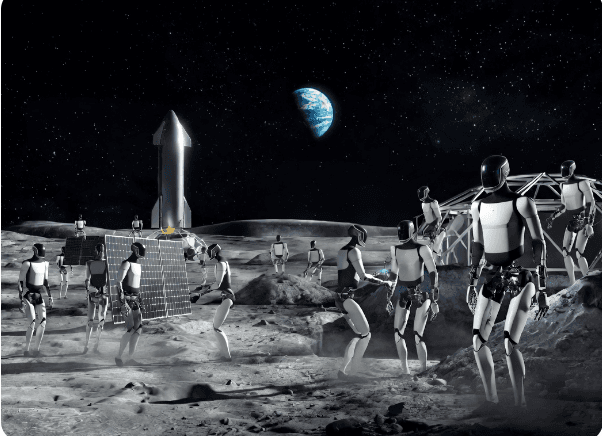
In 2026, we asked the SmartGuy® team how Elon’s Optimus robots could help colonize the Moon within 10 years. Fueled by coffee, imagination, and a few pizzas, here’s their vision: fleets of Optimus robots not only building a self-growing lunar city but also mining high-value resources like platinum-group metals (potentially worth trillions) and helium-3 (valued at millions per kilogram). These mining operations alone could finance the entire project many times over, enabling exciting crowdfunding opportunities and live camera feeds that broadcast real-time progress to the world, sparking massive public excitement and renewed energy for NASA’s lunar ambitions.
Here’s the precise, sequential process Optimus robots would follow to establish and grow a lunar colony:
Phase 1: Initial Deployment & Site Survey (First Uncrewed Starship Landings)
Optimus units are unloaded from Starship cargo bays using their bipedal legs and grippers for stable low-gravity mobility.
Robots conduct autonomous terrain mapping: walking the surface, using onboard cameras and sensors to scan for flat, resource-rich sites near polar ice (water) and sunlight.
They deploy temporary solar panels from cargo to create the first charging stations.
Small teams of 10–20 Optimus robots clear landing debris, mark safe zones, and transmit real-time data back to Earth for the next wave.
Phase 2: Energy Infrastructure Setup
Optimus robots unload and assemble Tesla solar arrays: positioning panels on lightweight lunar frames, aligning them toward the Sun (or using polar peaks for near-continuous power).
They connect high-efficiency wiring, inverters, and battery storage (adapted Megapacks) using fine hand dexterity to crimp cables and seal against dust.
Robots dig shallow trenches with specialized end-effectors and bury power lines to protect from micrometeorites.
Once online, the solar farm powers the entire robot fleet, enabling continuous operation without Earth resupply.
Phase 3: Site Preparation & Regolith Excavation
Swarms of Optimus units use shovels, bulldozer attachments, or built-in tools to excavate regolith (lunar soil).
They pile dirt into berms for natural radiation shielding and level ground for future structures.
Robots compact soil into roads or pathways for easier internal movement and future cargo transport.
Phase 4: Habitat Construction & Assembly
Optimus robots unload prefabricated modules or Starship hull sections delivered by follow-on flights.
Step-by-step: (a) align and bolt structural frames with torque wrenches; (b) weld or seal pressurized joints using vacuum-compatible tools; (c) install airlocks, windows, and hatches with precise manipulation.
They layer 2+ meters of regolith on top for radiation/thermal protection, using conveyor systems or buckets they operate themselves.
Interior fit-out follows: installing life-support piping, electrical systems, lighting, and basic furniture - robots route cables, connect plumbing, and test seals autonomously.
Phase 5: In-Site Resource Utilization (ISRU) & Self-Replication
Optimus robots mine water ice from shadowed craters: drilling, heating, and extracting H₂O for oxygen and fuel.
They process regolith in simple solar furnaces to extract metals (iron, aluminum, silicon) for 3D printing new parts or additional robots.
Key Von Neumann step: Optimus units assemble small factories from shipped kits - building more Optimus bodies, tools, and solar panels using locally sourced materials.
This creates exponential growth: one robot seeds a factory that produces dozens more.
Phase 6: Life Support, Greenhouses & Expansion
Robots assemble hydroponic greenhouses: erecting frames, installing LED grow lights (powered by solar), and planting seeds for food/oxygen production.
They maintain systems: monitoring air quality, watering plants, and repairing leaks with onboard diagnostics.
Additional habitats, labs, and storage domes are built in parallel by coordinated swarms optimizing layouts via fleet AI.
Robots handle all maintenance: dusting solar panels, patching micrometeorite damage, and operating rovers for supply runs.
Phase 7: Human Readiness & Ongoing Operations
Once habitats are pressurized, powered, and stocked, Optimus robots prepare for crew arrival: stocking supplies, testing life support, and creating safe entry paths.
Upon human landing, robots assist: unloading cargo, providing mobility support in suits, and performing dangerous EVAs (spacewalks) so humans focus on science and leadership.
Long Term
Optimus continues expanding the city - building new sectors, maintaining infrastructure, and eventually supporting thousands of residents while self-replicating to reduce Earth launches.
The mining operations performed by the robots alone - extracting high-value resources such as platinum-group metals (potentially worth trillions in asteroid-impact craters) and helium-3 (valued at millions per kilogram for quantum computing and future fusion) - could generate sufficient revenue to finance the entire costs of the operation many times over, transforming the project into a highly profitable, self-sustaining venture.
This economic potential opens the door to innovative crowdfunding models, allowing global enthusiasts and investors to participate directly, while live camera feeds from the Optimus robots broadcast real-time progress to the world, sparking widespread public excitement and renewed energy for NASA’s lunar ambitions as humanity watches its first off-world industrial base take shape.
This robot-first approach eliminates human risk in the deadliest early phases, cuts costs dramatically, and enables rapid iteration thanks to frequent Starship flights. Optimus turns the Moon into humanity’s first true off-world foothold - a self-growing, solar-powered city ready for permanent settlement. The transformation begins with the next Starship cargo missions.
Sign in to share your thoughts