Share this now - someone’s life could change.


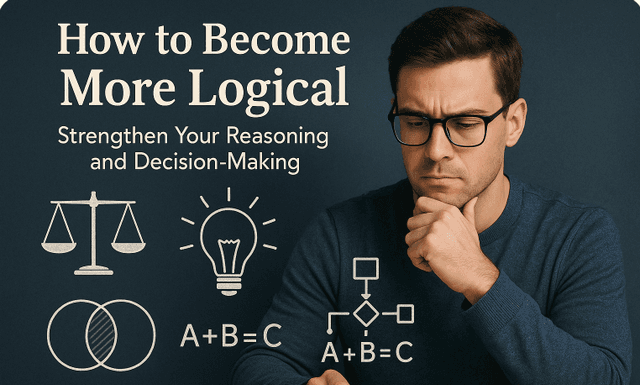
How to Become More Logical: Strengthen Your Reasoning and Decision-Making
Becoming more logical means learning to approach problems and decisions with structured reasoning, clear analysis, and emotional balance. Logical thinkers evaluate information critically, identify fallacies, and rely on facts and structured methods instead of impulses or assumptions. Whether in science, business, or everyday life, logic is the foundation of sound judgment.
WATCH THE VIDEO
Understand the Foundations of Logic
The first step in developing logical thinking is understanding the basic principles of reasoning.
Deductive reasoning moves from general premises to specific conclusions.
Inductive reasoning builds generalizations from specific observations.
The scientific method is a practical application of these principles, relying on hypotheses, data collection, and evaluation to reach reliable conclusions. By studying these foundations, you’ll improve your ability to analyze arguments with rigor.
Define Problems Clearly
Logical thinking starts with clarity. A poorly defined problem leads to weak solutions.
In computer science, algorithms are created by breaking problems into precise steps before writing a single line of code.
Similarly, in daily life, if your car breaks down, defining the issue clearly (battery, fuel, or engine) makes the solution more efficient.
By breaking challenges into smaller, well-defined parts, you can approach them logically and effectively.
Practice Critical Evaluation
Being logical requires questioning information rather than accepting it at face value.
Warren Buffett, for instance, doesn’t rely only on surface-level stock data. He examines company fundamentals, market conditions, and economic trends before making investment decisions.
You can strengthen this habit by always asking: Why? How? What evidence supports this?
Additionally, be aware of logical fallacies - such as ad hominem attacks or straw man arguments - which can undermine reasoning. Identifying fallacies sharpens your ability to think logically and make sound arguments.
Regulate Emotions for Clear Thinking
Emotions can cloud judgment, leading to irrational or hasty decisions.
Daniel Kahneman’s research distinguishes between System 1 thinking (fast, emotional, intuitive) and System 2 thinking (slow, deliberate, logical).
In emotionally charged situations, consciously engaging your slower, logical thought process helps you avoid errors.
Emotional regulation is essential for making decisions rooted in logic rather than bias.
Strengthen Logic With Syllogistic Reasoning
Syllogisms are a classic method of logical argumentation.
Example: If all humans are mortal (Premise 1), and Socrates is human (Premise 2), then Socrates is mortal (Conclusion).
Lawyers, philosophers, and academics often use syllogistic reasoning to construct strong arguments.
Practicing syllogisms helps refine your logical skills and train your mind to follow valid reasoning patterns.
Build Logical Skills Through Practice
Like any skill, logical thinking improves with practice.
Chess grandmasters like Magnus Carlsen excel at logic by analyzing positions, anticipating moves, and planning strategies several steps ahead.
Activities such as solving puzzles, debating, and playing strategy games strengthen logical reasoning in an engaging way.
The more you practice, the more naturally logical reasoning will become part of your daily decision-making.
Becoming More Logical in Daily Life
To think more logically:
Study deductive and inductive reasoning.
Define problems clearly before addressing them.
Critically evaluate information and spot fallacies.
Regulate emotions to avoid impulsive decisions.
Practice syllogistic reasoning to strengthen arguments.
Engage in logical exercises like puzzles, debates, and chess.
By integrating these steps, you’ll become more consistent, accurate, and objective in your reasoning.
Final Thoughts
From scientists applying the scientific method to investors like Warren Buffett and chess champions like Magnus Carlsen, logical thinking has always been the backbone of sound decision-making.
Start today:
Break down a problem you’re facing into smaller, clear steps.
Question one assumption you encounter with “Why?” or “How?”
Spend 10 minutes solving a logic puzzle or strategy game.
With consistent practice, you’ll sharpen your ability to think clearly, evaluate effectively, and make better decisions both personally and professionally.
Sign in to share your thoughts